How Can Parking Lots Help Fight Climate Change?
TL;DR
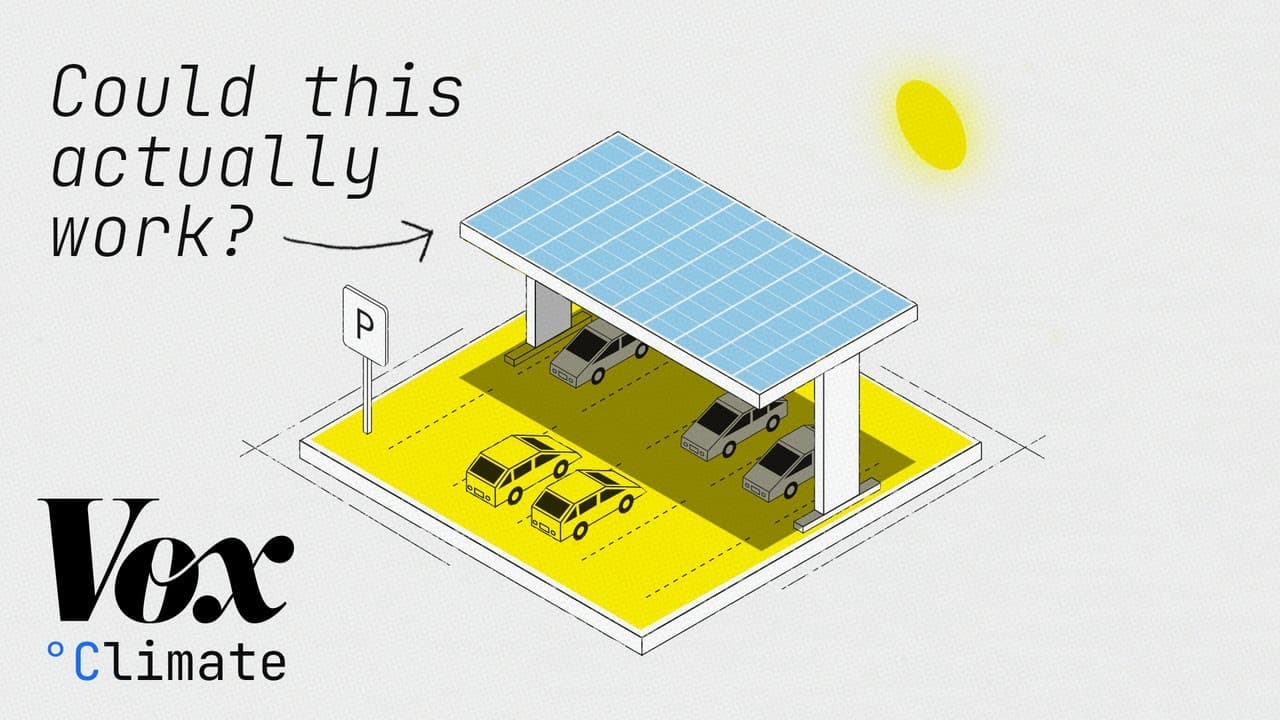
Parking lots, which cover over 5% of developed land in the US, can be transformed into solar canopies, offering a sustainable way to harness solar energy without disrupting rural ecosystems. Despite higher initial costs, these canopies can be economically viable in sunny regions and provide additional benefits like shaded parking and reduced urban heat, making them a significant part of the solution to meet renewable energy goals.
Transcript
[pensive violin music] This is a satellite image of the Mojave Desert in the US. It's a fragile desert ecosystem... dotted with wildflower fields and Joshua trees which are iconic in this region. But over the past several years the landscape has started to change. If you take a closer look in certain areas you start to see more and more of these... Read More
Key Insights
- Solar farms in rural areas can disrupt ecosystems and take up valuable land, causing local resistance.
- President Biden's plan for net-zero emissions by 2050 heavily relies on solar energy expansion.
- Parking lots, covering over 5% of developed land in the US, offer a potential solution for solar panel installation.
- France mandates solar canopies on large parking lots, potentially adding significant solar capacity.
- Solar canopies are more expensive due to structural requirements but can be profitable in high solar flux areas.
- Agrovoltaics allow for dual land use, combining solar panels with agricultural activities.
- Solar canopies could provide additional benefits such as shading cars and reducing urban heat.
- Policy changes and incentives are crucial for promoting solar canopy adoption in the US.
Install to Summarize YouTube Videos and Get Transcripts
Explore YouTube Video Summarizer or Get YouTube Transcript Extractor
Questions & Answers
Q: What are the main issues with installing solar farms in rural areas?
Solar farms in rural areas often face opposition due to their impact on natural landscapes, ecosystems, and agricultural land. They can disrupt plant and animal habitats, alter migration patterns, and reduce available farmland. Additionally, these installations may require extensive transmission lines to connect to urban centers, which can be costly and visually unappealing.
Q: How do parking lots present a solution for solar energy expansion?
Parking lots are abundant in urban areas, covering over 5% of developed land in the US. They represent underutilized spaces that can be retrofitted with solar canopies, providing a sustainable energy solution without the need for additional land clearing. This approach also places solar energy production closer to consumers, reducing transmission costs and infrastructure needs.
Q: What are the economic considerations for installing solar canopies?
Installing solar canopies is more expensive than traditional ground-mounted solar farms due to the need for elevated structures and additional materials for stability. However, they can be economically viable in areas with high solar radiation, where the potential for energy generation is greater. Selling excess energy back to the grid or using it for local microgrids can further enhance profitability.
Q: How do solar canopies benefit urban environments beyond energy production?
Solar canopies provide shade for parked vehicles, reducing heat buildup and potentially lowering cooling costs for drivers. They also contribute to reducing the urban heat island effect by covering large expanses of asphalt, which absorb and radiate heat. Additionally, they offer protection from snow and rain, enhancing the usability of parking lots in various weather conditions.
Q: What role does policy play in the adoption of solar canopies in the US?
Policy plays a crucial role in promoting solar canopy adoption by providing incentives, grants, and regulatory support. For example, Maryland offers grants for solar canopies, and New York City is proposing zoning changes to facilitate their installation. Such policies can help offset initial costs and encourage more widespread implementation of solar canopies.
Q: How does the concept of agrovoltaics contribute to solar energy solutions?
Agrovoltaics integrates solar panels with agricultural activities, allowing for dual land use. This approach preserves farmland while generating renewable energy, potentially supporting crop growth, grazing, and biodiversity. It addresses some concerns about land use conflicts by maintaining agricultural productivity alongside solar energy production.
Q: What are the challenges of implementing solar canopies on a large scale?
The primary challenge is the higher cost of installation compared to traditional solar farms, due to structural and material requirements. Additionally, there may be regulatory hurdles and the need for policy support to make these projects financially viable. Public and private sector collaboration is essential to overcome these challenges and promote large-scale adoption.
Q: What potential impact could solar canopies have on US energy goals?
Solar canopies could significantly contribute to the US's renewable energy goals by utilizing underused urban spaces for energy production. They offer a scalable solution that complements other renewable energy strategies, helping reduce reliance on fossil fuels and move towards the goal of net-zero carbon emissions by 2050.
Summary & Key Takeaways
-
The US is facing challenges in solar energy expansion due to land use conflicts in rural areas. Parking lots offer a viable alternative for solar panel installation, utilizing already cleared land close to urban consumers.
-
Solar canopies are more costly than traditional solar farms but can be economically viable in regions with high solar radiation. They also offer added benefits like car shading and reduced urban heat.
-
Countries like France are leading the way with policies mandating solar canopies on parking lots, highlighting the need for similar initiatives in the US to meet renewable energy goals.
Read in Other Languages (beta)
Share This Summary 📚
Summarize YouTube Videos and Get Video Transcripts with 1-Click
Try YouTube Summary with ChatGPT & Claude or YouTube Transcript Generator
Explore More Summaries from Vox 📚



Summarize YouTube Videos and Get Video Transcripts with 1-Click
Try YouTube Summary with ChatGPT & Claude or YouTube Transcript Generator