It's not you. Bad doors are everywhere.
TL;DR
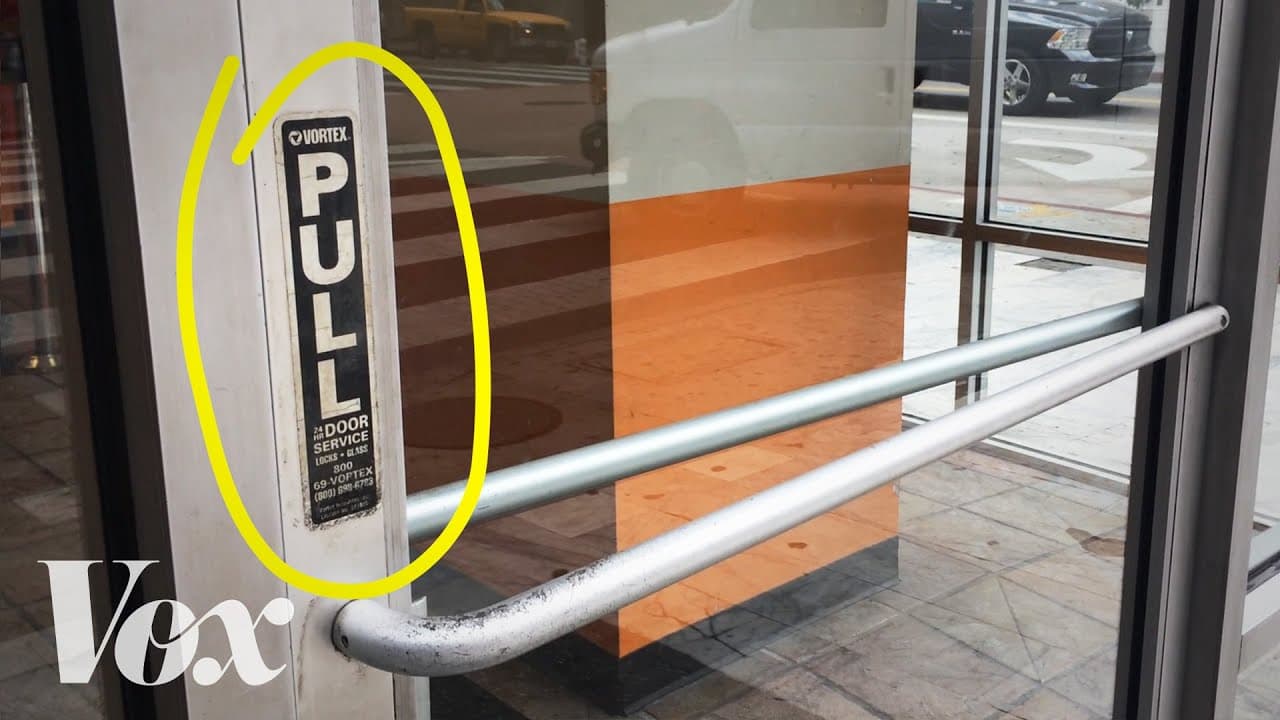
A Norman door is a door whose design tells you to do the opposite of what you should, so it needs a "Push" or "Pull" sign to correct it. It is named after Don Norman, who wrote the essential book on design after getting frustrated with the doors, taps, and light switches while living in Cambridge, England. Well-designed doors follow two principles, discoverability and feedback, so no sign is required. See why a flat plate means push and why bad doors are still everywhere.
Transcript
There’s this door on the 10th floor I just hate so much. Goddammit! Do you ever get this door wrong? “pretty regularly.” How often? “like 30% of the time.” Have you seen people misuse it? All the time. Every day. Constantly. I hate this door. Me too Kelsey. But here’s the thing: as soon as you start looking for confusing doors. They. Are. EVERYWHER... Read More
Key Insights
- 🚪 Norman doors, or confusing doors, are a common frustration due to their design flaws.
- 🎨 Design principles such as discoverability and feedback can prevent the need for signs on doors.
- 👤 Human-centered design aims to improve usability and user experience in various fields.
- 🥺 Many computer systems also lack discoverability and feedback, leading to confusion.
- 🧑⚕️ Human-centered design has the potential to solve large-scale problems in public health and other areas.
- 😚 An ideal door would be so well designed that users do not even realize they are opening and closing it.
- 🤢 Different door designs, such as flat plates, push bars, and pull handles, can indicate the correct way to operate them.
Install to Summarize YouTube Videos and Get Transcripts
Explore YouTube Video Summarizer or Get YouTube Transcript Extractor
Questions & Answers
Q: What is a Norman door?
A Norman door is one where the design tells you to do the opposite of what you're actually supposed to do, or gives the wrong signal and needs a sign to correct it. The result is confusion about whether to push or pull. Named after Don Norman, it captures why a simple door can end up needing an instruction manual.
Q: Who is Don Norman and why are these doors named after him?
Don Norman is the "Norman" of the Norman door. He has been a professor of psychology, cognitive science, and computer science, and a vice president of advanced technology at Apple. He wrote the essential book on design after living in Cambridge, England, where he grew so frustrated with doors, light switches, and water taps that he decided to write about them.
Q: Why do some doors need a "Push" or "Pull" sign?
They need a sign because their design fails to make the correct action obvious. As Don Norman asks, why does such a simple thing need an instruction manual? A well-designed door makes the operation clear on its own, so the sign becomes unnecessary.
Q: What are the basic principles of good design?
Two core principles are discoverability and feedback. Discoverability means that when you look at something, you can tell what operations you can do with it. Feedback means you are told what happened and why. When discoverability is missing, you simply don't know how to use something, which is also common in computer systems where you can't tell what's possible.
Q: What door designs show you how to open them without a sign?
A flat plate can only be pushed, so no sign is needed. A push bar with a piece sticking out on one side works well because you can see which side to push. A vertical bar is ambiguous and could go either way, while a small hand-sized handle tends to indicate pull.
Q: What is human-centered design and how does it work?
Human-centered design, also called user-centered design, is an iterative process that goes around in a circle. You observe what people are doing today, generate ideas for what to propose, then prototype the solution and test it. Don Norman preferred calling it people-centered, and the approach has spread worldwide to improve everyday things and to tackle large problems like public health, water, sanitation, and farming.
Q: What makes an ideal door?
An ideal door is one so well designed that as you walk up to it and through it, you aren't even aware you opened and shut a door. You don't have to think about it because operating it is automatic. That level of design removes the need for any sign or instruction.
Q: Why do bad doors still exist everywhere?
Don Norman notes that many things in life are fairly standardized, but doors tend not to be improved except for safety reasons. Whether someone buys a house isn't a function of whether it has good doors, so there is little pressure to fix them. As a result, terrible doors remain common.
Summary & Key Takeaways
-
Norman doors are doors that tell you to do the opposite of what you're supposed to do or give the wrong signal, resulting in confusion.
-
Discoverability and feedback are key principles of design that can prevent the need for signs on doors.
-
Human-centered design, also known as user-centered design, focuses on improving usability and user experience.
Read in Other Languages (beta)
Share This Summary 📚
Summarize YouTube Videos and Get Video Transcripts with 1-Click
Try YouTube Summary with ChatGPT & Claude or YouTube Transcript Generator
Explore More Summaries from Vox 📚



Summarize YouTube Videos and Get Video Transcripts with 1-Click
Try YouTube Summary with ChatGPT & Claude or YouTube Transcript Generator