Lecture 2.3 - Empirical Risk Minimization

TL;DR
ERM focuses on imitating observations, not models, for learning.
Transcript
we began with the definition of learning in terms of statistical risk minimization but we have evolved into a definition in terms of what we will see now is empirical risk minimization this is a form of learning that bypasses models by trying to imitate observations as opposed to imitating models let us formulate this mathematically get a pencil be... Read More
Key Insights
- Empirical Risk Minimization (ERM) is a learning approach that bypasses models by focusing on mimicking observed data rather than models themselves.
- ERM involves approximating statistical costs with data, using a training set of input-output pairs to estimate empirical risk.
- The empirical risk is calculated as an average over data samples, which is conceptually close to statistical risk under mild conditions.
- ERM replaces statistical risk minimization by focusing on minimizing empirical averages of pointwise losses rather than statistical averages.
- Despite the proximity of empirical and statistical risks, the optimal empirical and statistical classifiers may not be close if sample size is large.
- The discrepancy arises because the minimum of a sequence's limit is not the same as the limit of a sequence of minima.
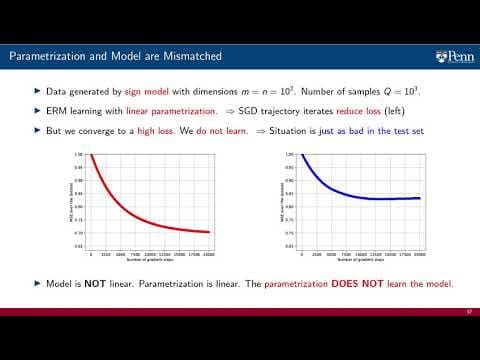
- ERM's trivial solution involves copying outputs for inputs in the training set, minimizing empirical risk but providing no insight beyond the training data.
- The approach highlights a critical limitation of ERM: it doesn't generalize beyond the training set, offering no information on unobserved data.
Install to Summarize YouTube Videos and Get Transcripts
Explore YouTube Video Summarizer or Get YouTube Transcript Extractor
Questions & Answers
Q: What is Empirical Risk Minimization (ERM)?
Empirical Risk Minimization (ERM) is a learning approach that focuses on minimizing the empirical risk, which is the average of pointwise losses over a dataset. Unlike Statistical Risk Minimization (SRM), which averages losses over a distribution, ERM uses observed data to approximate statistical costs, aiming to imitate observations instead of models.
Q: How does ERM differ from Statistical Risk Minimization (SRM)?
ERM differs from SRM in that it focuses on empirical data rather than theoretical distributions. While SRM averages losses over a probability distribution, ERM uses a dataset of input-output pairs to approximate these averages, making it more practical but potentially less generalizable if not carefully applied.
Q: Why might the optimal empirical and statistical classifiers not be similar?
The optimal empirical and statistical classifiers may not be similar due to a mathematical discrepancy. The minimum of the limit of a sequence is not the same as the limit of a sequence of minima. This means that even with large sample sizes, the empirical and statistical optima can differ significantly.
Q: What is the trivial solution to ERM?
The trivial solution to ERM involves making the optimal AI copy the output for all inputs in the training set. This ensures that pointwise losses vanish, minimizing empirical risk. However, it provides no insight into data outside the training set, highlighting ERM's limitation in generalization.
Q: What is the importance of the training set in ERM?
In ERM, the training set is crucial as it forms the basis for calculating empirical risk. It consists of input-output pairs used to approximate statistical costs. The quality and size of the training set can significantly affect the accuracy and generalizability of the learned model.
Q: What is the role of the law of large numbers in ERM?
The law of large numbers underpins the approximation of statistical risk with empirical risk in ERM. It ensures that as the sample size increases, the empirical average of pointwise losses converges to the expected value, making empirical risk a reliable estimate of statistical risk under certain conditions.
Q: Why is caution necessary when applying ERM?
Caution is necessary when applying ERM because its focus on empirical data can lead to overfitting the training set, resulting in poor generalization to unobserved data. The trivial solution of copying outputs in the training set highlights this limitation, emphasizing the need for methods that ensure broader applicability.
Q: What is the main limitation of ERM highlighted in the content?
The main limitation of ERM highlighted is its lack of generalization beyond the training set. While it minimizes empirical risk effectively, it fails to provide insights into data not included in the training set, making it essential to combine ERM with other strategies for broader applicability and understanding.
Summary & Key Takeaways
-
Empirical Risk Minimization (ERM) shifts the learning focus from statistical models to observed data, approximating statistical costs with empirical data averages. By using a training set of input-output pairs, ERM calculates empirical risk, which is conceptually close to statistical risk under certain conditions.
-
While ERM minimizes empirical averages of pointwise losses, it does not guarantee that the optimal empirical and statistical classifiers are similar, even with large sample sizes. This discrepancy arises from the mathematical mistake of exchanging a limit with minimization.
-
The trivial solution to ERM involves copying outputs for inputs in the training set, ensuring minimal empirical risk but failing to generalize beyond the training data. This highlights ERM's limitation in providing insights about unobserved data, emphasizing the need for caution in its application.
Read in Other Languages (beta)
Share This Summary 📚
Summarize YouTube Videos and Get Video Transcripts with 1-Click
Try YouTube Summary with ChatGPT & Claude or YouTube Transcript Generator
Explore More Summaries from Alelab Alelab 📚
Summarize YouTube Videos and Get Video Transcripts with 1-Click
Try YouTube Summary with ChatGPT & Claude or YouTube Transcript Generator