First Order Partial Derivation of Composite Function Problem 3
TL;DR
Solving composite function problem through partial differentiation to prove result equals zero.
Transcript
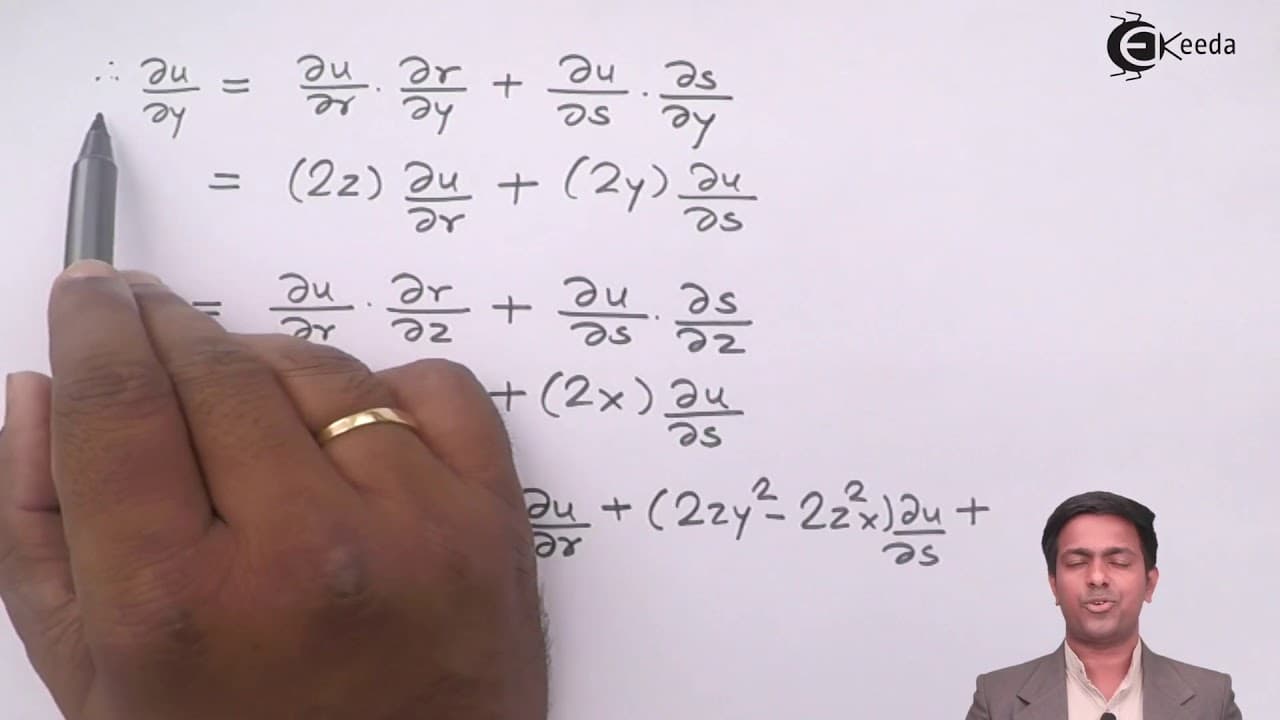
hello students so now we are gonna start with the problem number three which is based on composite function so your we are gonna take one composite function and we are gonna find out the given result with the help of partial differentiation of composite function so here we have u as function of x square plus 2 y z comma y square plus 2 zx and we ha... Read More
Key Insights
- ❓ Composite functions involve intermediate variables affecting dependent-variable relationships.
- ❓ Rearranging functions can reveal hidden relationships and dependencies on specific variables.
- 📏 Applying the chain rule in partial differentiation helps in finding accurate results in composite function problems.
- 🟰 Canceling out opposite-signed terms is crucial in proving results to equal zero.
- ❓ Properly structured explanations and step-by-step calculations are essential in solving complex mathematical problems.
- ❓ Understanding composition of functions and their dependencies is fundamental in advanced mathematics.
- 🦻 Tree diagram visualization aids in simplifying complex composite function problem-solving.
Install to Summarize YouTube Videos and Get Transcripts
Explore YouTube Video Summarizer or Get YouTube Transcript Extractor
Questions & Answers
Q: How is the given function rearranged to show dependence on x, y, and z?
The given function is rearranged into variables r and s, where r and s are functions of x, y, and z, showcasing the relationships clearly.
Q: What is a composite function, and how is it identified in this problem?
A composite function involves an intermediate variable affecting the relationship between two variables, as seen in the structure of u as a function of r and s here.
Q: How is the chain rule applied to find partial derivatives in this problem?
The chain rule is applied from u to x, y, and z, with the calculations involving derivatives of r and s with respect to x, y, and z.
Q: How is the result proven to be equal to zero in this composite function problem?
After calculating each partial derivative and rearranging the terms, all terms cancel out, leading to the final conclusion that the result equals zero.
Summary & Key Takeaways
-
Composite function problem solving using partial differentiation.
-
Provided function is rearranged to show dependence on x, y, and z.
-
Chain rule applied to find partial derivatives and prove result equals zero.
Read in Other Languages (beta)
Share This Summary 📚
Summarize YouTube Videos and Get Video Transcripts with 1-Click
Try YouTube Summary with ChatGPT & Claude or YouTube Transcript Generator
Explore More Summaries from Ekeeda 📚






Summarize YouTube Videos and Get Video Transcripts with 1-Click
Try YouTube Summary with ChatGPT & Claude or YouTube Transcript Generator