What Are Reciprocals in Fractions?
TL;DR
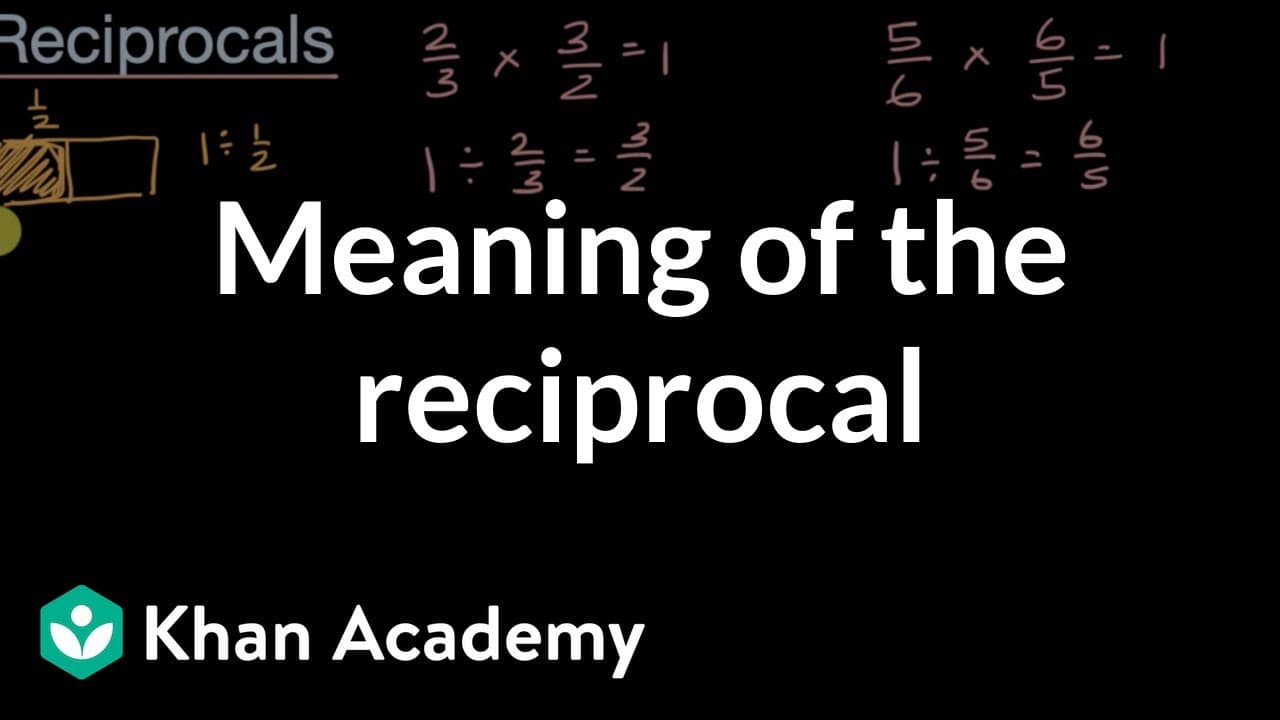
Reciprocals in fractions are found by swapping the numerator and denominator, resulting in a number that, when multiplied by the original fraction, equals one. They can also represent how many times the fraction fits into one, offering a deeper understanding of their mathematical significance.
Transcript
- [Instructor] Let's talk a little bit about reciprocals. Now, when you first learn reciprocals some folks will immediately tell you, Hey, just swap the numerator and the denominator. So for example, if I have the fraction 2/3, the reciprocal of 2/3, if I swap the numerator and the denominator, is 3/2. If I had the fraction 5/6, the reciprocal of t... Read More
Key Insights
- ❓ Reciprocals in fractions are obtained by swapping the numerator and denominator.
- ✖️ Reciprocals represent the number that, when multiplied by the original fraction, equals one.
- 🙈 Reciprocals can be seen as how many of the fraction fit into one.
- 👀 The reciprocal of a fraction may not always look like a simple swap of the numerator and denominator, but it still achieves the same result.
- ❓ Reciprocals can be used to simplify mathematical operations involving fractions.
- 🗂️ Understanding reciprocals is essential in dividing fractions and solving equations involving fractions.
- 🥳 Reciprocals have applications in various mathematical concepts, such as ratios and proportions.
Install to Summarize YouTube Videos and Get Transcripts
Explore YouTube Video Summarizer or Get YouTube Transcript Extractor
Questions & Answers
Q: What is a reciprocal in fractions?
A reciprocal in fractions is obtained by swapping the numerator and denominator. It is the number that, when multiplied by the original fraction, equals one.
Q: How can reciprocals be interpreted?
Reciprocals can be interpreted as the number that, when multiplied by the original fraction, results in one. They can also be seen as how many of the fraction fit into one.
Q: How do you find the reciprocal of 1/2?
To find the reciprocal of 1/2, swap the numerator and denominator, resulting in 2/1 or 2. This means that 2 multiplied by 1/2 equals 1.
Q: What is the reciprocal of 3/2?
The reciprocal of 3/2 is 2/3. This means that 2/3 multiplied by 3/2 equals 1.
Summary & Key Takeaways
-
Reciprocals in fractions can be found by swapping the numerator and denominator.
-
Reciprocals can be interpreted as the number that, when multiplied by the original number, equals one.
-
Reciprocals can also be thought of as how many of the number or fraction fit into one.
Read in Other Languages (beta)
Share This Summary 📚
Summarize YouTube Videos and Get Video Transcripts with 1-Click
Try YouTube Summary with ChatGPT & Claude or YouTube Transcript Generator
Explore More Summaries from Khan Academy 📚



Summarize YouTube Videos and Get Video Transcripts with 1-Click
Try YouTube Summary with ChatGPT & Claude or YouTube Transcript Generator