Why Doesn't Time Flow Backwards? (Big Picture Ep. 1/5)
TL;DR
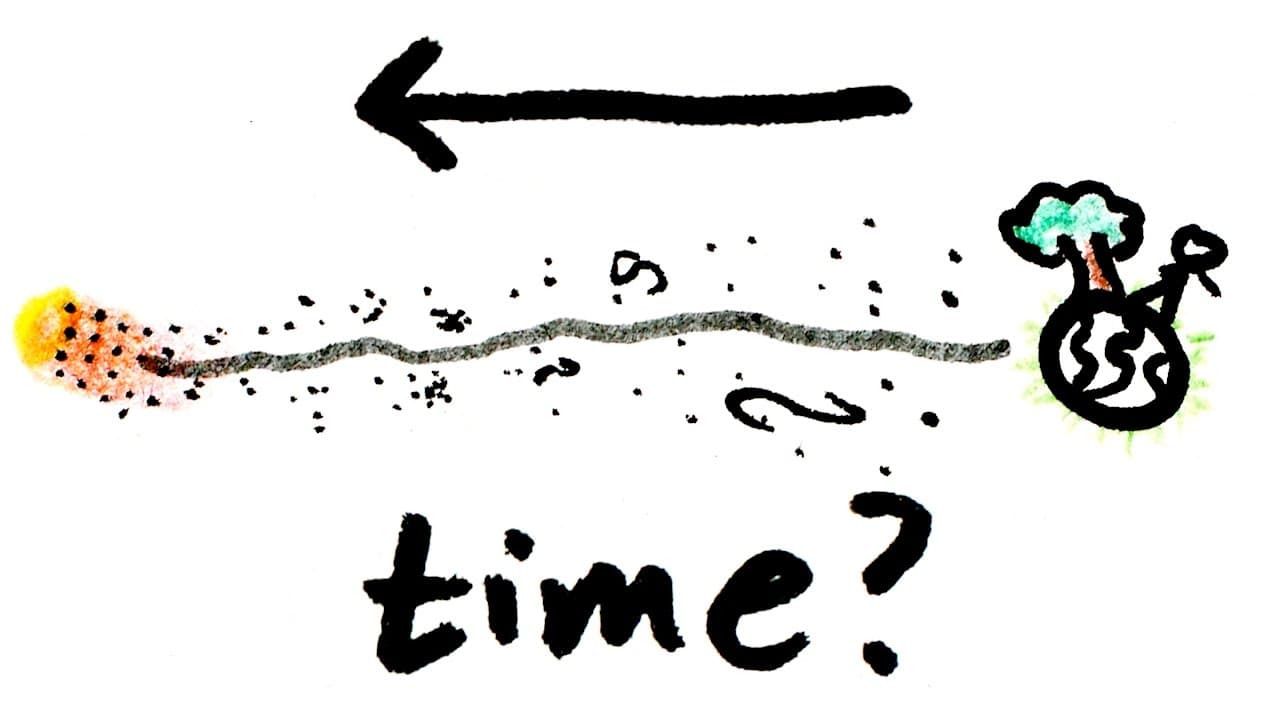
Physics laws are timeless, but thermodynamics dictates time's direction towards increasing entropy.
Transcript
The basic laws of physics – things like F=ma, “gravity is inversely proportional to the distance squared”, Schrodinger’s equation, and so on – don’t say anything about the direction of time. Sure, they relate what’s going on now to what happens next, and to what happened previously, but there’s no distinction between forwards and backwards in time.... Read More
Key Insights
- 🖤 Fundamental physics laws are timeless, lacking inherent time direction.
- 💘 Thermodynamics introduces the concept of time's arrow towards increasing entropy.
- ⏳ The Big Bang's low-entropy state set the stage for time's flow and universe organization.
- 👾 A high-entropy universe would result in empty space devoid of structures or life.
- 🌟 Initial low-entropy conditions led to the formation of stars, galaxies, and life.
- ⏳ Our universe's unique starting point gave rise to time's flow and the existence of conscious life.
- 💖 The series aims to educate and spark interest in science through collaboration and storytelling.
Install to Summarize YouTube Videos and Get Transcripts
Explore YouTube Video Summarizer or Get YouTube Transcript Extractor
Questions & Answers
Q: Why don't the basic laws of physics specify the direction of time?
The laws like F=ma and gravity are time-symmetric, equally applicable in past and future, focusing on the present's relation to past and future but not indicating a preferred temporal direction.
Q: How does the second law of thermodynamics introduce the concept of time's direction?
The second law implies systems trend towards higher entropy, increasing disorder, defining a direction from low entropy (orderly state like Big Bang) to equilibrium (maximum disorder).
Q: What is the significance of the low-entropy state at the Big Bang?
The low-entropy start was crucial for time's flow and the universe's organization, leading to the formation of stars, galaxies, and life in an evolving system.
Q: How does the concept of entropy and time relate to the expansion of the universe?
As the universe expands and dissipates energy, stars will burn out, black holes will evaporate, eventually leading to maximum entropy, an empty space with no structures or life.
Summary & Key Takeaways
-
Fundamental physics laws don't specify time's direction, but the second law of thermodynamics does, towards increasing entropy.
-
The universe began in a low-entropy state at the Big Bang, leading to the current flow of time.
-
Time's arrow is a consequence of the specific initial conditions of our universe, not inherent in fundamental physics.
Read in Other Languages (beta)
Share This Summary 📚
Summarize YouTube Videos and Get Video Transcripts with 1-Click
Try YouTube Summary with ChatGPT & Claude or YouTube Transcript Generator
Explore More Summaries from minutephysics 📚

Summarize YouTube Videos and Get Video Transcripts with 1-Click
Try YouTube Summary with ChatGPT & Claude or YouTube Transcript Generator