Derivative of inverse sine | Taking derivatives | Differential Calculus | Khan Academy
TL;DR
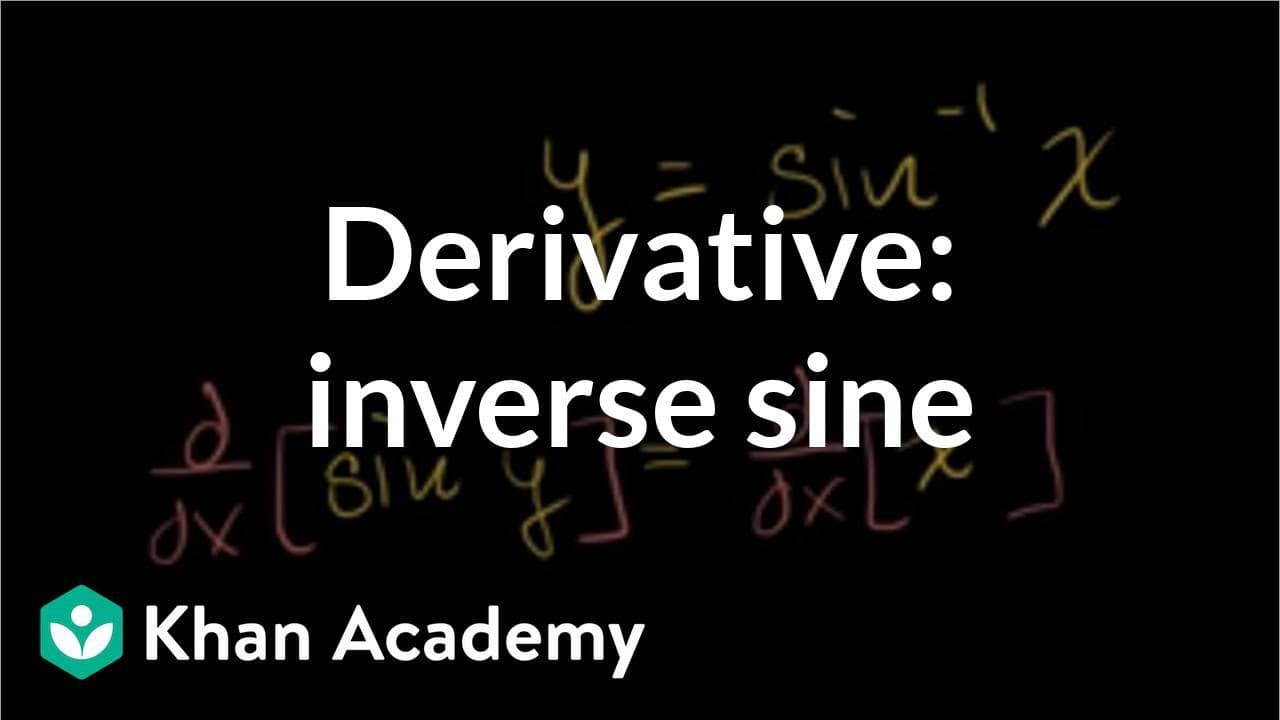
The derivative of the inverse sine of X is equal to 1 divided by the square root of 1 minus X squared.
Transcript
What I would like to explore in this video, is to see if we could figure out the derivative of Y is with respect to X. If Y is equal to the inverse sine, the inverse sine of X. And like always, I encourage you to pause this video and try to figure this out on your own. And I will give you two hints. First hint is, well, we don't know what the deriv... Read More
Key Insights
- 👨💼 The derivative of the inverse sine of X is a valuable result in calculus, providing information about the rate of change of functions involving the inverse sine.
- ❓ Implicit differentiation is a powerful technique used to find derivatives when the dependent and independent variables are not explicitly given in an equation.
- 😑 Trigonometric identities, such as the Pythagorean identity, are utilized to rewrite expressions and simplify the process of finding derivatives.
- 👨💼 Understanding the derivative of the inverse sine helps in analyzing the behavior of functions and solving various mathematical problems.
- ❎ The derived expression, 1 divided by the square root of 1 minus X squared, is useful in determining slopes, tangent lines, and critical points.
- 👨💼 The chain rule is applied in the process of finding the derivative of the inverse sine.
- 😑 Re-expressing the derivative in terms of X allows for easier application in equations and calculations.
Install to Summarize YouTube Videos and Get Transcripts
Explore YouTube Video Summarizer or Get YouTube Transcript Extractor
Questions & Answers
Q: How can the derivative of the inverse sine of X be found?
The video demonstrates the process of using implicit differentiation and trigonometric identities to arrive at the derivative of 1 divided by the square root of 1 minus X squared.
Q: Why is it important to understand the derivative of the inverse sine?
Understanding this derivative is crucial in calculus, as it can be used in various applications and mathematical problems. It helps in the analysis of functions and their rates of change.
Q: How can the derived expression be useful in calculus?
The derived expression, 1 divided by the square root of 1 minus X squared, can be used to find slopes, tangent lines, and critical points of functions involving the inverse sine. It provides valuable information for further mathematical analysis.
Q: Can the process of finding the derivative be applied to other inverse trigonometric functions?
Yes, similar techniques can be applied to find the derivatives of other inverse trigonometric functions. By using implicit differentiation and trigonometric identities, the derivatives of the inverse cosine, inverse tangent, etc., can be determined.
Summary & Key Takeaways
-
The video discusses how to find the derivative of Y with respect to X when Y is equal to the inverse sine of X.
-
By using implicit differentiation and trigonometric identities, the derivative is derived as 1 divided by the square root of 1 minus X squared.
-
The importance of understanding this derivative is highlighted, especially when encountering it in calculus.
Read in Other Languages (beta)
Share This Summary 📚
Summarize YouTube Videos and Get Video Transcripts with 1-Click
Try YouTube Summary with ChatGPT & Claude or YouTube Transcript Generator
Explore More Summaries from Khan Academy 📚



Summarize YouTube Videos and Get Video Transcripts with 1-Click
Try YouTube Summary with ChatGPT & Claude or YouTube Transcript Generator