Using Statistics in Psychology | Psychology
TL;DR
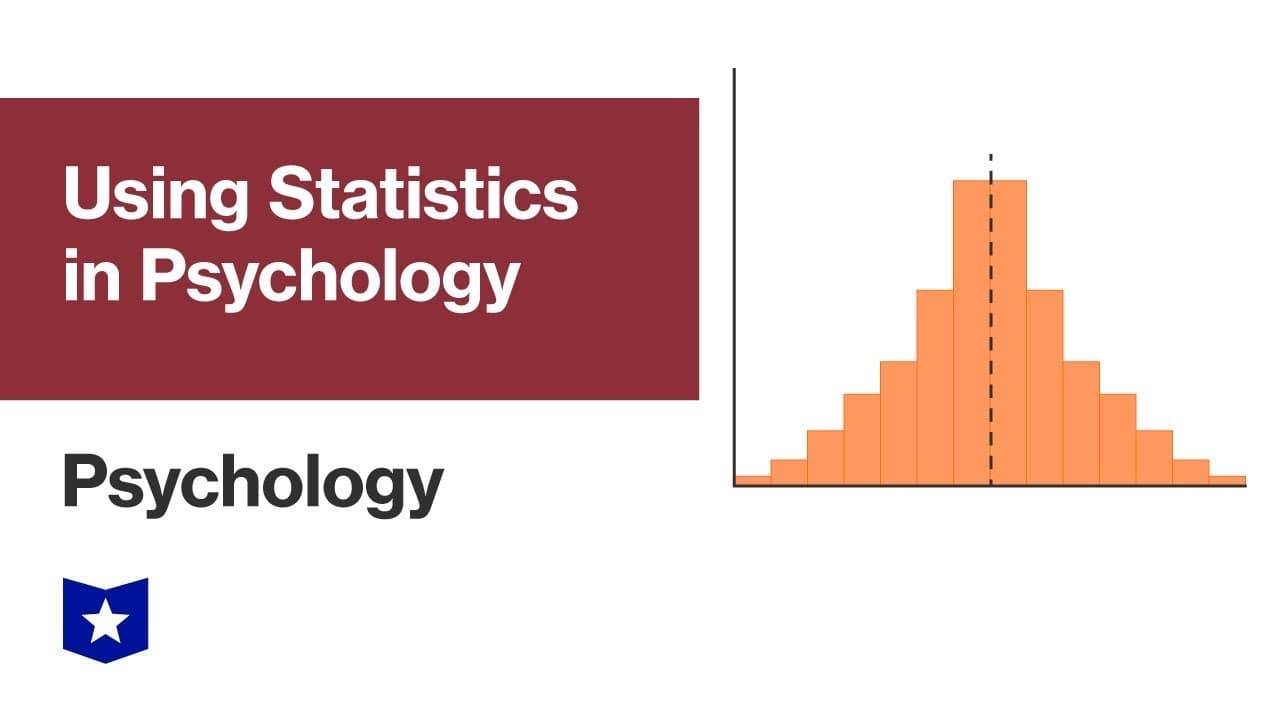
Scientists use descriptive statistics to summarize data and inferential statistics to make predictions based on that data.
Transcript
scientists aim to accomplish two goals with their data first they want to organize and describe the data in meaningful ways second they want to use the data to make inferences or predictions about a population of interest to achieve the first goal scientists rely on descriptive statistics descriptive statistics summarize a data set the most often i... Read More
Key Insights
- 📳 Descriptive statistics summarize data using central tendency measures like mean, median, and mode.
- 🧡 Variance, represented by range and standard deviation, shows how values differ in a dataset.
- 🌥️ Inferential statistics help generalize conclusions from a sample to a larger population.
- 😀 Statistical significance, with a p-value of 0.05, indicates the probability of results being due to chance.
- 🌍 Practical significance, determined by effect size, assesses the usefulness of results in the real world.
- 🏆 Different types of inferential statistics, like correlation coefficients and t-tests, serve various purposes in data analysis.
- ⚾ Descriptive statistics are used to summarize data, while inferential statistics are used to make predictions based on that data.
Install to Summarize YouTube Videos and Get Transcripts
Explore YouTube Video Summarizer or Get YouTube Transcript Extractor
Questions & Answers
Q: What is the purpose of descriptive statistics?
Descriptive statistics help summarize data by providing measures of central tendency like mean, median, and mode, along with measures of variance like range and standard deviation. They organize and describe data in meaningful ways.
Q: How is the mean calculated in a dataset?
The mean is calculated by adding all values in a dataset and dividing the sum by the total number of values. For example, if exam scores are 67, 72, 72, 91, and 77, the mean would be 75.8.
Q: What is the difference between statistical significance and practical significance?
Statistical significance, indicated by a p-value of 0.05, shows the probability that a result occurred due to chance. Practical significance, determined by effect size, assesses if the result is useful in the real world.
Q: How do scientists use inferential statistics in data analysis?
Scientists use inferential statistics to make predictions about a larger population based on sample data. Tools like correlation coefficients and t-tests help generalize conclusions from the sample.
Summary & Key Takeaways
-
Scientists aim to organize and describe data and make inferences from it using descriptive and inferential statistics.
-
Descriptive statistics involve measures of central tendency like mean, median, and mode, as well as measures of variance like range and standard deviation.
-
Inferential statistics help generalize conclusions from a sample to a larger population using tools like correlation coefficients and t-tests.
Read in Other Languages (beta)
Share This Summary 📚
Summarize YouTube Videos and Get Video Transcripts with 1-Click
Try YouTube Summary with ChatGPT & Claude or YouTube Transcript Generator
Explore More Summaries from Course Hero 📚




Summarize YouTube Videos and Get Video Transcripts with 1-Click
Try YouTube Summary with ChatGPT & Claude or YouTube Transcript Generator