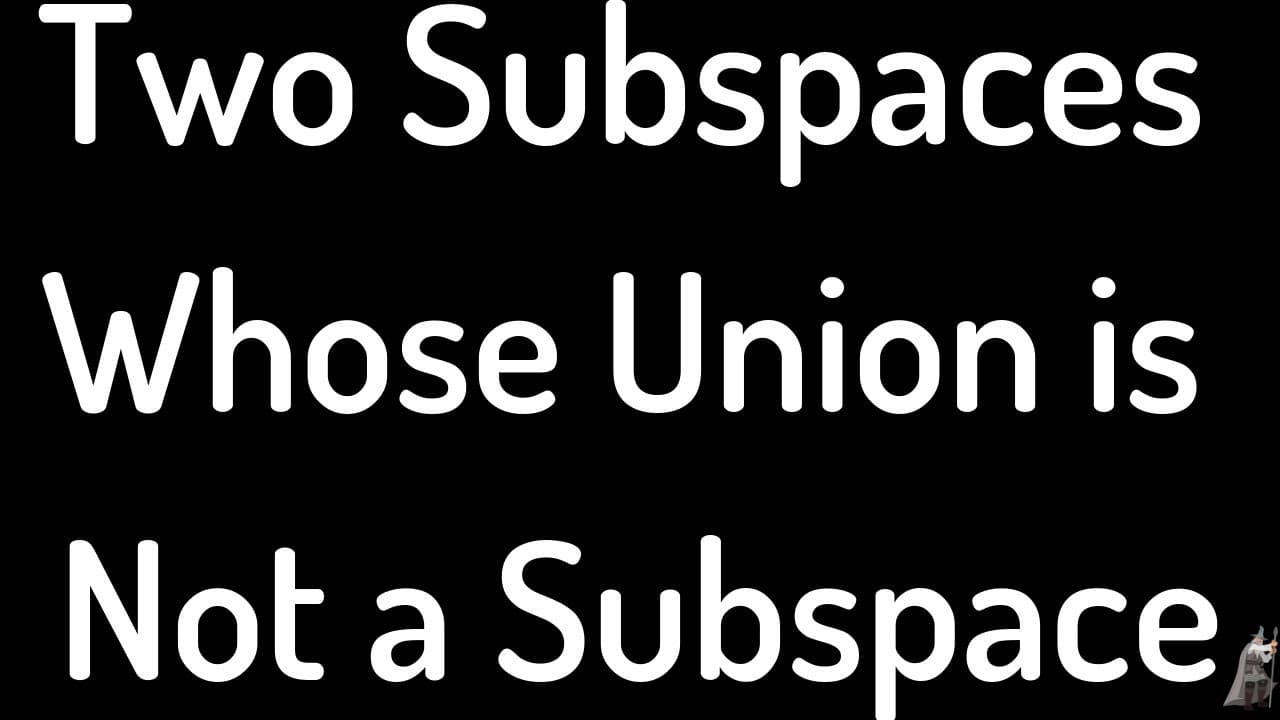
Two Subspaces of R^2 whose Union is not a Subspace
TL;DR
Exploring two subspaces in R-squared and proving their union is not a subspace through vector addition analysis.
Transcript
find two subspaces of r-squared whose union is not a subspace so let's go ahead and work this out so to figure this out one way to do it is to draw a picture and think about what's going on so there's the y-axis and there's the x-axis and so any subspace of R squared must pass through the origin because it has to actually contain the zero vector ri... Read More
Key Insights
- 🛳️ Subspaces in R-squared must pass through the origin and obey closure under vector addition.
- ☺️ Y=x and y=0 represent two distinct subspaces in R-squared.
- ❣️ The union of y=x and y=0 is not a subspace due to the non-closure of vector addition.
- 😫 Closure under vector addition is a crucial property determining whether a set is a subspace.
- 🚱 The example of vectors 3 3 and 1 0 failing closure under vector addition highlights the non-subspace nature of their union.
- 0️⃣ Understanding subspace properties like closure and containment of zero vector is essential in linear algebra.
- 👾 Visualizing subspaces and their properties aids in grasping concepts of vector spaces.
Install to Summarize YouTube Videos and Get Transcripts
Explore YouTube Video Summarizer or Get YouTube Transcript Extractor
Questions & Answers
Q: What defines a subspace in R-squared?
A subspace in R-squared must pass through the origin, contain the zero vector, and be closed under vector addition and scalar multiplication.
Q: Explain the properties of subspaces y=x and y=0 in R-squared.
The subspace y=x consists of vectors where x and y components are equal, while the subspace y=0 has vectors with a y-coordinate of 0, both passing through the origin.
Q: Why does the union of y=x and y=0 fail to be a subspace in R-squared?
The union is not a subspace because it's not closed under vector addition – evident by choosing vectors outside the subspaces that, when added, result in a vector not in the union.
Q: How is the non-closure under vector addition demonstrated in the video example?
By selecting vectors 3 3 and 1 0, showing their sum 4 3 isn't in the union, violating closure property in relation to W 1 and W 2.
Summary & Key Takeaways
-
Two subspaces in R-squared are examined: y=x and y=0.
-
The union of these subspaces is not a subspace due to failure of closure under vector addition.
-
Vector addition of examples outside the subspaces illustrates the non-closure property.
Read in Other Languages (beta)
Share This Summary 📚
Summarize YouTube Videos and Get Video Transcripts with 1-Click
Try YouTube Summary with ChatGPT & Claude or YouTube Transcript Generator
Explore More Summaries from The Math Sorcerer 📚


Summarize YouTube Videos and Get Video Transcripts with 1-Click
Try YouTube Summary with ChatGPT & Claude or YouTube Transcript Generator