Power Transmission And Losses In Rectangular Waveguide - Microwave Transmission
TL;DR
Analysis of power propagation in a rectangular waveguide, covering transmitted power, power losses, and key formulas.
Transcript
click the bell icon to get latest videos from akira hello friends i welcome you all to this video we are with the 8th chapter of micro-engineering where the micro view that has been generated we have seen in the initial chapters have been propagating having a transmission through a guided medium so which is a single conductor transmission line rect... Read More
Key Insights
- ✊ Utilizing the Poynting theorem for calculating transmitted power in a rectangular waveguide.
- ✊ Differentiating between power losses from dielectric materials and metallic waveguide walls.
- ✊ Employing attenuation constants and surface resistance to quantify power dissipation mechanisms.
- ✊ Investigating the impact of surface resistance on power transmission and losses.
- ✊ Analyzing the relationship between transmitted power and power losses for efficient waveguide design.
- ✊ Exploring the interplay between electric and magnetic field components in power propagation.
- ✊ Consideration of frequency parameters and intrinsic impedance in power transmission analysis.
Install to Summarize YouTube Videos and Get Transcripts
Explore YouTube Video Summarizer or Get YouTube Transcript Extractor
Questions & Answers
Q: How is transmitted power calculated in a rectangular waveguide?
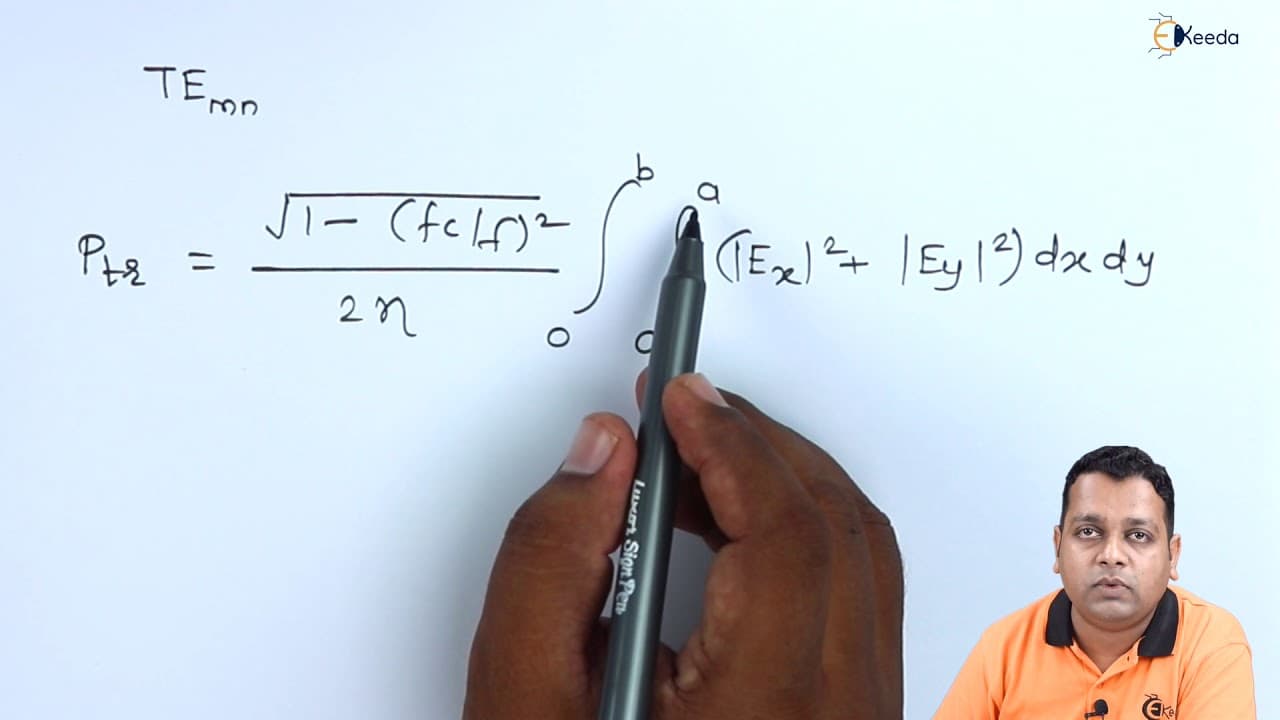
Transmitted power in a rectangular waveguide is calculated using the Poynting theorem, which involves the cross product of the electric and magnetic field vectors to determine the direction of power transfer. This calculation provides insight into the power propagation dynamics within the waveguide.
Q: How do power losses occur in a rectangular waveguide?
Power losses in a rectangular waveguide can occur due to dielectric materials filled in the cavity and the conductivity of the metallic walls. Dielectric losses are influenced by the attenuation constant alpha, while metallic wall losses are determined by the surface resistance of the material.
Q: What role does the surface resistance play in power loss calculations?
The surface resistance, denoted as RS, quantifies how deeply microwave signals penetrate the metallic walls of the waveguide. It is related to the skin depth and conductivity of the material, impacting the power loss per unit length calculation through the tangential magnetic field component.
Q: Why are power losses critical to consider in waveguide design?
Understanding power losses in a waveguide is crucial for optimizing signal propagation efficiency and minimizing energy dissipation. By analyzing and mitigating losses due to dielectric materials and metallic walls, engineers can enhance the performance of microwave transmission systems.
Summary & Key Takeaways
-
Investigates power transmission and losses in a rectangular waveguide for microwave signals.
-
Examines transmitted power calculations using the Poynting theorem in complex form.
-
Discusses power losses due to dielectric materials and metallic waveguide walls, including attenuation constants and surface resistance.
Read in Other Languages (beta)
Share This Summary 📚
Summarize YouTube Videos and Get Video Transcripts with 1-Click
Try YouTube Summary with ChatGPT & Claude or YouTube Transcript Generator
Explore More Summaries from Ekeeda 📚





Summarize YouTube Videos and Get Video Transcripts with 1-Click
Try YouTube Summary with ChatGPT & Claude or YouTube Transcript Generator