Electron Transport Chain - ATP Synthase, Chemiosmosis, & Oxidative Phosphorylation
TL;DR
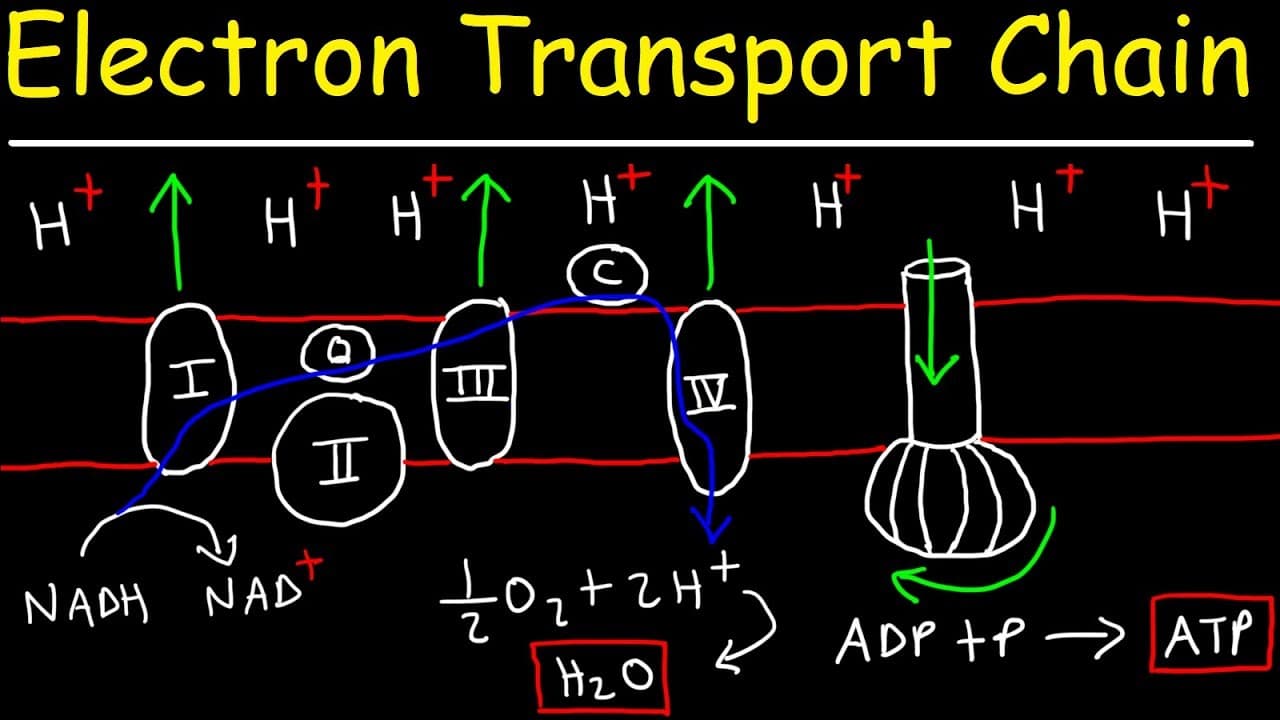
The electron transport chain is a crucial stage in cellular respiration where electrons are transferred through complexes to generate ATP.
Transcript
now let's move on to stage four of cellular respiration and that is the electron transport chain now the nadh molecule that we generated in the krebs cycle and even in glycolysis as well as pyruvate oxidation it's going to give up a hydrogen and some electrons at complex one complex one is called nadh dehydrogenase as all dehydrogenase enzymes go i... Read More
Key Insights
- ❓ NADH donates electrons to complex 1, and electrons are transferred through complexes 2, 3, and 4 before reaching oxygen.
- 🚗 Mobile electron carriers, ubiquinone and cytochrome c, play a crucial role in transferring electrons between complexes.
- ⛽ Protons are pumped out of the matrix, creating a positive charge and a concentration gradient for ATP synthesis.
- ⛓️ The electron transport chain and chemiosmosis together constitute oxidative phosphorylation, where ATP is generated through electron transfer and proton movement.
- 💐 Electrons flow from less electronegative species to more electronegative species, releasing energy in the process.
- 🧑🏭 ATP synthase acts as a turbine, utilizing the flow of protons to catalyze the synthesis of ATP.
- ❓ NADH activates three complexes and yields three ATP molecules, while FADH2 activates two complexes and yields two ATP molecules.
Install to Summarize YouTube Videos and Get Transcripts
Explore YouTube Video Summarizer or Get YouTube Transcript Extractor
Questions & Answers
Q: What is the function of the electron transport chain in cellular respiration?
The electron transport chain transfers electrons from NADH to oxygen, generating ATP through oxidative phosphorylation.
Q: How do electrons travel through the membrane if it is nonpolar?
Electrons are carried by mobile electron carriers, such as ubiquinone and cytochrome c, as they cannot move by themselves across the nonpolar membrane.
Q: Why is oxygen the final electron acceptor in the electron transport chain?
Oxygen is highly electronegative and has a strong affinity for electrons, making it an ideal final acceptor to drive the transfer of electrons through the chain.
Q: How is ATP synthesized during the electron transport chain?
Protons are pumped out of the mitochondrial matrix, creating a positive charge in the intermembrane space. These protons flow back through ATP synthase, driving the synthesis of ATP.
Summary & Key Takeaways
-
Stage four of cellular respiration is the electron transport chain, where NADH molecules donate electrons to complexes.
-
Electrons are carried by mobile electron carriers, such as ubiquinone and cytochrome c, through complexes 1-4.
-
Protons are pumped out of the matrix to create a positive charge in the intermembrane space, driving ATP synthesis through ATP synthase.
Read in Other Languages (beta)
Share This Summary 📚
Summarize YouTube Videos and Get Video Transcripts with 1-Click
Try YouTube Summary with ChatGPT & Claude or YouTube Transcript Generator
Explore More Summaries from The Organic Chemistry Tutor 📚




Summarize YouTube Videos and Get Video Transcripts with 1-Click
Try YouTube Summary with ChatGPT & Claude or YouTube Transcript Generator