Lecture 8.8 - Equivariance, Stability, and Transference
TL;DR
Lecture discusses equivariance, stability, and prediction in networks.
Transcript
we clubs de lectura and the first party records reflections on wye variance estabilidad and transferencia my first reflexión y estaba la cuestión clases son questions and wood en cuestión salvado pensamos hacer cuestiones el software de donde iban a balance cuestiones like that is war for this world art not identifique cuestiones de cannot be rubén... Read More
Key Insights
- Equivariance and stability are crucial concepts in understanding how networks handle transformations and predictions across various domains.
- The lecture emphasizes the importance of experimental validation in confirming theoretical predictions in network performance.
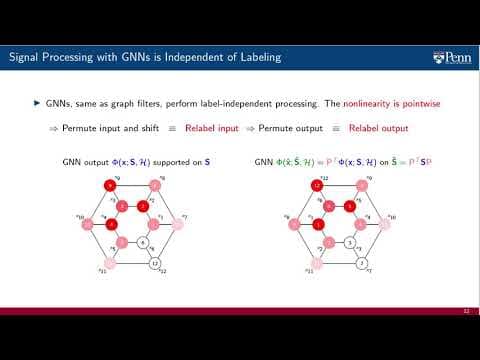
- Equivariance allows for the shift operator to function effectively, enhancing prediction capabilities in networks.
- Stability in networks ensures consistent performance, even when faced with dynamic inputs or environmental changes.
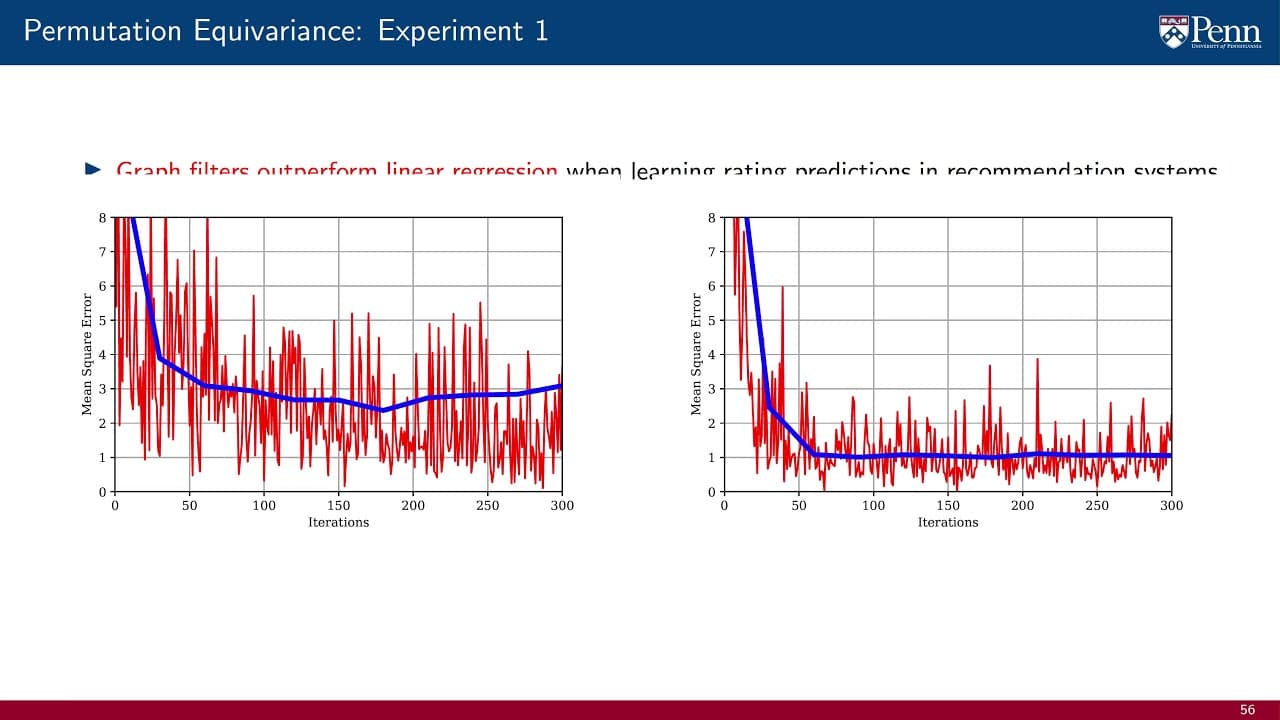
- Graph filters play a significant role in enhancing prediction accuracy and discriminative capabilities in networks.
- The lecture highlights the importance of understanding the limitations of network predictions and the conditions under which they excel.
- Experimental demonstrations showed that certain prediction models outperform others in specific scenarios, emphasizing the need for tailored solutions.
- The integration of theoretical concepts with practical applications is crucial for advancing network technology and understanding its potential impact.
Install to Summarize YouTube Videos and Get Transcripts
Explore YouTube Video Summarizer or Get YouTube Transcript Extractor
Questions & Answers
Q: What is the significance of equivariance in networks?
Equivariance is significant in networks because it allows them to handle transformations effectively, maintaining consistent performance across various domains. This property enables networks to apply the shift operator efficiently, enhancing their prediction capabilities by ensuring that the network's response to input changes is predictable and stable.
Q: How does stability impact network performance?
Stability impacts network performance by ensuring that the network's output remains consistent even when faced with dynamic inputs or environmental changes. This reliability is crucial for applications where consistent performance is necessary, as it prevents the network from producing erratic or unpredictable results in response to minor variations in input.
Q: Why is experimental validation important in network predictions?
Experimental validation is important in network predictions because it confirms the theoretical predictions and ensures that the models perform as expected in real-world scenarios. Without experimental validation, theoretical models may not accurately reflect practical performance, leading to unreliable predictions and potentially flawed decision-making processes.
Q: What role do graph filters play in networks?
Graph filters play a crucial role in networks by enhancing prediction accuracy and discriminative capabilities. They allow networks to process and analyze data more effectively, leading to better performance in tasks such as recommendation systems and rating predictions. Graph filters help in refining the network's ability to differentiate between various input patterns.
Q: How do experimental demonstrations contribute to understanding network performance?
Experimental demonstrations contribute to understanding network performance by providing empirical evidence of how different models perform under various conditions. These demonstrations highlight the strengths and limitations of each model, allowing researchers to identify the most effective solutions for specific scenarios and tailor their approaches accordingly.
Q: What are the main challenges in network predictions?
The main challenges in network predictions include handling dynamic inputs, ensuring stability, and accurately validating theoretical models through experiments. Networks must be able to adapt to changes while maintaining consistent performance, and researchers must ensure that their predictions are reliable and applicable to real-world situations.
Q: Why is it important to integrate theoretical concepts with practical applications in network technology?
Integrating theoretical concepts with practical applications in network technology is important because it bridges the gap between theory and practice, ensuring that models are not only theoretically sound but also practically viable. This integration helps in advancing network technology by providing solutions that are both innovative and applicable to real-world problems.
Q: What insights can be gained from understanding the limitations of network predictions?
Understanding the limitations of network predictions provides insights into the conditions under which networks excel and where they may struggle. This knowledge allows researchers to develop more robust models, tailor solutions to specific problems, and anticipate potential challenges, ultimately leading to more reliable and effective network technologies.
Summary & Key Takeaways
-
The lecture covers key concepts such as equivariance and stability, which are essential for understanding network performance and prediction capabilities. It highlights the importance of experimental validation in confirming theoretical predictions and discusses how graph filters can enhance prediction accuracy.
-
Equivariance allows networks to handle transformations effectively, while stability ensures consistent performance under dynamic conditions. The lecture emphasizes the need for tailored solutions in network predictions, as experimental demonstrations showed varying performance across different models and scenarios.
-
The integration of theoretical concepts with practical applications is crucial for advancing network technology. The lecture provides a comprehensive overview of the topics covered throughout the course, ensuring a thorough understanding of the main theorems and practical results.
Read in Other Languages (beta)
Share This Summary 📚
Summarize YouTube Videos and Get Video Transcripts with 1-Click
Try YouTube Summary with ChatGPT & Claude or YouTube Transcript Generator
Explore More Summaries from Alelab Alelab 📚




Summarize YouTube Videos and Get Video Transcripts with 1-Click
Try YouTube Summary with ChatGPT & Claude or YouTube Transcript Generator