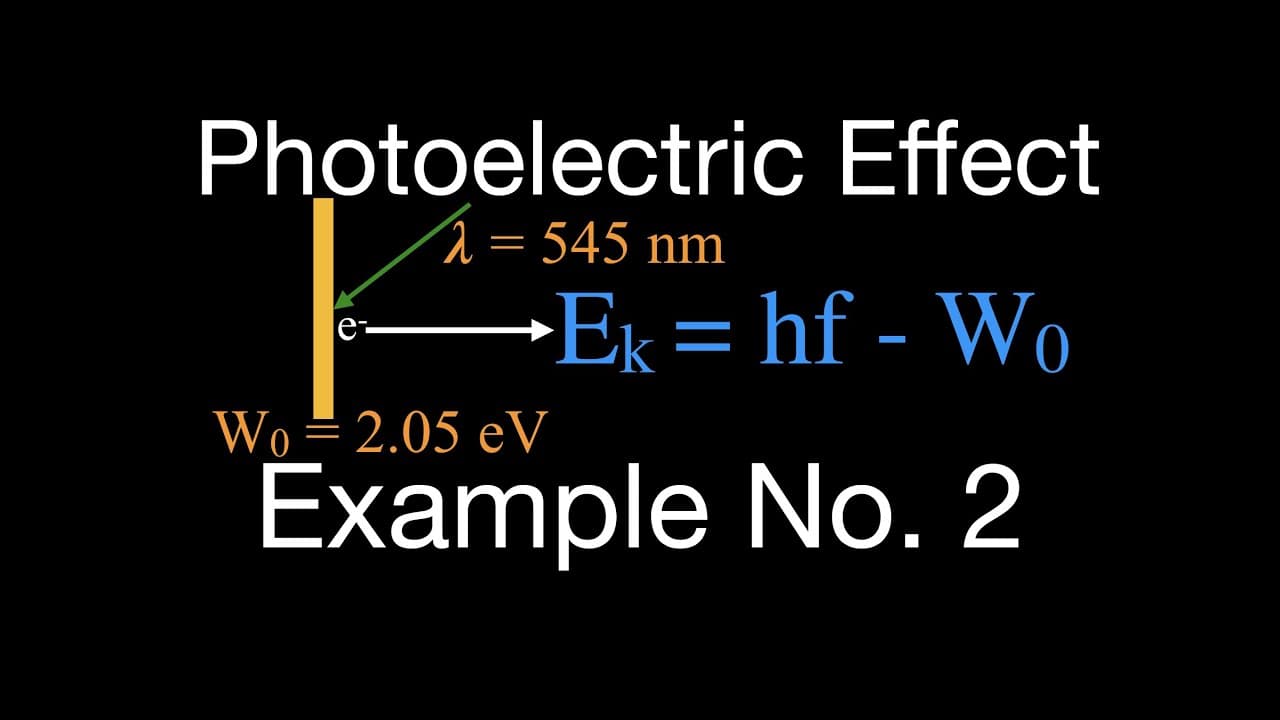
Photoelectric Effect (3 of 8 ) Example No.2 (Very Helpful)
TL;DR
Explaining the kinetic energy of electrons in a photoelectric effect scenario.
Transcript
okay in today's video I'm going to go over another example for the photoelectric effect before we get started please don't forget subscribe to my channel get all my excellent physics chemistry and math videos and I've also made some other videos about the photoelectric effect an explanation and some other example problems and you can link to those ... Read More
Key Insights
- ❓ Understanding the photoelectric effect involves concepts of energy transfer and electron emission.
- 🙂 Calculation of kinetic energy involves determining the difference between the energy of light and the work function.
- ❓ Velocity of electrons is directly proportional to their kinetic energy in the photoelectric effect.
- 😫 Work function plays a significant role in setting the threshold for electron emission.
- 🙅 The stopping potential provides a measure of the energy required to halt electron movement.
- ⚡ Conversion between units like electron volts and joules is essential for energy calculations.
- 🈂️ Physics principles like Planck's constant and elementary charge are fundamental to photoelectric effect calculations.
Install to Summarize YouTube Videos and Get Transcripts
Explore YouTube Video Summarizer or Get YouTube Transcript Extractor
Questions & Answers
Q: What is the work function in the context of the photoelectric effect?
The work function refers to the minimum energy required to release an electron from a metal surface in the photoelectric effect, usually measured in electron volts (eV).
Q: How is the kinetic energy of ejected electrons calculated in the photoelectric effect?
The kinetic energy of ejected electrons is determined by subtracting the work function from the energy of the incoming light, as per the equation KE = Energy of Light - Work Function.
Q: What factors determine the maximum velocity of electrons in the photoelectric effect?
The maximum velocity of electrons is dependent on their kinetic energy, which in turn is influenced by the energy of the incident light and the work function of the metal surface they are ejected from.
Q: Why is the stopping potential crucial in the photoelectric effect?
The stopping potential indicates the minimum voltage required to prevent the ejected electrons from reaching the anode, thereby providing insight into the energy of the electrons being emitted.
Summary & Key Takeaways
-
Introduction to the photoelectric effect and its application in physics.
-
Calculation of the kinetic energy and velocity of ejected electrons.
-
Determination of the stopping potential for the electrons.
Read in Other Languages (beta)
Share This Summary 📚
Summarize YouTube Videos and Get Video Transcripts with 1-Click
Try YouTube Summary with ChatGPT & Claude or YouTube Transcript Generator
Explore More Summaries from Step by Step Science 📚
Summarize YouTube Videos and Get Video Transcripts with 1-Click
Try YouTube Summary with ChatGPT & Claude or YouTube Transcript Generator