What Is Comparative Advantage and Why Is It Important?
TL;DR
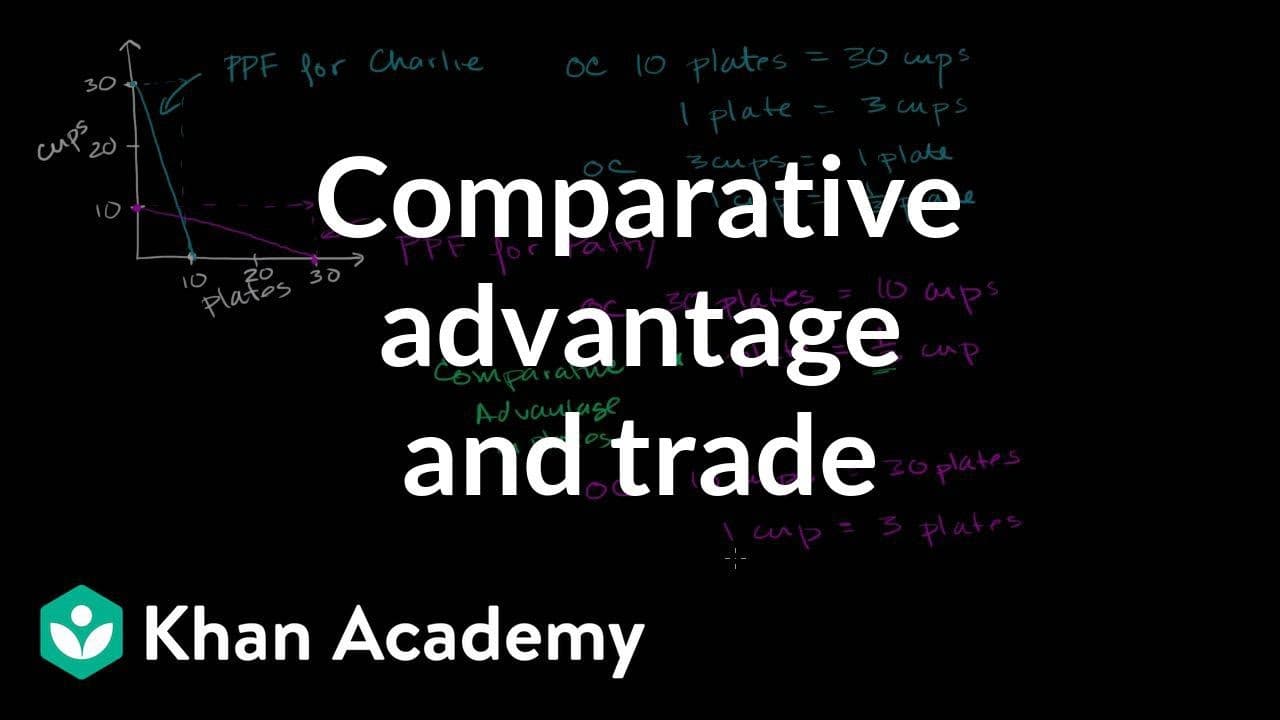
Comparative advantage is when a producer can make a good at a lower opportunity cost than another. In the example of Charlie and Patty, Charlie has a comparative advantage in producing cups, while Patty has it in plates. Specializing in their respective advantages allows them to trade efficiently, leading to greater overall production and economic gains.
Transcript
Let's now move away from the world of the hunter-gatherer and into the dinnerware market. So let's say we're going to talk about two products -- two types of dinnerware. We'll have cups on this axis, and we will have plates on this axis. And let's say we have a producer, Charlie, and if he were to focus all of his time on cups, he could produce - l... Read More
Key Insights
- 😘 Comparative advantage arises when a producer has a lower opportunity cost in producing a certain product.
- 🉐 Specializing in comparative advantage allows for increased production and gains from trade.
- 🖐️ Quantity produced alone does not determine comparative advantage; opportunity cost plays a crucial role.
Install to Summarize YouTube Videos and Get Transcripts
Explore YouTube Video Summarizer or Get YouTube Transcript Extractor
Questions & Answers
Q: What is comparative advantage?
Comparative advantage refers to the situation where a producer has a lower opportunity cost in producing a particular product compared to another producer.
Q: How does opportunity cost affect comparative advantage?
Opportunity cost determines the trade-offs a producer faces when allocating resources. The producer with a lower opportunity cost in producing a certain product has a comparative advantage in that product.
Q: What are the benefits of specializing in comparative advantage?
By specializing in their comparative advantage, producers can achieve higher levels of production and trade with each other to obtain a greater variety of goods and services.
Q: Can comparative advantage be solely based on the quantity produced?
No, comparative advantage is not solely determined by the quantity produced. It depends on the opportunity cost, which takes into account the trade-offs and resources involved in production.
Summary & Key Takeaways
-
The video explains the concept of comparative advantage using the example of two producers, Charlie and Patty, in the dinnerware market.
-
Charlie can produce 30 cups or 10 plates, while Patty can produce 10 cups or 30 plates.
-
Charlie has a comparative advantage in cups, while Patty has a comparative advantage in plates.
Read in Other Languages (beta)
Share This Summary 📚
Summarize YouTube Videos and Get Video Transcripts with 1-Click
Try YouTube Summary with ChatGPT & Claude or YouTube Transcript Generator
Explore More Summaries from Khan Academy 📚



Summarize YouTube Videos and Get Video Transcripts with 1-Click
Try YouTube Summary with ChatGPT & Claude or YouTube Transcript Generator