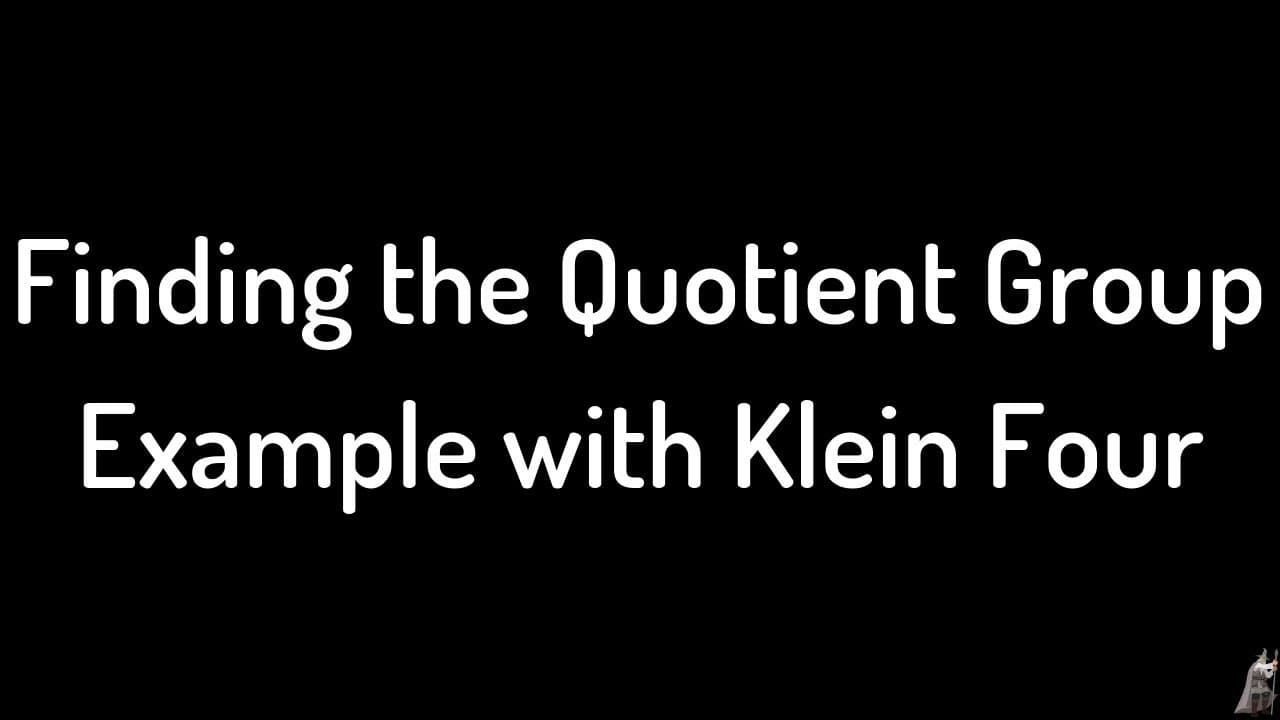
Finding the Elements of the Quotient Group Klein Four-Group Example
TL;DR
Klein Four Group with subgroup analysis, quotient group determination, and cyclic group confirmation.
Transcript
so we have two groups in this problem G is equal to V V here is the climb for group so we can write this as e a B C and I'll explain the multiplication in a second and H is the cyclic subgroup generated by B and we have to answer two questions why is H normal and G and we have to find the quotient group G mod H right because H is normal so this doe... Read More
Key Insights
- 🔙 The Klein Four Group G consists of elements E, A, B, and C with defined multiplication rules.
- 🇧🇦 The cyclic subgroup H, generated by B, contains only elements E and B within the group.
- 😀 H is proven to be normal in G due to the abelian nature of the Klein Four Group.
- 🇧🇦 Determining the quotient group G mod H involves finding the cosets of H, resulting in two cosets.
- 👥 The quotient group G mod H is identified as cyclic, with H A serving as the generator for the group.
- 👥 The powers of the generator H A confirm the cyclic nature of the quotient group.
- 👥 Understanding the structure of the Klein Four Group and its subgroups is fundamental in group theory.
Install to Summarize YouTube Videos and Get Transcripts
Explore YouTube Video Summarizer or Get YouTube Transcript Extractor
Questions & Answers
Q: What is the Klein Four Group and how are its elements defined?
The Klein Four Group is denoted as G with elements E, A, B, and C, where their multiplication rules are defined, showcasing E as the identity element and others as non-identity elements.
Q: Why is the cyclic subgroup H considered normal in the Klein Four Group G?
The Klein Four Group is abelian, making any subgroup normal within it. H, being a subgroup generated by B, is normal as per the definition of abelian groups.
Q: How is the quotient group G mod H determined?
The quotient group G mod H involves finding the cosets of H in G, leading to the identification of two cosets, H and H A, which forms the quotient group of order 2.
Q: Is the quotient group G mod H cyclic, and how is a generator identified?
Yes, the quotient group G mod H is cyclic with H A as the generator, as the powers of H A produce the same two elements, confirming its cyclic nature.
Summary & Key Takeaways
-
The content discusses the Klein Four Group, represented as G with elements E, A, B, C, and their multiplication rules.
-
It explains the cyclic subgroup H generated by element B with only elements E and B.
-
Demonstrates the process of proving H as normal in G, determining the quotient group G mod H, and confirming its cyclic nature with H A as the generator.
Read in Other Languages (beta)
Share This Summary 📚
Summarize YouTube Videos and Get Video Transcripts with 1-Click
Try YouTube Summary with ChatGPT & Claude or YouTube Transcript Generator
Explore More Summaries from The Math Sorcerer 📚


Summarize YouTube Videos and Get Video Transcripts with 1-Click
Try YouTube Summary with ChatGPT & Claude or YouTube Transcript Generator