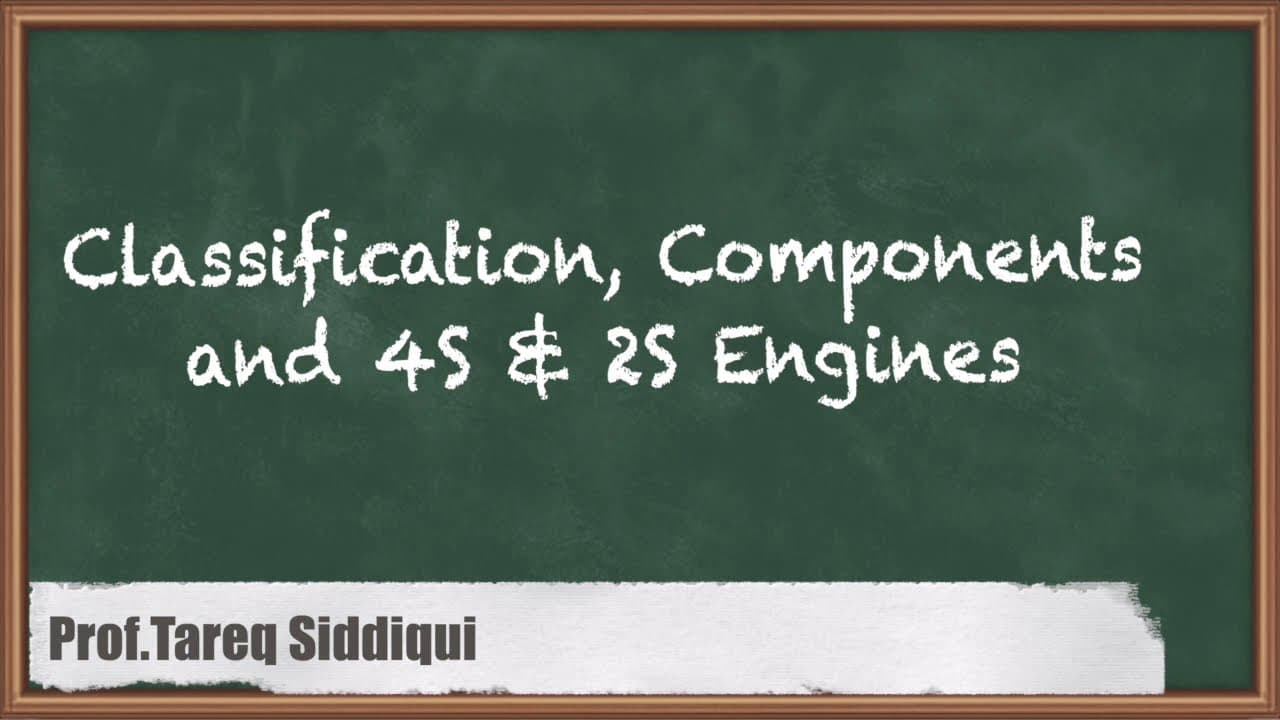
Classification of Internal Combustion Engines - Introduction of Internal Combustion Engines
TL;DR
Learn about the classification of internal combustion engines based on design, working cycle, and ignition methods.
Transcript
hello everyone in this lecture we are going to take introduction of IC engine and in fact we are going to cover certain topics which are classification of an automobile IC engine major engine components and operation of force program two-stroke engine and some differences between the two okay so let us go classification of IC engines the very first... Read More
Key Insights
- 😎 Internal combustion engines can be classified based on design, working cycle, ignition, and cooling methods.
- 🚒 Different engine designs include reciprocating, inline, V, opposite piston, radial, and rotary engines.
- 🏍️ Working cycles can be either two-stroke or four-stroke, determining the number of revolutions needed for all strokes.
- 💖 Ignition methods categorize engines as spark ignition (SI) with spark plugs, or compression ignition (CI) relying on compression for combustion.
- 🥵 Cooling methods vary from air-cooling with fins to water-cooling with jackets for higher heat dissipation in engines.
- 🚒 Applications of IC engines range from cars, buses, and trucks to mopeds, outboard motors, lawnmowers, and marine engines.
Install to Summarize YouTube Videos and Get Transcripts
Explore YouTube Video Summarizer or Get YouTube Transcript Extractor
Questions & Answers
Q: What are the basic classifications of internal combustion engines?
The basic classifications include reciprocating, inline, V, opposite piston, and radial engines based on design.
Q: How do two-stroke and four-stroke engines differ in their working cycles?
Two-stroke engines complete all four strokes (intake, compression, power, and exhaust) in a single revolution, while four-stroke engines complete them in two revolutions of the crankshaft.
Q: What are the key differences between spark ignition (SI) and compression ignition (CI) engines?
SI engines use spark plugs to ignite the air-fuel mixture externally, while CI engines rely on compression to ignite the fuel internally without spark plugs.
Q: How do air-cooled, water-cooled, and oil-cooled engines differ in terms of cooling methods?
Air-cooled engines use fins to dissipate heat, while water-cooled engines circulate coolant around the engine, and oil-cooled engines use oil jackets for cooling.
Summary & Key Takeaways
-
Classification of IC engines based on design include reciprocating, inline, V, opposite piston, and radial engines.
-
Working cycle classification includes two-stroke and four-stroke engines.
-
Ignition method classification covers spark ignition (SI) and compression ignition (CI) engines, with details on cooling methods.
Read in Other Languages (beta)
Share This Summary 📚
Summarize YouTube Videos and Get Video Transcripts with 1-Click
Try YouTube Summary with ChatGPT & Claude or YouTube Transcript Generator
Explore More Summaries from Ekeeda 📚





Summarize YouTube Videos and Get Video Transcripts with 1-Click
Try YouTube Summary with ChatGPT & Claude or YouTube Transcript Generator