How Do Period, Frequency, and Angular Velocity Relate?
TL;DR
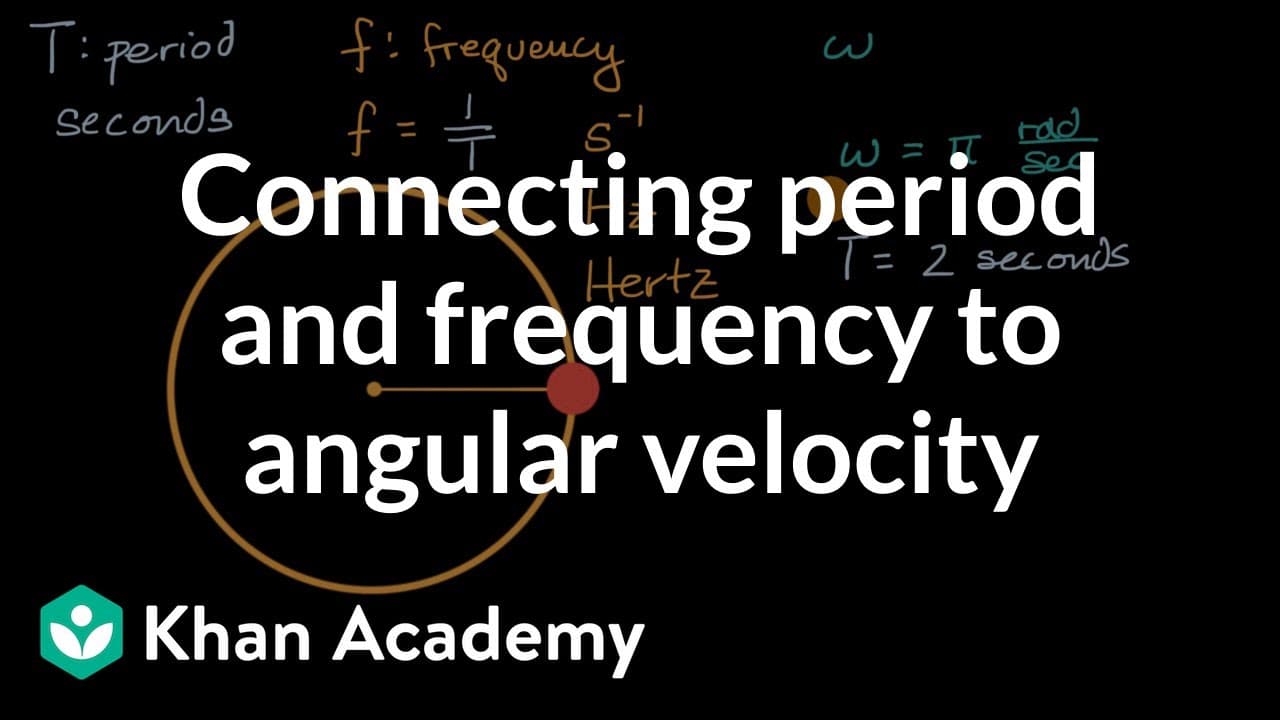
Period measures the time for a single cycle in uniform circular motion, while frequency indicates how many cycles occur per second, being the inverse of the period. Angular velocity describes the rotation rate and connects these two concepts, with frequency often expressed in hertz (Hz).
Transcript
- [Instructor] What we're going to do in this video is continue talking about uniform circular motion. And in that context, we're gonna talk about the idea of period, which we denote with a capital T, or we tend to denote with a capital T, and a very related idea. And that's of frequency, which we typically denote with a lower case f. So you might ... Read More
Key Insights
- 🏍️ Period represents the time for one complete cycle in uniform circular motion and is measured in seconds.
- 🏍️ Frequency is the number of cycles an object can complete in a second and is the reciprocal of the period.
- ☠️ Angular velocity is the rate at which an object rotates and is connected to the magnitude of the period and frequency.
- 🤨 The period is calculated by dividing two pi radians by the angular velocity.
- 🥡 The frequency can be found by taking the reciprocal of the period.
- 🥋 In uniform circular motion, the period and frequency have an inverse relationship.
- 🏍️ The unit of frequency is often represented as hertz (Hz) or cycles per second.
Install to Summarize YouTube Videos and Get Transcripts
Explore YouTube Video Summarizer or Get YouTube Transcript Extractor
Questions & Answers
Q: What is period in uniform circular motion?
Period refers to the time it takes for an object to complete one full cycle in uniform circular motion. It is measured in seconds and represents how long it takes to go around once.
Q: How is frequency related to period in uniform circular motion?
Frequency is the reciprocal of the period, meaning it represents the number of cycles an object can complete in one second. It is often measured in hertz (Hz) or cycles per second.
Q: How is the concept of angular velocity connected to period and frequency?
Angular velocity is the measure of how fast an object rotates around a fixed axis. The magnitude of angular velocity is related to the period and frequency, as it determines how quickly an object goes through its cycles.
Q: What is the formula that connects period and angular velocity?
The period is equal to two pi radians divided by the magnitude of the angular velocity. This formula shows that a larger angular velocity will result in a smaller period, as the object completes cycles more quickly.
Summary & Key Takeaways
-
Period represents the time it takes for an object in uniform circular motion to complete one cycle or revolution.
-
Frequency is the number of cycles an object can complete in one second and is the reciprocal of the period.
-
Angular velocity is the rate at which an object rotates around a fixed axis and is closely related to the magnitude of the period and frequency.
Read in Other Languages (beta)
Share This Summary 📚
Summarize YouTube Videos and Get Video Transcripts with 1-Click
Try YouTube Summary with ChatGPT & Claude or YouTube Transcript Generator
Explore More Summaries from Khan Academy 📚



Summarize YouTube Videos and Get Video Transcripts with 1-Click
Try YouTube Summary with ChatGPT & Claude or YouTube Transcript Generator