What JavaScript Concepts Should Junior Developers Know for Interviews?
TL;DR
Junior developers should master key JavaScript concepts such as variable types (var, let, const), hoisting, closures, and the differences between classes and objects. Understanding promises and the principles of mutability versus immutability is crucial for effective coding. Familiarity with cookies, caching, and client-side storage options like local and session storage is also essential for modern web development and interview success.
Transcript
okay so someone on my Discord sent me a list of questions he was asked in an actual interview he was doing for a junior position for a react front and roll I believe but anyway let's just kind of go through these and I think just understanding how to answer some of these things will just overall make you a better developer in terms of JavaScript an... Read More
Key Insights
- 💌 Understanding the differences between variable types in JavaScript (var, let, const) is crucial for writing robust code and avoiding scope-related errors.
- 👻 Hoisting allows functions and variables to be used before their declaration, improving code organization and preventing reference errors.
- 👨💻 Closures enable encapsulation of variables and functions, essential for creating private state and modular code structures.
- 🈸 The distinction between mutable and immutable variables can impact application state management, particularly in frameworks like React.
- 👨💻 Promises simplify asynchronous programming in JavaScript, offering a cleaner alternative to callback functions and enhancing code readability.
- 👤 Cookies serve as a mechanism for session management and user state persistence, requiring careful security considerations to protect user data.
- 👤 Local storage and session storage provide different persistence levels for client-side data, impacting user experience and data management strategies.
Install to Summarize YouTube Videos and Get Transcripts
Explore YouTube Video Summarizer or Get YouTube Transcript Extractor
Questions & Answers
Q: What are the main differences between var, let, and const in JavaScript?
In JavaScript, var is function-scoped and can be redeclared and reassigned; it is also subject to hoisting, meaning it can be used before its declaration. let is block-scoped, meaning it is only accessible within the block in which it is defined and can also be reassigned but cannot be redeclared in the same scope. const, like let, is block-scoped but cannot be reassigned after its initial declaration, making it suitable for variables that should remain constant throughout their lifecycle.
Q: Can you explain hoisting and its significance in JavaScript?
Hoisting in JavaScript is a mechanism where variable and function declarations are moved to the top of their containing scope during the compilation phase. This allows functions to be called before they are defined in the code, preventing errors related to referencing undeclared variables. Understanding hoisting helps developers avoid confusion with the order of execution in their code and leads to better structuring of functions and variables.
Q: What is the concept of closures in JavaScript?
A closure in JavaScript refers to a function that retains access to its lexical scope, even when the function is executed outside that scope. This means that inner functions can access variables of outer functions even after the outer function has completed execution. Closures are commonly used to create private variables and encapsulate functionality, making them a powerful feature in JavaScript programming.
Q: What is the difference between mutable and immutable variables?
Mutable variables can be changed or updated after their initial assignment, while immutable variables cannot be altered once defined. In JavaScript, primitive types like numbers and strings are immutable, whereas objects and arrays are mutable. To ensure immutability in JavaScript, developers often use const or methods like Object.freeze() to prevent unintentional modifications to objects and promote predictable state management, particularly in frameworks like React.
Q: How do promises work in JavaScript?
Promises in JavaScript are objects that represent the eventual completion (or failure) of an asynchronous operation and its resulting value. A promise can be in one of three states: pending, fulfilled, or rejected. Promises allow developers to attach handlers using .then() for successful resolutions and .catch() for handling errors, making asynchronous code easier to manage and read compared to traditional callback methods.
Q: What are cookies, and how are they used in web development?
Cookies are small pieces of data stored on the user's browser that are sent to the server with HTTP requests. They are used to persist user sessions, store user preferences, and track user behavior across different sessions. Properly configured secure cookies can help maintain user authentication and state, but developers must be cautious of security vulnerabilities, such as Cross-Site Request Forgery (CSRF), by implementing secure cookie practices.
Q: What is the difference between local storage and session storage?
Local storage and session storage are both part of the Web Storage API, but they serve different purposes. Local storage persists data even after the browser is closed and reopened, allowing permanent storage of user settings or preferences. Session storage, on the other hand, is temporary and only lasts for the duration of a page session; it is cleared when the tab or window is closed. Local storage is ideal for long-term data, while session storage is suited for ephemeral data needs.
Q: How do HTTP methods differ in a RESTful API?
In a RESTful API, various HTTP methods are used to perform operations on resources. The most common methods are GET (to retrieve data), POST (to create new resources), PUT (to update existing resources completely), PATCH (to partially update resources), and DELETE (to remove resources). Each method defines a specific interaction with the resource, adhering to standard conventions that make REST APIs predictable and easier to use.
Summary & Key Takeaways
-
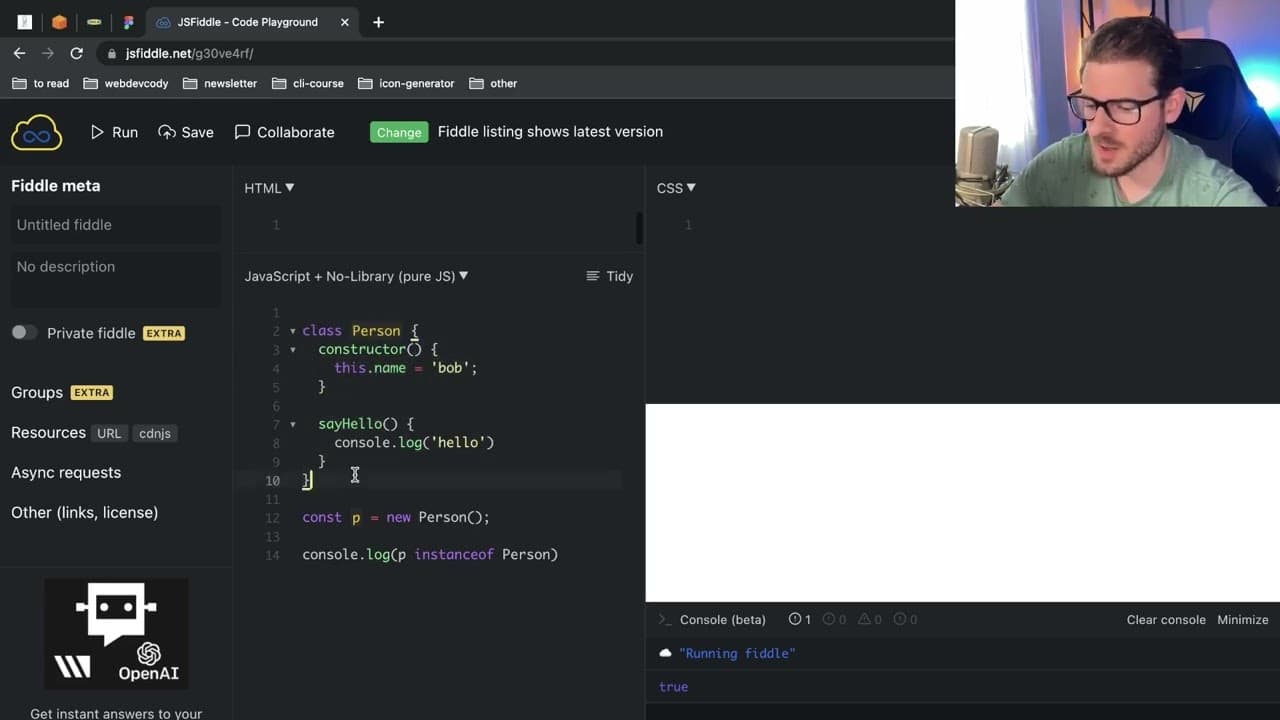
The content provides insight into essential JavaScript concepts such as variable types, hoisting, object prototypes, and the differences between classes and objects, which are pivotal for junior developers.
-
Key distinctions between
var,let, andconstare explained, with a focus on scope and reassignment, emphasizing best practices in modern JavaScript development. -
The discussion also covers asynchronous programming with promises, mutability versus immutability, closures, and the role of cookies and caching in web development, providing a solid foundation for interview preparation.
Read in Other Languages (beta)
Share This Summary 📚
Summarize YouTube Videos and Get Video Transcripts with 1-Click
Try YouTube Summary with ChatGPT & Claude or YouTube Transcript Generator
Explore More Summaries from Web Dev Cody 📚




Summarize YouTube Videos and Get Video Transcripts with 1-Click
Try YouTube Summary with ChatGPT & Claude or YouTube Transcript Generator