Minimum Number of Days to Make m Bouquets
TL;DR
The content discusses calculating days needed for bouquet creation and managing unique integers after removals.
Transcript
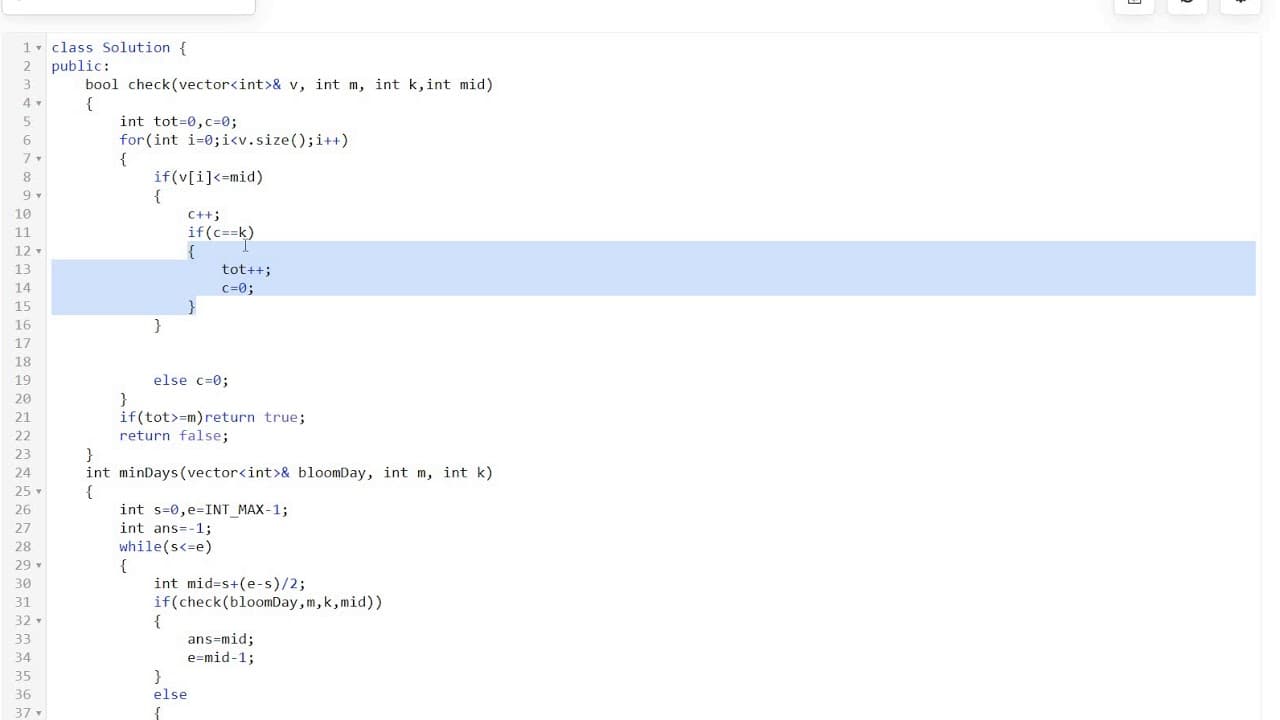
hello everyone welcome back to decoding trivia solving minimum number of days to make em Buki we are given an array bloom D and an integer M and another integer K now we need to make M Buki to make up okay you need to use K Edison flowers from the garden the garden consists of n flowers the ia flower will bloom in a certain number of days and the c... Read More
Key Insights
- 💐 Understanding the constraints of consecutive flowers is vital for solving bouquet-related problems effectively.
- 👨🔬 Binary search can be a powerful technique for optimizing search problems within a defined range of possible values.
- 😒 The use of frequency maps is essential in managing collections of items, especially in cases where removal needs to be strategic.
- ❓ The problem of managing unique integers highlights the importance of element frequency in determining which items to prioritize for removal.
- 👨🔬 The overall efficiency of solutions can often be improved by combining techniques such as search algorithms and data frequency analysis.
- 🍵 Handling scenarios with specific removal constraints requires clear understanding and strategic decision-making to achieve desired results.
- 🦻 Implementing boolean checks and reinitializing counters aids in maintaining accurate condition evaluations during algorithm execution.
Install to Summarize YouTube Videos and Get Transcripts
Explore YouTube Video Summarizer or Get YouTube Transcript Extractor
Questions & Answers
Q: What is the core problem presented in the video?
The primary problem is to determine the minimum number of days necessary to create a specified number of bouquets from a garden of flowers, each with specific blooming days. Additionally, it addresses reducing unique integers after a given number of removals from an integer array.
Q: How is the minimum number of days for bouquets calculated?
The calculation involves using a binary search method to find the optimal waiting period (mid) where the total number of bouquets formed meets or exceeds the target number. A helper function is used to check if enough bouquets can be made within those days by counting consecutive bloomed flowers.
Q: Why is frequency important in reducing unique integers after K removals?
Frequency is crucial because the algorithm prioritizes removing elements that appear least frequently, thereby maximizing the retention of elements with higher frequency. This strategy minimizes the total number of unique integers remaining after K removals, ensuring that most common elements stay intact.
Q: What is the time complexity of the bouquet solution?
The overall time complexity of the bouquet solution is a combination of log N for the binary search portion and O(M log M) for the checking function, where M represents the maximum day range across flower blooms. This results in an efficient approach to finding the required days.
Summary & Key Takeaways
-
The video explains how to determine the minimum days required to produce a specified number of bouquets using bloomed flowers while considering the constraints of consecutive flowers needed.
-
It introduces a binary search strategy combined with a frequency map to minimize unique integers after a specific number of removals from a set of integers.
-
The solutions involve using verification functions to ensure that specified requirements are met and optimizing processes for efficiency in both problem-solving scenarios.
Read in Other Languages (beta)
Share This Summary 📚
Summarize YouTube Videos and Get Video Transcripts with 1-Click
Try YouTube Summary with ChatGPT & Claude or YouTube Transcript Generator
Explore More Summaries from Fraz 📚


Summarize YouTube Videos and Get Video Transcripts with 1-Click
Try YouTube Summary with ChatGPT & Claude or YouTube Transcript Generator