Thermit Welding - Welding Process - Production Process 1
TL;DR
Learn about thermit welding, a process using a chemical reaction to fuse large structures without electrical supply.
Transcript
click the bell icon to get latest videos from Ekeeda Hello friends today we are going to see a different welding process which is known as thermit welding it requires some chemicals heat and the welding is done and how it is done we're gonna see in detail so in thermit welding process fusion is required sohow fusion is done by using exothermic reac... Read More
Key Insights
- ♻️ Thermit welding involves fusion and exothermic reactions using a mixture of aluminum and iron oxide.
- 🌥️ Large structures can be joined without requiring electricity, making it useful for repairs in various industries.
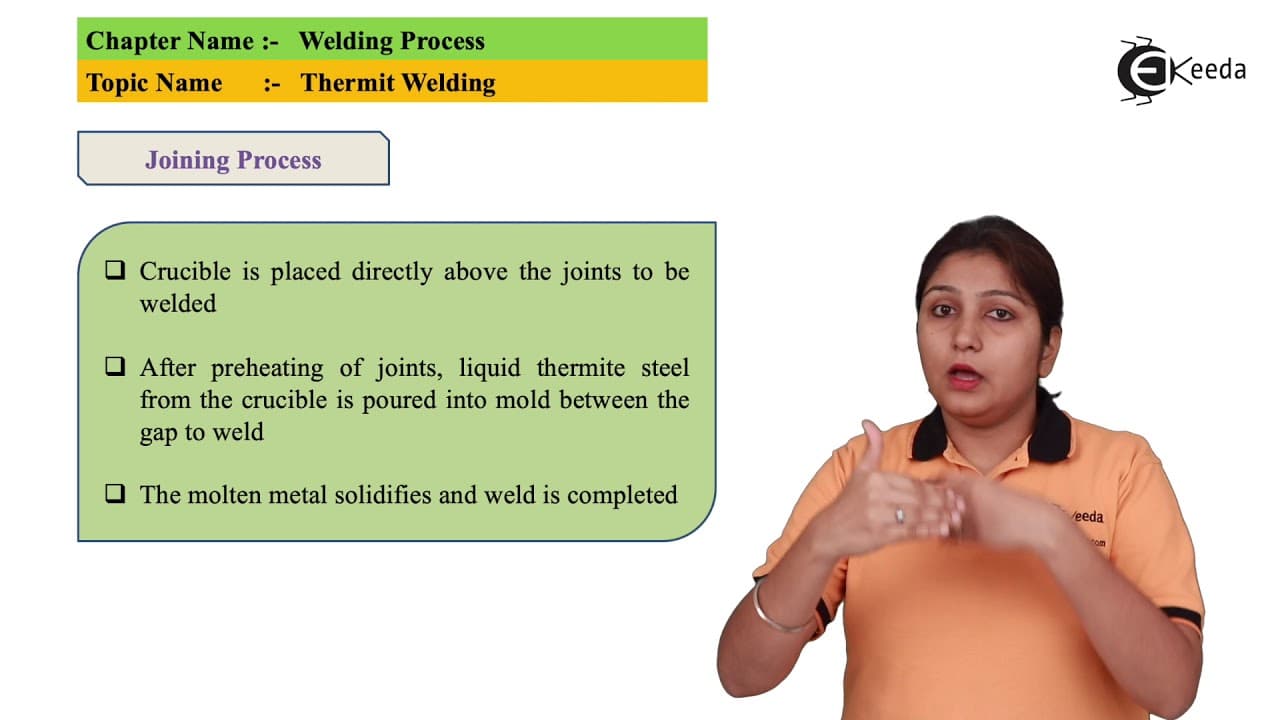
- 🫗 The process includes filling gaps with wax, pouring superheated liquid, and allowing it to solidify.
- 🤘 Thermit welding is versatile and can be used to join non-ferrous metals as well.
- ♻️ The composition of the thermit mixture is 75% iron oxide and 25% aluminum oxide.
- 🫠 The process involves ignition, melting, pouring, solidifying, and casting stages.
- 🛤️ Advantages include its ability to repair voids or cracks in structures like railway tracks.
Install to Summarize YouTube Videos and Get Transcripts
Explore YouTube Video Summarizer or Get YouTube Transcript Extractor
Questions & Answers
Q: What is thermit welding and how does it differ from other welding processes?
Thermit welding uses an exothermic reaction involving aluminum and iron oxide, while other welding processes may require electrical supply. It is ideal for joining large structures without electricity.
Q: How is the thermit welding process initiated, and what is the composition of the thermit mixture?
The thermit mixture, consisting of aluminum oxide (75%) and iron oxide (25%), is ignited in a crucible to produce superheated liquid. This liquid is then poured into the object to be welded for fusion.
Q: What are the advantages and disadvantages of thermit welding?
Thermit welding allows for the joining of large structures without an electrical supply, such as repairing railway tracks. However, the process can be time-consuming due to the solidification stage.
Q: What are the applications of thermit welding in various industries?
Thermit welding can be used in repairing railway tracks, joining pipes, and other objects, as well as in working with non-ferrous metals.
Summary & Key Takeaways
-
Thermit welding is a process involving fusion and exothermic reactions using a mixture of aluminum and iron oxide.
-
The process involves filling gaps with wax, pouring superheated liquid into the object to be welded, and allowing it to solidify.
-
Advantages include joining large structures without electrical supply, as seen in railway track repairs, and can be used on non-ferrous metals.
Read in Other Languages (beta)
Share This Summary 📚
Summarize YouTube Videos and Get Video Transcripts with 1-Click
Try YouTube Summary with ChatGPT & Claude or YouTube Transcript Generator
Explore More Summaries from Ekeeda 📚





Summarize YouTube Videos and Get Video Transcripts with 1-Click
Try YouTube Summary with ChatGPT & Claude or YouTube Transcript Generator