Shop Like a Pro in Portugal 🇵🇹
TL;DR
Learn essential Portuguese shopping vocabulary and packaging terms.
Transcript
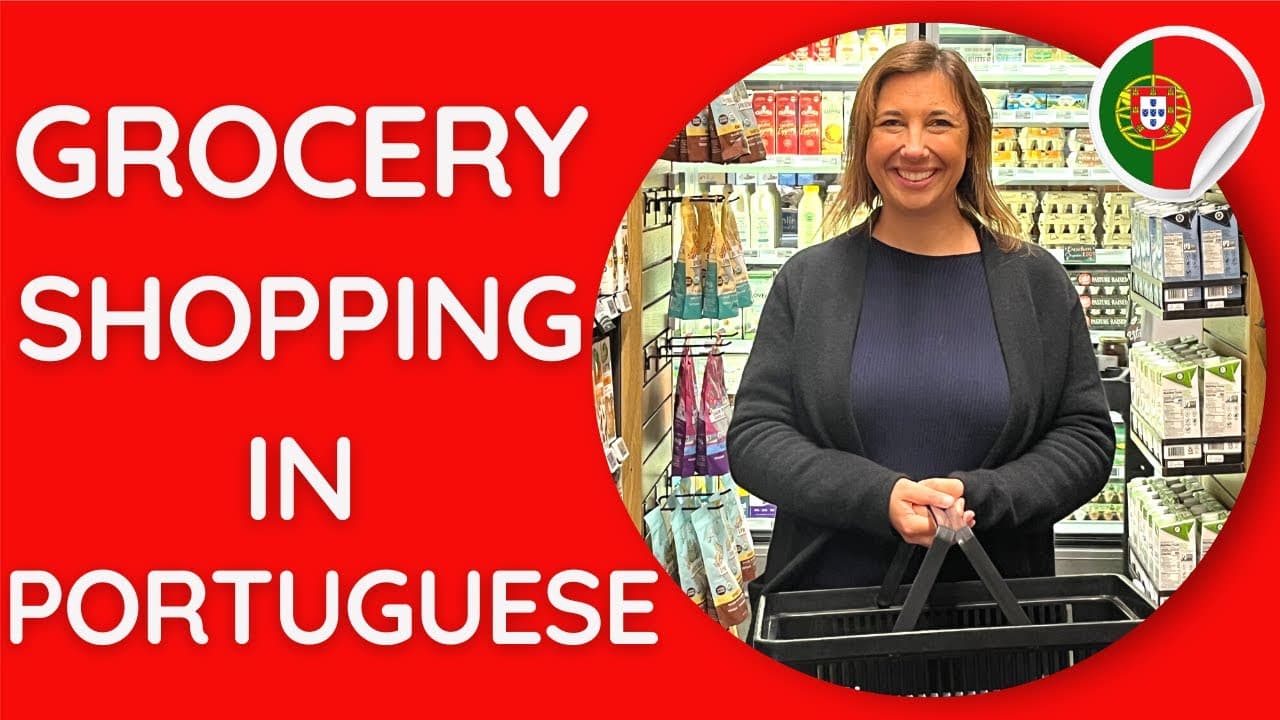
Olá a todos! Shopping seems like a very simple activity when all we need to do is grab a package of something from the shelf (prateleira) and put it in the cart (carrinho). Let me walk you through a list of essential vocabulary used when shopping, focusing on types of packaging or ways to buy or order food at a market. If you are learning Portugues... Read More
Key Insights
- The Portuguese words 'mercado' and 'supermercado' have distinct meanings, unlike their English counterparts. 'Mercado' refers to a farmers market, while 'supermercado' means a grocery store.
- In Portuguese, the word 'pacote' is commonly used for various packaged goods, such as pasta, rice, and milk, and is more frequently used than 'package' in English.
- Items like matches, strawberries, and chocolate bonbons are typically sold in 'caixas' (boxes), while 'saco' (bag) is used for pre-weighed items like potatoes and carrots.
- Liquid or preserved items are often sold in 'frasco' (jars), which should not be confused with 'jarro,' meaning a water pitcher. Examples include jars of jam and honey.
- Canned goods, such as sardines and beans, are referred to as 'lata' in Portuguese, while bottled liquids like olive oil and wine are called 'garrafa.'
- The term 'embalagem' is used for various packaging types, including shampoo and toilet paper, similar to 'packet' or 'container' in English.
- For items like eggs, Portuguese uses 'dúzia' (dozen) and 'meia-dúzia' (half-dozen), while weight measurements like 'quilo' (kilogram) and 'gramas' (grams) are used for fruits and cold meats.
- Portuguese uses specific terms for quantities, such as 'fatia' (slice) for cake and pizza, 'mão-cheia' (handful) for snacks, and 'cacho' (bunch) for bananas and grapes.
Install to Summarize YouTube Videos and Get Transcripts
Explore YouTube Video Summarizer or Get YouTube Transcript Extractor
Questions & Answers
Q: What is the difference between 'mercado' and 'supermercado' in Portuguese?
In Portuguese, 'mercado' refers to a farmers market, which is a place where fresh produce and local goods are sold directly by vendors. 'Supermercado,' on the other hand, is equivalent to a grocery store, where a wide range of packaged and processed foods are available. This distinction is important for Portuguese learners to understand cultural and linguistic nuances.
Q: How is the word 'pacote' used in Portuguese shopping vocabulary?
The word 'pacote' in Portuguese is commonly used to refer to various types of packaged goods. It is more frequently used than its English counterpart 'package.' Examples include 'um pacote de massa' (a package of pasta) and 'um pacote de manteiga' (a package of butter). This term helps differentiate similar items, such as distinguishing between 'batatas fritas' (French fries) and 'batatas fritas de pacote' (chips).
Q: What are some examples of items sold in 'caixas' in Portugal?
In Portugal, items such as matches ('fósforos'), strawberries ('morangos'), and chocolate bonbons ('bombons') are typically sold in 'caixas,' which means boxes. This term is used to describe the packaging for these products, providing clarity when shopping. Understanding the use of 'caixa' helps learners navigate Portuguese markets and grocery stores more effectively.
Q: What is the significance of the term 'frasco' in Portuguese shopping?
The term 'frasco' in Portuguese refers to jars, which are glass containers with lids used for packaging liquid or preserved items. Examples include 'um frasco de compota' (a jar of jam) or 'um frasco de mel' (a jar of honey). It is important not to confuse 'frasco' with 'jarro,' which means a water pitcher. Knowing the correct term ensures accurate communication when purchasing these items.
Q: How do Portuguese speakers refer to canned goods?
In Portuguese, canned goods are referred to as 'lata.' This term is used for metal containers that hold preserved foods, such as 'uma lata de sardinhas' (a can of sardines) or 'uma lata de feijão' (a can of beans). Understanding this vocabulary is essential for learners to effectively shop for canned products in Portuguese-speaking regions.
Q: What does 'embalagem' mean in the context of Portuguese shopping?
The word 'embalagem' in Portuguese encompasses various types of packaging, including packets, containers, and bottles. It is a generic term used for products like shampoo ('champô'), conditioner ('amaciador'), and toilet paper ('papel higiénico'). Recognizing 'embalagem' helps learners identify different packaging types and enhances their shopping experience in Portuguese-speaking areas.
Q: How do Portuguese speakers express quantities like 'dozen' and 'half-dozen'?
In Portuguese, quantities like 'dozen' and 'half-dozen' are expressed as 'dúzia' and 'meia-dúzia,' respectively. These terms are commonly used for items such as eggs, where one might purchase 'uma dúzia de ovos' (a dozen eggs) or 'meia-dúzia de ovos' (half a dozen eggs). Familiarity with these expressions aids in accurate communication during shopping.
Q: What are some specific terms for quantities in Portuguese shopping vocabulary?
Portuguese shopping vocabulary includes specific terms for various quantities. 'Fatia' refers to a slice, used for items like cake or pizza. 'Mão-cheia' means a handful, applicable to snacks or small items. 'Cacho' denotes a bunch, used for fruits like bananas or grapes. These terms help learners specify quantities accurately when shopping in Portuguese-speaking environments.
Summary & Key Takeaways
-
The video explains essential Portuguese vocabulary related to shopping, focusing on packaging and ordering food at markets. It highlights the differences between 'mercado' and 'supermercado' and provides examples of how to use terms like 'pacote,' 'caixa,' 'saco,' and more.
-
Viewers learn the significance of packaging terms in Portuguese, including 'frasco' for jars, 'lata' for cans, and 'garrafa' for bottles. The video emphasizes the importance of understanding these terms for effective communication while shopping in Portugal.
-
The content encourages learners to practice writing shopping lists using the newly acquired vocabulary, enhancing their language skills. The video also promotes additional resources and support available through Patreon and social media platforms.
Read in Other Languages (beta)
Share This Summary 📚
Summarize YouTube Videos and Get Video Transcripts with 1-Click
Try YouTube Summary with ChatGPT & Claude or YouTube Transcript Generator
Explore More Summaries from Learn European Portuguese Online 📚

Summarize YouTube Videos and Get Video Transcripts with 1-Click
Try YouTube Summary with ChatGPT & Claude or YouTube Transcript Generator