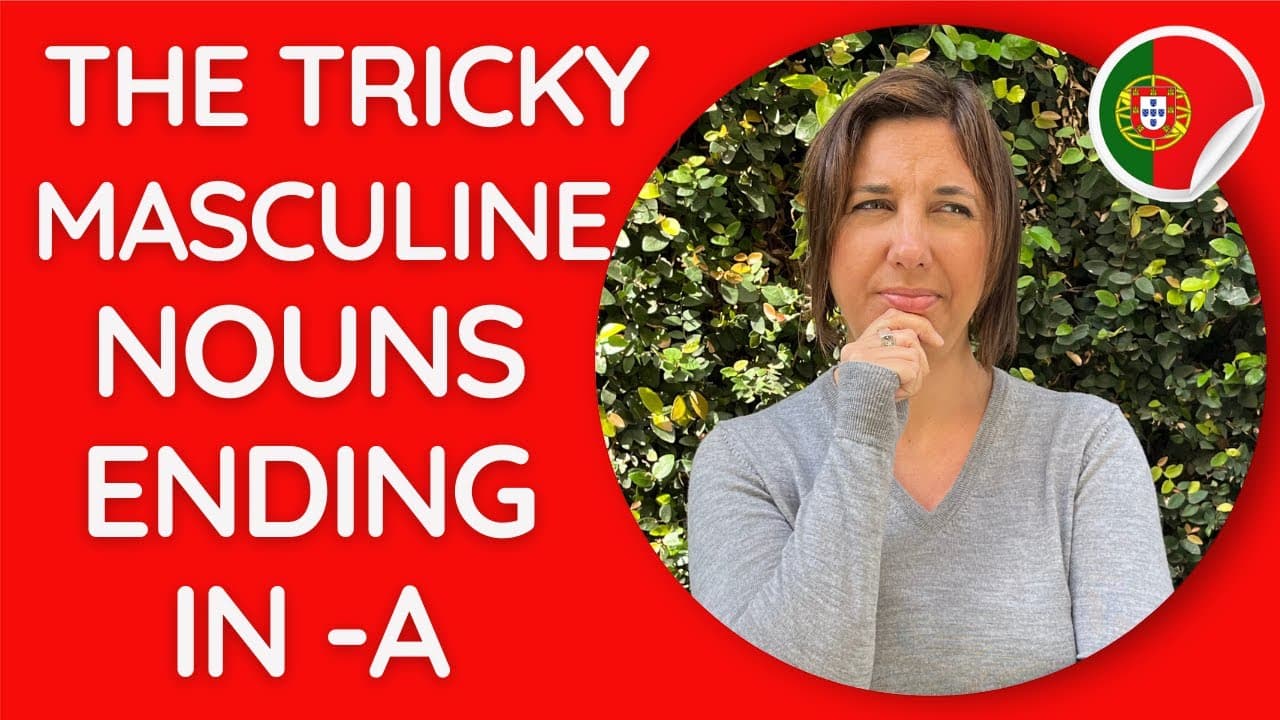
Tips to Help You Identify Portuguese Masculine Nouns Ending in -a
TL;DR
Learn to identify tricky masculine nouns ending in -a in Portuguese.
Transcript
For most students that are learning Portuguese, knowing the gender of nouns is one of the most difficult things in the learning process. It all begins with understanding that every noun has a masculine or a feminine gender. How about those particularly challenging words that end with an -a and are masculine? As you can see there is always an ex... Read More
Key Insights
- Portuguese nouns have genders, often derived from their Latin origins, but external influences have created exceptions.
- Nouns of Greek origin ending in -ama, -ema, -ima, and -oma are masculine, despite ending in -a.
- Non-Latin words ending in -a with an acute accent, like 'o sofá' and 'o chá', are masculine.
- Professional titles ending in -ista can be masculine or feminine, depending on the article used.
- Astronomy-related Greek words ending in -eta are masculine, as are some Italian-derived words.
- The word 'dia' is a commonly used masculine noun ending in -a, contrasting with feminine 'tarde' and 'noite'.
- Understanding noun gender is crucial for mastering Portuguese, requiring memorization and practice.
- The video offers resources for further learning, including a Patreon page and social media channels.
Install to Summarize YouTube Videos and Get Transcripts
Explore YouTube Video Summarizer or Get YouTube Transcript Extractor
Questions & Answers
Q: Why do some Portuguese nouns ending in -a have masculine gender?
Some Portuguese nouns ending in -a are masculine due to their etymological origins. Words of Greek origin, for example, often retain their original gender when borrowed into Portuguese, leading to exceptions in gender rules. Additionally, external influences from languages like Arabic and Mandarin contribute to these gender anomalies.
Q: What are some examples of Greek-origin masculine nouns ending in -a?
Examples of Greek-origin masculine nouns ending in -a include words with suffixes like -ama, -ema, -ima, and -oma. These suffixes often appear in scientific or technical terms that have been borrowed into Portuguese, maintaining their masculine gender despite ending in -a, such as 'o clima' (the climate).
Q: How do professional titles ending in -ista work in Portuguese?
Professional titles ending in -ista in Portuguese can be either masculine or feminine. The gender is determined by the article preceding the noun, rather than changing the noun itself. For example, 'o turista' refers to a male tourist, while 'a turista' refers to a female tourist, with the article indicating the gender.
Q: What role do non-Latin languages play in Portuguese noun gender?
Non-Latin languages have introduced words into Portuguese that do not follow typical gender rules. For instance, words borrowed from Arabic or Mandarin, like 'o sofá' and 'o chá', are masculine despite ending in -a. These influences create exceptions that learners must memorize to understand Portuguese noun gender accurately.
Q: Why is the word 'dia' an important example in Portuguese?
The word 'dia' is an important example of a masculine noun ending in -a, which contrasts with other time-related words like 'tarde' and 'noite' that are feminine. Understanding 'dia' helps learners grasp the concept of gender exceptions in Portuguese, as it is commonly used in greetings like 'Bom Dia' (Good Morning).
Q: How can learners practice identifying masculine nouns ending in -a?
Learners can practice identifying masculine nouns ending in -a by using them in sentences and paying attention to context. Writing exercises, flashcards, and engaging with native speakers can reinforce memorization. The video also suggests using additional resources like Patreon content and social media posts for practice.
Q: What resources does the video offer for further learning?
The video offers several resources for further learning, including a Patreon page with exclusive content, social media platforms for creative posts, and links to an online store for additional materials. These resources aim to support learners in mastering European Portuguese by providing diverse and engaging content.
Q: How does the video address common mistakes in learning Portuguese?
The video addresses common mistakes in learning Portuguese by highlighting the importance of understanding noun gender, particularly the exceptions to typical rules. It advises learners to memorize specific masculine nouns ending in -a and provides examples to clarify these concepts, helping to prevent confusion and errors in language use.
Summary & Key Takeaways
-
The video addresses the challenge of identifying masculine nouns in Portuguese that end in -a, often a source of confusion for learners. It explains that these exceptions are usually due to the words' origins, such as Greek or non-Latin languages, which influence their gender.
-
Key categories of masculine nouns ending in -a include those of Greek origin, words with an acute accent, and professional titles ending in -ista. The video provides examples of each, helping learners to memorize and apply these rules in practice.
-
The presenter emphasizes the importance of understanding noun gender in Portuguese, offering additional resources for learners through a Patreon page and social media platforms. The video concludes with encouragement for viewers to practice using these nouns in sentences.
Read in Other Languages (beta)
Share This Summary 📚
Summarize YouTube Videos and Get Video Transcripts with 1-Click
Try YouTube Summary with ChatGPT & Claude or YouTube Transcript Generator
Explore More Summaries from Learn European Portuguese Online 📚



Summarize YouTube Videos and Get Video Transcripts with 1-Click
Try YouTube Summary with ChatGPT & Claude or YouTube Transcript Generator