Lorentz transformation derivation part 3 | Special relativity | Physics | Khan Academy
TL;DR
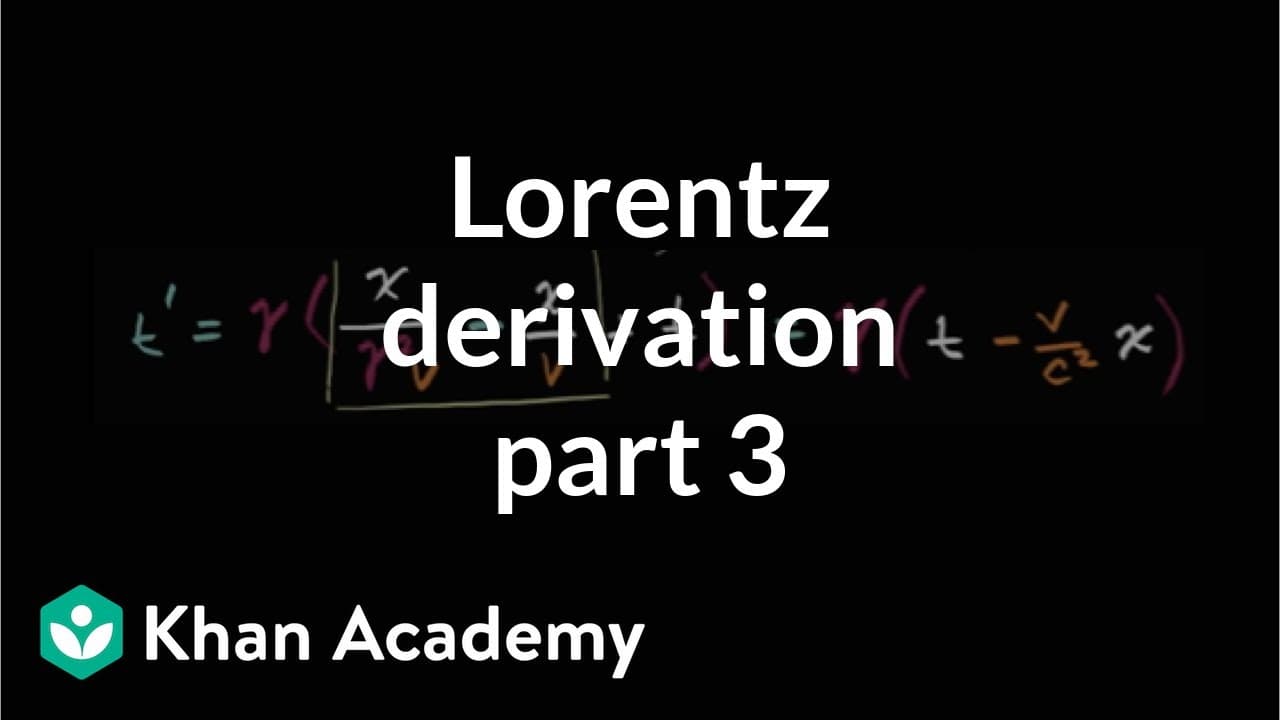
The video explains the process of solving for t prime in the Lorentz Transformation, which involves substituting variables and simplifying algebraic expressions.
Transcript
- [Voiceover] We've made some good progress in our derivation of parts of the Lorentz transformation. We've been able to express x prime in terms of our Lorentz factor and x and v and t. And we've been able to switch things around and represent x in terms of the Lorentz factor and x prime and v and t prime. And we were able to solve for the Lorentz... Read More
Key Insights
- ⌛ Solving for t prime is the final step in completing the Lorentz Transformation and expressing time in terms of space and time.
- 😃 Algebraic operations, such as substitution and rearrangement, are used to manipulate the equations and derive the final expression for t prime.
- 🧑🏭 The simplification of the equation involves canceling terms, factoring out a gamma, and multiplying by the reciprocal.
Install to Summarize YouTube Videos and Get Transcripts
Explore YouTube Video Summarizer or Get YouTube Transcript Extractor
Questions & Answers
Q: What is the purpose of solving for t prime in the Lorentz Transformation?
Solving for t prime allows us to complete the full transformation, providing a way to express time in terms of x and t. It is an essential step in understanding space-time relationships in special relativity.
Q: How is t prime derived in the video?
The video starts with an equation involving x prime, x, v, and t. By rearranging and substituting x prime with a given expression, the equation is manipulated algebraically to solve for t prime.
Q: What steps are involved in solving for t prime?
The steps include dividing both sides of the equation by the Lorentz factor, rearranging the equation to isolate t prime, substituting x prime with the given expression, and simplifying the resulting equation using algebraic operations.
Q: Why is it necessary to factor out a gamma in the derived equation for t prime?
Factoring out a gamma makes the equation simpler by allowing for the cancellation of terms. It helps in obtaining a final expression for t prime using simplified terms.
Summary & Key Takeaways
-
The video focuses on solving for t prime in the Lorentz Transformation by substituting variables and rearranging equations.
-
The initial equation is divided by the Lorentz factor and rearranged to solve for t prime.
-
Substituting x prime with a given expression, the equation is simplified using algebraic operations.
-
The final result is derived as t prime = gamma times t minus v over c squared times x.
Read in Other Languages (beta)
Share This Summary 📚
Summarize YouTube Videos and Get Video Transcripts with 1-Click
Try YouTube Summary with ChatGPT & Claude or YouTube Transcript Generator
Explore More Summaries from Khan Academy 📚



Summarize YouTube Videos and Get Video Transcripts with 1-Click
Try YouTube Summary with ChatGPT & Claude or YouTube Transcript Generator