What Is Young's Double Slit Experiment and Its Key Equations?
TL;DR
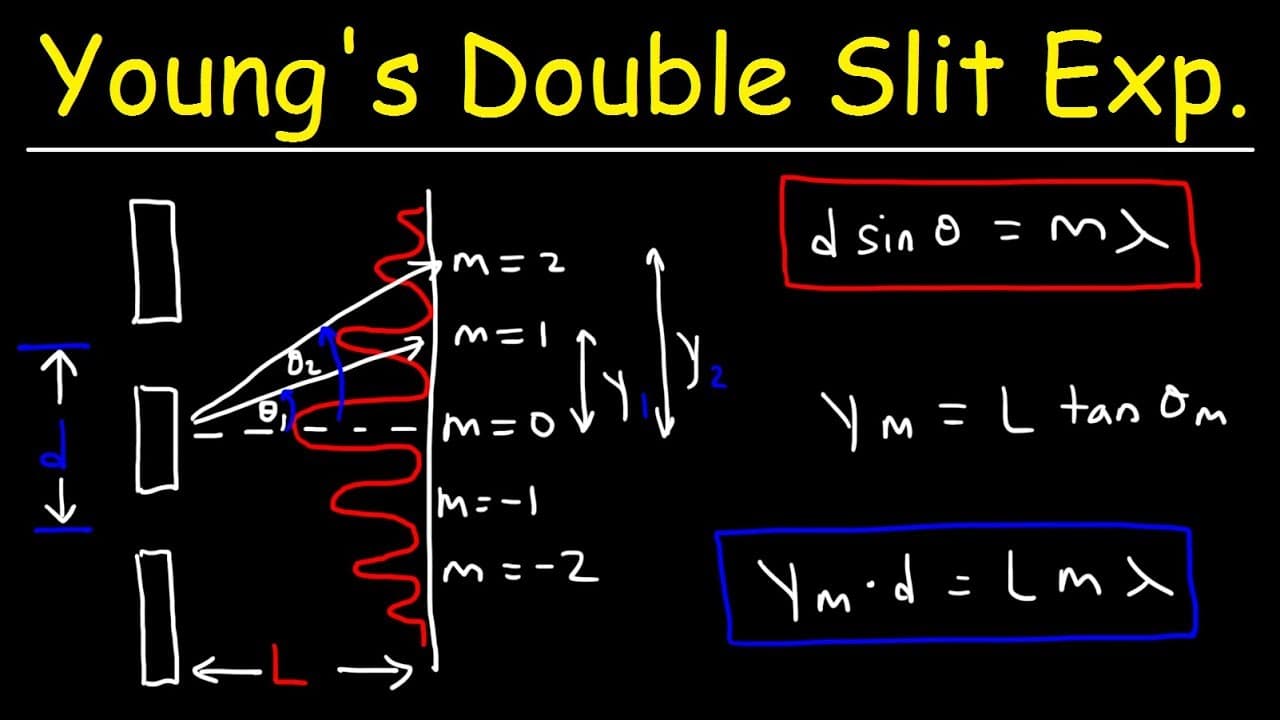
Young's double slit experiment demonstrates how light waves create an interference pattern through the concepts of constructive and destructive interference. The essential equations used to determine slit separation and fringe positions are dsin(theta) = mlambda and ymd = lmlambda, where d is the distance between slits and y is the fringe distance.
Transcript
in this video we're going to go over some practice problems associated with young's double slit experiment so we have a first order bright fringe and it's observed to be at an angle of 1.5 degrees when a light with a wavelength of 600 nanometers passes through the two narrow slits how far apart are the two slits well first let's get a good understa... Read More
Key Insights
- 🙂 Young's double slit experiment involves diffraction and interference of light waves passing through two narrow slits.
- 👋 Constructive interference occurs when waves add up in phase, creating bright fringes, while destructive interference results in dark fringes.
- ❓ The equations dsin(theta) = mlambda and ymd = lmlambda are used to calculate various aspects of the experiment.
- ❓ The distance between slits can be determined using dsin(theta) = mlambda, while the distance between fringes and the center is calculated using ymd = lmlambda.
Install to Summarize YouTube Videos and Get Transcripts
Explore YouTube Video Summarizer or Get YouTube Transcript Extractor
Questions & Answers
Q: What is Young's double slit experiment?
Young's double slit experiment involves passing light waves through two narrow slits, causing diffraction and interference, resulting in an observable pattern on a screen.
Q: How does constructive interference occur?
Constructive interference occurs when two waves are in phase and add up, resulting in a larger wave and a bright fringe in the interference pattern.
Q: What is the equation used to calculate the distance between slits?
The equation dsin(theta) = mlambda is used to calculate the distance between slits, where d is the distance between the slits, theta is the angle of the fringe, m is the order of the fringe, and lambda is the wavelength of light.
Q: How is the distance between a fringe and the center determined?
The equation ymd = lmlambda is used to calculate the distance between a fringe and the center of the pattern, where y is the distance from the center to the fringe, m is the order of the fringe, d is the distance between the slits, l is the distance from the slits to the screen, and lambda is the wavelength of light.
Summary & Key Takeaways
-
Young's double slit experiment involves two narrow slits that diffract light waves, creating an interference pattern on a screen.
-
Constructive interference occurs when waves are in phase and add up, resulting in bright fringes, while destructive interference occurs when waves are out of phase and cancel out, resulting in dark fringes.
-
Two key equations, dsin(theta) = mlambda and ymd = lmlambda, are used to calculate various aspects of the experiment, including the distance between slits and fringe positions.
Read in Other Languages (beta)
Share This Summary 📚
Summarize YouTube Videos and Get Video Transcripts with 1-Click
Try YouTube Summary with ChatGPT & Claude or YouTube Transcript Generator
Explore More Summaries from The Organic Chemistry Tutor 📚




Summarize YouTube Videos and Get Video Transcripts with 1-Click
Try YouTube Summary with ChatGPT & Claude or YouTube Transcript Generator