Products
Features
YouTube Video Summarizer
Summarize YouTube videos
Web & PDF Highlighter
Highlight web pages & PDFs
Chat with PDF
Ask any PDF questions with AI
Ask AI Clone
Chat with your highlights & memories
Audio Transcriber
Transcribe audio files to text
Glasp Reader
Read and highlight articles
Kindle Highlight Export
Export your Kindle highlights
Idea Hatch
Hatch ideas from your highlights
Integrations
Obsidian Plugin
Notion Integration
Pocket Integration
Instapaper Integration
Medium Integration
Readwise Integration
Snipd Integration
Hypothesis Integration
Apps & Extensions
Chrome Extension
Safari Extension
Edge Add-ons
Firefox Add-ons
iOS App
Android App
Discover
Discover
Ideas
Discover new ideas and insights
Articles
Curated articles and insights
Books
Book recommendations by great minds
Posts
Essays and notes from readers
Quotes
Inspiring quotes collection
Videos
Curated videos and summaries
Explore Glasp
Glasp Newsletter
Weekly insights and updates
Glasp Talk
Interview series with great minds
Glasp Blog
Latest news and articles
Glasp Use Cases
Learn how others use Glasp
Build & Support
Glasp API
Access Glasp's API for developers
MCP Connector
Connect Glasp to Claude & ChatGPT
Community
Glasp Reddit Community
Students
Student discount and benefits
FAQs
Frequently Asked Questions
AboutPricing
DashboardLog inSign up

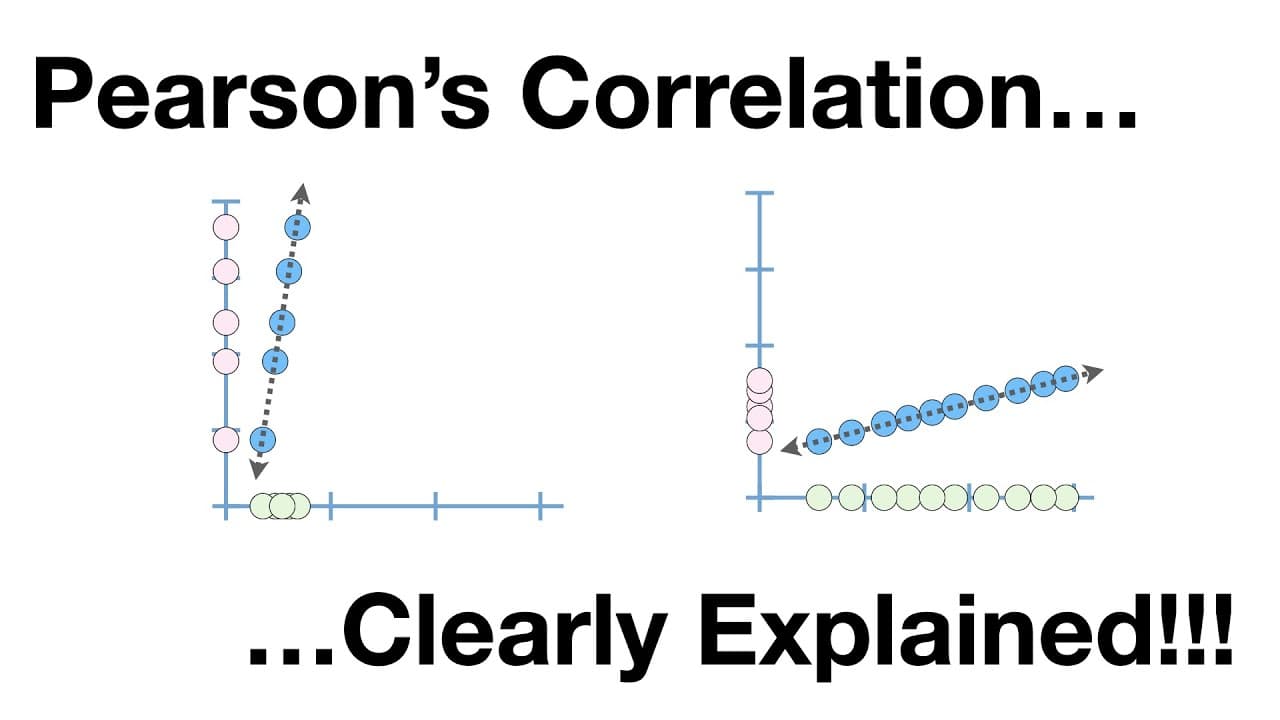
What Is Pearson's Correlation and How Is It Used?
362.9K views
•
August 5, 2019
by
StatQuest with Josh Starmer
YouTube video player
What Is Pearson's Correlation and How Is It Used?

TL;DR

Pearson's correlation quantifies the strength of a linear relationship between two variables on a scale from -1 to 1, where -1 signifies a strong negative relationship, 1 indicates a strong positive relationship, and 0 represents no relationship. Confidence in these correlation values increases with larger datasets, while R squared can further clarify relationships.

Transcript

correlation it's the sensation across the nation stack quests hello I'm Josh starburns welcome to stack quest today is part two in our series on covariance and correlation this time we're going to talk about correlation however before we dive deep into correlation I want to talk about relationships not the fun and/or confusing kind we sometimes fin... Read More

Key Insights

  • 📶 Correlation values indicate the strength of relationships between variables.
  • 🛩️ Confidence in correlation values increases with larger sample sizes and smaller p-values.
  • 😚 Correlation values closer to -1 or 1 signify strong relationships, while values closer to 0 indicate weak or no relationships.
  • ❓ Variance and covariance are essential in calculating correlation values accurately.
  • ❎ R squared can further quantify relationships beyond simple linear correlations.
  • 💄 The scale of data does not affect correlation values, making them easier to interpret.
  • ⚾ Correlation values can help make predictions based on observed trends in the data.

Install to Summarize YouTube Videos and Get Transcripts

Explore YouTube Video Summarizer or Get YouTube Transcript Extractor

Questions & Answers

Q: What does correlation measure?

Correlation quantifies the strength of relationships between variables, indicating the degree to which they are related.

Q: How does sample size affect confidence in correlation values?

Larger sample sizes lead to smaller p-values, increasing confidence in the relationships inferred from correlation analysis.

Q: Why does correlation range from -1 to 1?

Correlation values range from -1 to 1 to represent the strength of relationships, with values closer to these extremes indicating stronger relationships.

Q: What role does covariance play in calculating correlation?

Covariance is used to calculate correlation values, with the numerator representing the strength of the relationship between variables.

Summary & Key Takeaways

  • Correlation explains the strength of relationships between variables with values closer to -1 or 1 indicating strong relationships.

  • The more data collected, the higher the confidence in inferences made based on correlation values.

  • Correlation values close to zero indicate a weak or no relationship between variables.


Read in Other Languages (beta)

English

Share This Summary 📚

Summarize YouTube Videos and Get Video Transcripts with 1-Click

Download browser extensions on:

Try YouTube Summary with ChatGPT & Claude or YouTube Transcript Generator

Explore More Summaries from StatQuest with Josh Starmer 📚
ROC and AUC, Clearly Explained! thumbnail
ROC and AUC, Clearly Explained!
StatQuest with Josh Starmer
What Are One-Hot, Label, and Target Encoding Techniques? thumbnail
What Are One-Hot, Label, and Target Encoding Techniques?
StatQuest with Josh Starmer
How Does the ReLU Activation Function Work in Neural Networks? thumbnail
How Does the ReLU Activation Function Work in Neural Networks?
StatQuest with Josh Starmer
How to Calculate Maximum Likelihood for Binomial Distribution thumbnail
How to Calculate Maximum Likelihood for Binomial Distribution
StatQuest with Josh Starmer
Alternative Hypotheses: Main Ideas!!! thumbnail
Alternative Hypotheses: Main Ideas!!!
StatQuest with Josh Starmer
CatBoost Part 2: Building and Using Trees thumbnail
CatBoost Part 2: Building and Using Trees
StatQuest with Josh Starmer

Summarize YouTube Videos and Get Video Transcripts with 1-Click

Download browser extensions on:

Try YouTube Summary with ChatGPT & Claude or YouTube Transcript Generator

Apps & Extensions

  • Chrome Extension
  • Safari Extension
  • Edge Add-ons
  • Firefox Add-ons
  • iOS App
  • Android App

Key Features

  • YouTube Video Summarizer
  • Web & PDF Summarizer
  • Web & PDF Highlighter
  • Chat with PDF
  • Ask AI Clone
  • Audio Transcriber
  • Glasp Reader
  • Kindle Highlight Export
  • Idea Hatch

Integrations

  • Obsidian Plugin
  • Notion Integration
  • Pocket Integration
  • Instapaper Integration
  • Medium Integration
  • Readwise Integration
  • Snipd Integration
  • Hypothesis Integration

More Features

  • APIs
  • MCP Connector
  • Blog & Post
  • Embed Links
  • Image Highlight
  • Personality Test
  • Quote Shots

Company

  • About us
  • Blog
  • Community
  • FAQs
  • Job Board
  • Newsletter
  • Pricing
Terms

•

Privacy

•

Guidelines

© 2026 Glasp Inc. All rights reserved.