How to Convert Decimals to Fractions Easily
TL;DR
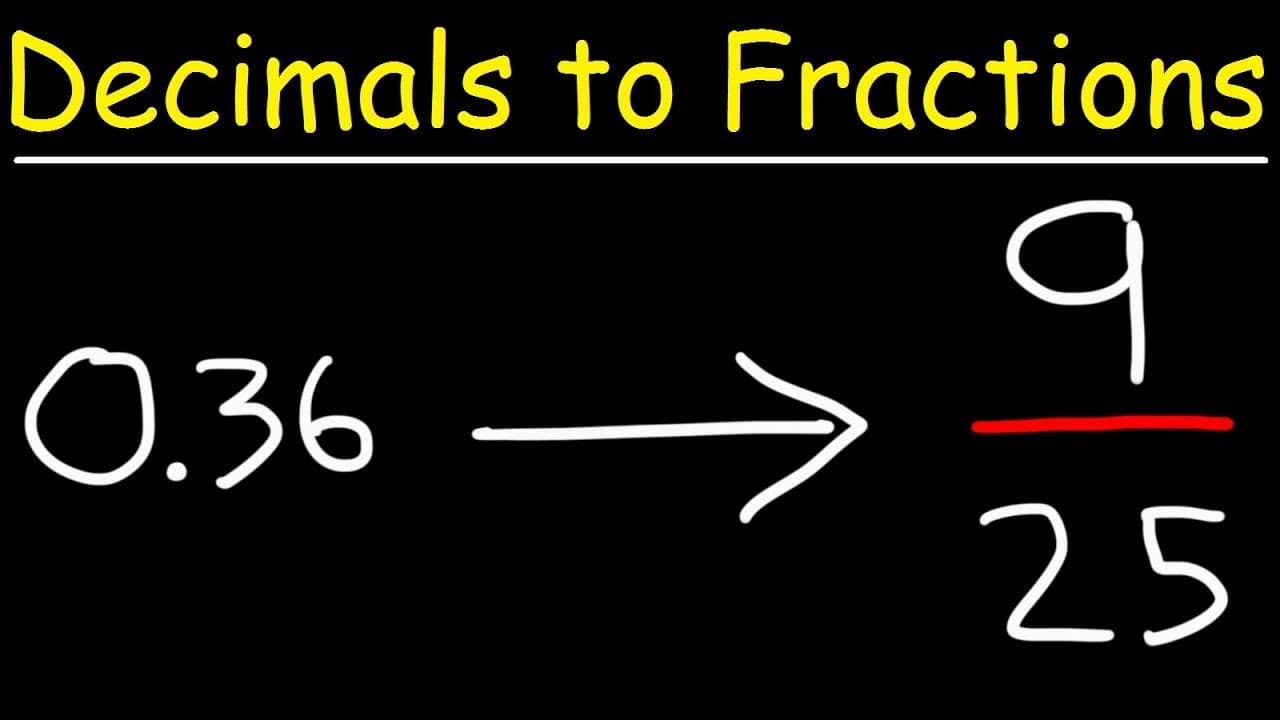
To convert a decimal to a fraction, place the decimal over one and multiply both the numerator and denominator by a power of ten based on the number of decimal places. Then simplify the fraction by dividing the numerator and denominator by their greatest common factors. This process allows for an accurate fractional representation of decimal numbers.
Transcript
now what about converting a decimal into a fraction how can we do that notice that we have one digit to the right of the decimal it's in the tenths place what you want to do is put it over one and multiply the top and the bottom by ten if there's two digits use one hundred four three years of thousand now 0.3 times ten is basically equal to three y... Read More
Key Insights
- ✊ Converting a decimal into a fraction involves multiplying the decimal by a power of ten and simplifying the resulting fraction.
- 👉 The number of digits to the right of the decimal point determines the power of ten used in the conversion.
- 🧑🏭 Dividing both numerator and denominator by their common factors simplifies the fraction.
- 🔁 Decimals with repeating patterns can also be converted into fractions using a different approach.
- #️⃣ Converting decimals into fractions provides an alternative representation for real numbers.
- 🆘 The process of converting decimals into fractions helps understand the relationship between decimals and fractions.
- 🪜 Fractions obtained from converting decimals can be further manipulated, added, or subtracted.
Install to Summarize YouTube Videos and Get Transcripts
Explore YouTube Video Summarizer or Get YouTube Transcript Extractor
Questions & Answers
Q: How do you convert a decimal into a fraction?
To convert a decimal into a fraction, put the decimal over one and multiply the top and bottom by a power of ten. This process allows you to shift the decimal point and represent the decimal value as a fraction.
Q: How does multiplying by a power of ten convert a decimal into a fraction?
Multiplying by a power of ten effectively shifts the decimal point to the left. It helps in creating a fraction where the numerator represents the decimal digits and the denominator is the power of ten used.
Q: How do you simplify the fraction obtained from converting a decimal?
To simplify a fraction, find common factors between the numerator and denominator and divide both by those factors. Keep simplifying until the fraction cannot be reduced further.
Q: Can all decimals be converted into fractions?
No, not all decimals can be converted into exact fractions. Some decimals, like irrational numbers (e.g., pi), cannot be represented precisely as fractions and require infinite decimal representations.
Summary & Key Takeaways
-
To convert a decimal number into a fraction, put the decimal over one and multiply the top and bottom by a power of ten. The resulting fraction is the converted form.
-
If the decimal has one digit to the right of the decimal point, multiply by 10. For two digits, multiply by 100, and so on.
-
Reduce the fraction by finding common factors and dividing both numerator and denominator until no further simplification is possible.
Read in Other Languages (beta)
Share This Summary 📚
Summarize YouTube Videos and Get Video Transcripts with 1-Click
Try YouTube Summary with ChatGPT & Claude or YouTube Transcript Generator
Explore More Summaries from The Organic Chemistry Tutor 📚


Summarize YouTube Videos and Get Video Transcripts with 1-Click
Try YouTube Summary with ChatGPT & Claude or YouTube Transcript Generator