The different types of mutations | Biomolecules | MCAT | Khan Academy
TL;DR
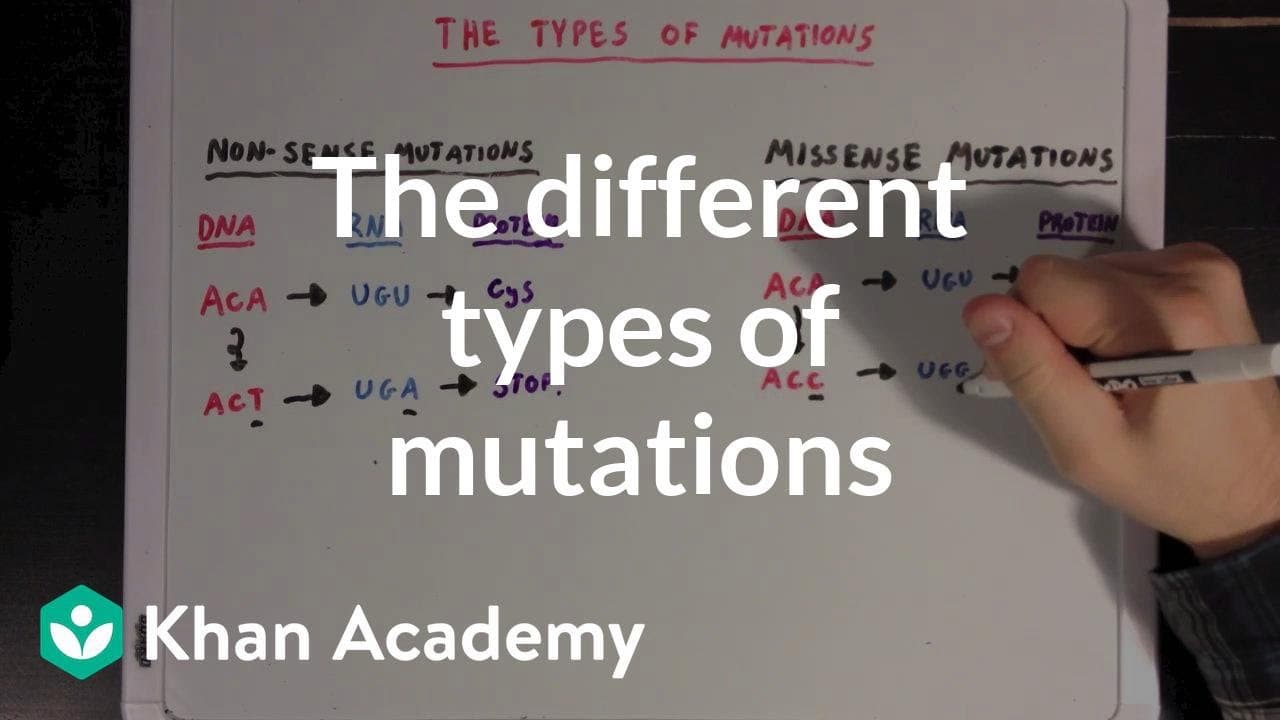
Mutations in DNA can lead to abnormalities in protein production, and there are different types of mutations such as point mutations, frame-shift mutations, missense mutations, and non-sense mutations.
Transcript
Voiceover: So, today we're going to talk about the different types of genetic mutations that you would find in a cell. But first, I want to review the central dogma of molecular biology and how the genetic information of a cell is stored in the form of DNA, which is then transcribed to form RNA and then translated to generate protein. Nucleotides f... Read More
Key Insights
- 〽️ Mutations affect protein production by altering the DNA sequence.
- 🥺 Point mutations involve the replacement of one DNA base with another, leading to a change in one amino acid.
- 🖼️ Frame-shift mutations occur when a base is added or deleted, causing a shift in the reading frame of RNA and significant changes in the protein.
- ✋ Non-sense mutations can truncate the protein by introducing a stop codon, while missense mutations change one amino acid to another.
- ⚾ Missense mutations can be further classified as silent, conservative, or non-conservative based on the impact on the resulting protein.
- 🚱 Silent mutations do not affect the protein, conservative mutations result in the substitution of amino acids with similar properties, and non-conservative mutations introduce amino acids with different properties.
- 😥 Sickle cell disease is an example of a point mutation classified as a nonconservative missense mutation, where one amino acid is swapped for another of a different type, resulting in a less active protein.
Install to Summarize YouTube Videos and Get Transcripts
Explore YouTube Video Summarizer or Get YouTube Transcript Extractor
Questions & Answers
Q: What is the central dogma of molecular biology?
The central dogma describes how genetic information is stored in DNA, transcribed to RNA, and then translated to form proteins.
Q: How do point mutations affect protein production?
Point mutations occur when one DNA base is replaced with another, leading to a change in the RNA sequence and ultimately a change in one amino acid in the protein.
Q: What distinguishes frame-shift mutations from point mutations?
In frame-shift mutations, an addition or deletion of a base occurs, causing a shift in the reading frame of RNA. This often leads to significant changes in the resulting protein.
Q: What are missense and non-sense mutations?
Missense mutations change one amino acid to another, while non-sense mutations result in the RNA sequence becoming a stop codon instead of coding for an amino acid.
Summary & Key Takeaways
-
The central dogma of molecular biology explains how genetic information is stored in DNA and translated into proteins via RNA.
-
Genetic mutations are mistakes in DNA that result in abnormal protein production.
-
Point mutations involve the replacement of one DNA base with another, while frame-shift mutations involve the addition or deletion of a base, causing a change in the reading frame of RNA.
Read in Other Languages (beta)
Share This Summary 📚
Summarize YouTube Videos and Get Video Transcripts with 1-Click
Try YouTube Summary with ChatGPT & Claude or YouTube Transcript Generator
Explore More Summaries from khanacademymedicine 📚





Summarize YouTube Videos and Get Video Transcripts with 1-Click
Try YouTube Summary with ChatGPT & Claude or YouTube Transcript Generator