What Causes Forced Vibrations in Rotating Machinery?
TL;DR
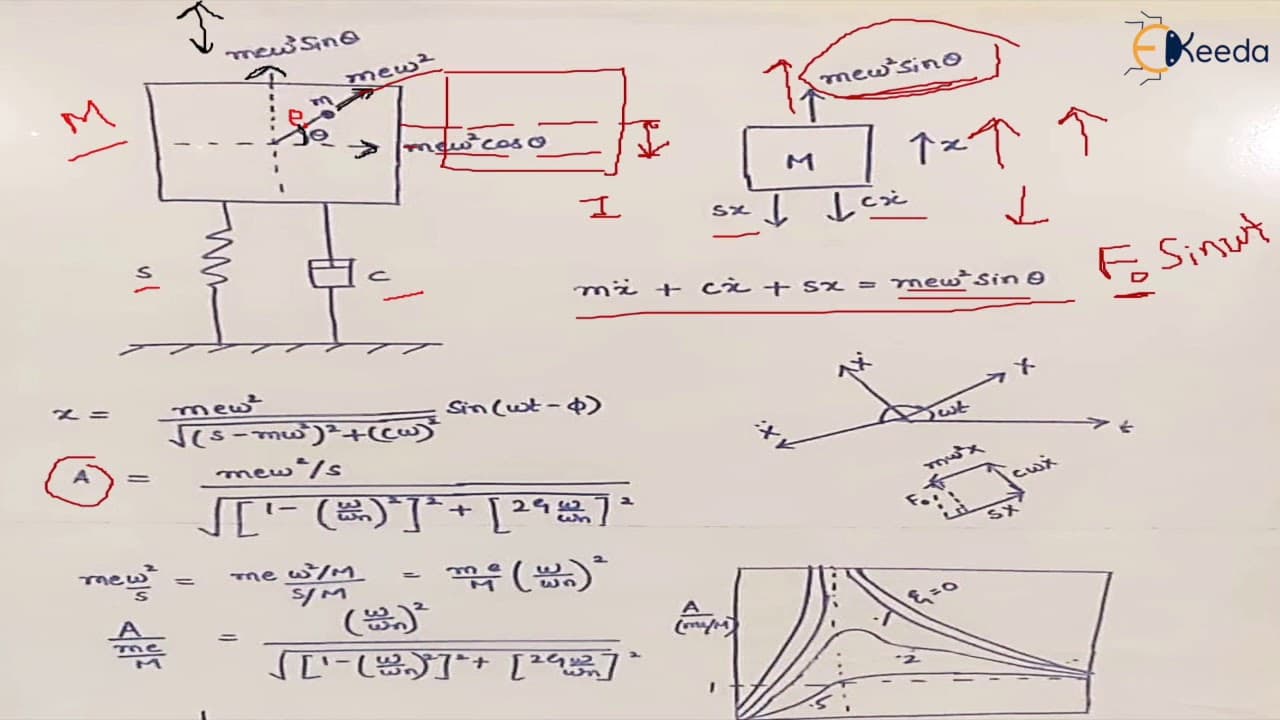
Forced vibrations in rotating machinery occur due to unbalances from rotating masses creating centrifugal forces. These forces lead to both vertical and horizontal vibrations, with their amplitude influenced by mass distribution, eccentricity, damping factors, and frequency ratios. Balancing strategies are essential to mitigate vibrations from both rotating and reciprocating masses in machinery.
Transcript
hello everyone in this video we'll discuss about the force vibrations due to rotating masses now we already know that in all types of rotating machineries uh maybe you know electric motor or turbine or a pump they always consist of some unbalances and why these unbalances are there they are because of the rotating masses in the body we have already... Read More
Key Insights
- 🥺 Rotating masses in machines create unbalances leading to vibrations impacting system performance.
- 🚥 Centrifugal forces from unbalanced masses produce vertical and horizontal vibrations in systems.
- 📳 Amplitude of vibrations is influenced by mass distribution, eccentricity, damping factor, and frequency ratio.
- ⚖️ Reciprocating masses also generate unbalances necessitating balance strategies in systems.
- 🦻 Analyzing force vibrations in rotating and reciprocating mass systems aids in system stability assessment.
- 📳 Higher frequency ratios reduce vibrations by decreasing amplitude in rotating mass systems.
- ⚖️ Understanding inertia forces from reciprocating masses helps in balancing system vibrations effectively.
Install to Summarize YouTube Videos and Get Transcripts
Explore YouTube Video Summarizer or Get YouTube Transcript Extractor
Questions & Answers
Q: How do rotating masses in machines cause vibrations?
Rotating masses in machines create unbalances, producing centrifugal forces that lead to vertical and horizontal vibrations, impacting the system's stability and performance.
Q: What factors determine the amplitude of vibrations in rotating mass systems?
The amplitude of vibrations in rotating mass systems depends on the mass distribution, eccentricity, damping factor, and frequency ratio, affecting the system's response and behavior.
Q: How can the vibrations caused by reciprocating masses be balanced in a system?
Vibrations from reciprocating masses can be balanced by considering the inertia force formula, taking into account the impact of piston-cylinder dynamics and factors influencing the system's stability.
Q: Why are higher frequency ratios preferred in systems with rotating masses?
Higher frequency ratios reduce the amplitude of vibrations in systems with rotating masses, allowing for better stability and performance by decreasing the impact of unbalances.
Summary & Key Takeaways
-
Rotating machineries have unbalances due to rotating masses producing vibrations in systems.
-
Unbalanced masses create centrifugal forces leading to vertical and horizontal vibrations.
-
Analyzing force vibrations and amplitude calculation in rotating and reciprocating mass systems.
Read in Other Languages (beta)
Share This Summary 📚
Summarize YouTube Videos and Get Video Transcripts with 1-Click
Try YouTube Summary with ChatGPT & Claude or YouTube Transcript Generator
Explore More Summaries from Ekeeda 📚






Summarize YouTube Videos and Get Video Transcripts with 1-Click
Try YouTube Summary with ChatGPT & Claude or YouTube Transcript Generator