Products
Features
YouTube Video Summarizer
Summarize YouTube videos
Web & PDF Highlighter
Highlight web pages & PDFs
Chat with PDF
Ask any PDF questions with AI
Ask AI Clone
Chat with your highlights & memories
Audio Transcriber
Transcribe audio files to text
Glasp Reader
Read and highlight articles
Kindle Highlight Export
Export your Kindle highlights
Idea Hatch
Hatch ideas from your highlights
Integrations
Obsidian Plugin
Notion Integration
Pocket Integration
Instapaper Integration
Medium Integration
Readwise Integration
Snipd Integration
Hypothesis Integration
Apps & Extensions
Chrome Extension
Safari Extension
Edge Add-ons
Firefox Add-ons
iOS App
Android App
Discover
Discover
Ideas
Discover new ideas and insights
Articles
Curated articles and insights
Books
Book recommendations by great minds
Posts
Essays and notes from readers
Quotes
Inspiring quotes collection
Videos
Curated videos and summaries
Explore Glasp
Glasp Newsletter
Weekly insights and updates
Glasp Talk
Interview series with great minds
Glasp Blog
Latest news and articles
Glasp Use Cases
Learn how others use Glasp
Build & Support
Glasp API
Access Glasp's API for developers
MCP Connector
Connect Glasp to Claude & ChatGPT
Community
Glasp Reddit Community
Students
Student discount and benefits
FAQs
Frequently Asked Questions
AboutPricing
DashboardLog inSign up

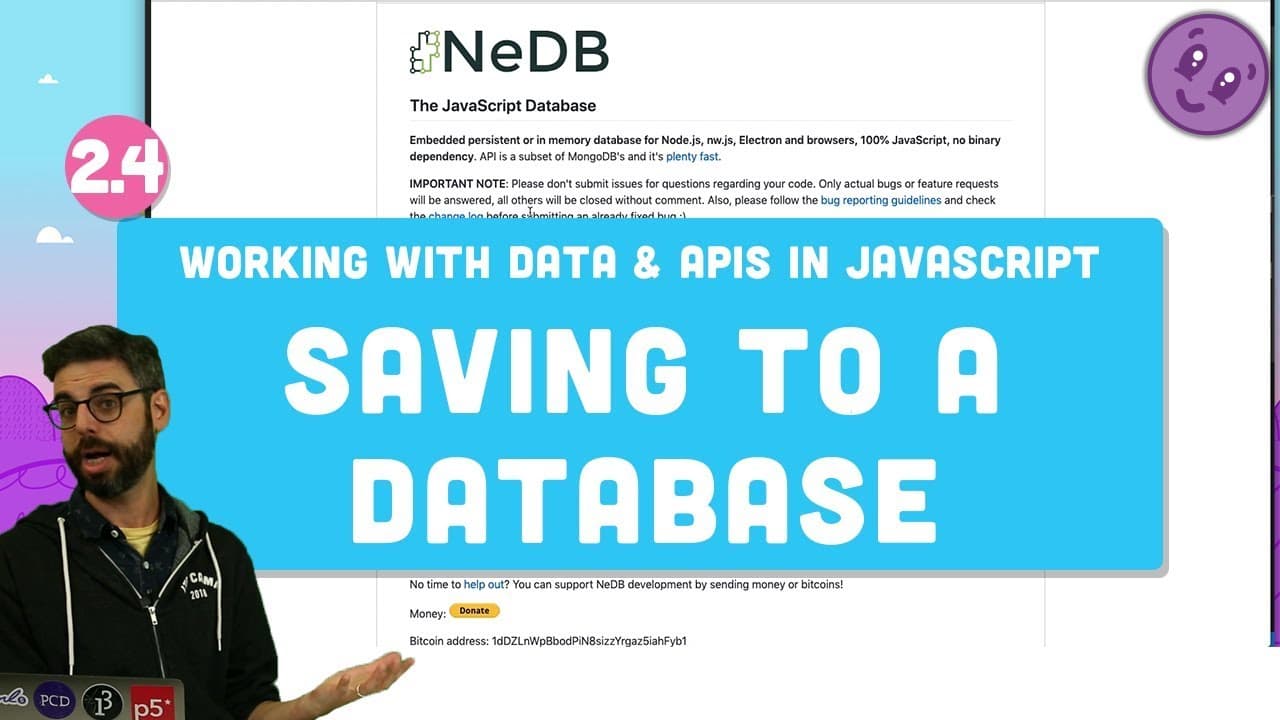
How to Use NeDB for Persistent Data Storage in Node.js
224.1K views
•
June 4, 2019
by
The Coding Train
YouTube video player
How to Use NeDB for Persistent Data Storage in Node.js

TL;DR

To implement persistent data storage in Node.js using NeDB, install the NeDB package and create a datastore for your database. Use methods like insert to save data, ensuring it persists through server restarts. NeDB is lightweight, JavaScript-based, and ideal for learning database functionality, especially when multiple clients need to share data.

Transcript

It's time to add a database. Why do you need a database? So a database is for persistence, your ability to store information over the long haul. So whether or not you quit the server, restart the server, clients are connecting or disconnecting, their information is saved. So a classic example of this is, you made a game and you need a high score li... Read More

Key Insights

  • 💁 Databases are crucial for persistently storing information across server restarts in web applications.
  • ⚾ NeDB offers a lightweight, JavaScript-based solution for basic database functionalities and learning purposes.
  • 🛟 Shared data among multiple clients requires a server-based database, not limited client-side storage.
  • 🈸 Implementing NeDB involves steps like installation, database creation, data insertion, and retrieval in Node.js applications.

Install to Summarize YouTube Videos and Get Transcripts

Explore YouTube Video Summarizer or Get YouTube Transcript Extractor

Questions & Answers

Q: Why is a database important in web development?

A database enables persistent storage of information, ensuring data is saved and accessible even after server restarts or client connections.

Q: How does NeDB differ from traditional databases like MongoDB?

NeDB is a lightweight, simple JavaScript-based database system, serving as a good starting point before transitioning to more robust systems like MongoDB.

Q: Why is client-side storage insufficient for sharing data between clients?

Client-side storage like local storage is confined to individual browsers, making it unsuitable for sharing data among multiple clients connected to a server.

Q: What are the steps involved in implementing NeDB in a Node.js application?

You can install the NeDB package, create a database, load existing data, insert new data, and retrieve data using NeDB's MongoDB-like API.

Summary & Key Takeaways

  • Importance of databases for persistence in storing information, such as high scores or user accounts securely.

  • Local storage limitations in sharing data across clients, necessitating a server-based database.

  • Introduction to NeDB, a lightweight JavaScript-based database system, for basic functionality and learning database operations.


Read in Other Languages (beta)

English

Share This Summary 📚

Summarize YouTube Videos and Get Video Transcripts with 1-Click

Download browser extensions on:

Try YouTube Summary with ChatGPT & Claude or YouTube Transcript Generator

Explore More Summaries from The Coding Train 📚
Coding Challenge #116: Lissajous Curve Table thumbnail
Coding Challenge #116: Lissajous Curve Table
The Coding Train
Computer Mouse Conference Demos! (node.js + tensorflow.js) thumbnail
Computer Mouse Conference Demos! (node.js + tensorflow.js)
The Coding Train
Coding Challenge #126: Toothpicks thumbnail
Coding Challenge #126: Toothpicks
The Coding Train
Classifying Poses with ml5.js Part 2 thumbnail
Classifying Poses with ml5.js Part 2
The Coding Train
ITP/IMA Winter Show 2019 thumbnail
ITP/IMA Winter Show 2019
The Coding Train
9.4: Genetic Algorithm: Looking at Code - The Nature of Code thumbnail
9.4: Genetic Algorithm: Looking at Code - The Nature of Code
The Coding Train

Summarize YouTube Videos and Get Video Transcripts with 1-Click

Download browser extensions on:

Try YouTube Summary with ChatGPT & Claude or YouTube Transcript Generator

Apps & Extensions

  • Chrome Extension
  • Safari Extension
  • Edge Add-ons
  • Firefox Add-ons
  • iOS App
  • Android App

Key Features

  • YouTube Video Summarizer
  • Web & PDF Summarizer
  • Web & PDF Highlighter
  • Chat with PDF
  • Ask AI Clone
  • Audio Transcriber
  • Glasp Reader
  • Kindle Highlight Export
  • Idea Hatch

Integrations

  • Obsidian Plugin
  • Notion Integration
  • Pocket Integration
  • Instapaper Integration
  • Medium Integration
  • Readwise Integration
  • Snipd Integration
  • Hypothesis Integration

More Features

  • APIs
  • MCP Connector
  • Blog & Post
  • Embed Links
  • Image Highlight
  • Personality Test
  • Quote Shots

Company

  • About us
  • Blog
  • Community
  • FAQs
  • Job Board
  • Newsletter
  • Pricing
Terms

•

Privacy

•

Guidelines

© 2026 Glasp Inc. All rights reserved.