Given a Value for the Hyperbolic Cosine of u Find the Other Five Hyperbolic Functions of u
TL;DR
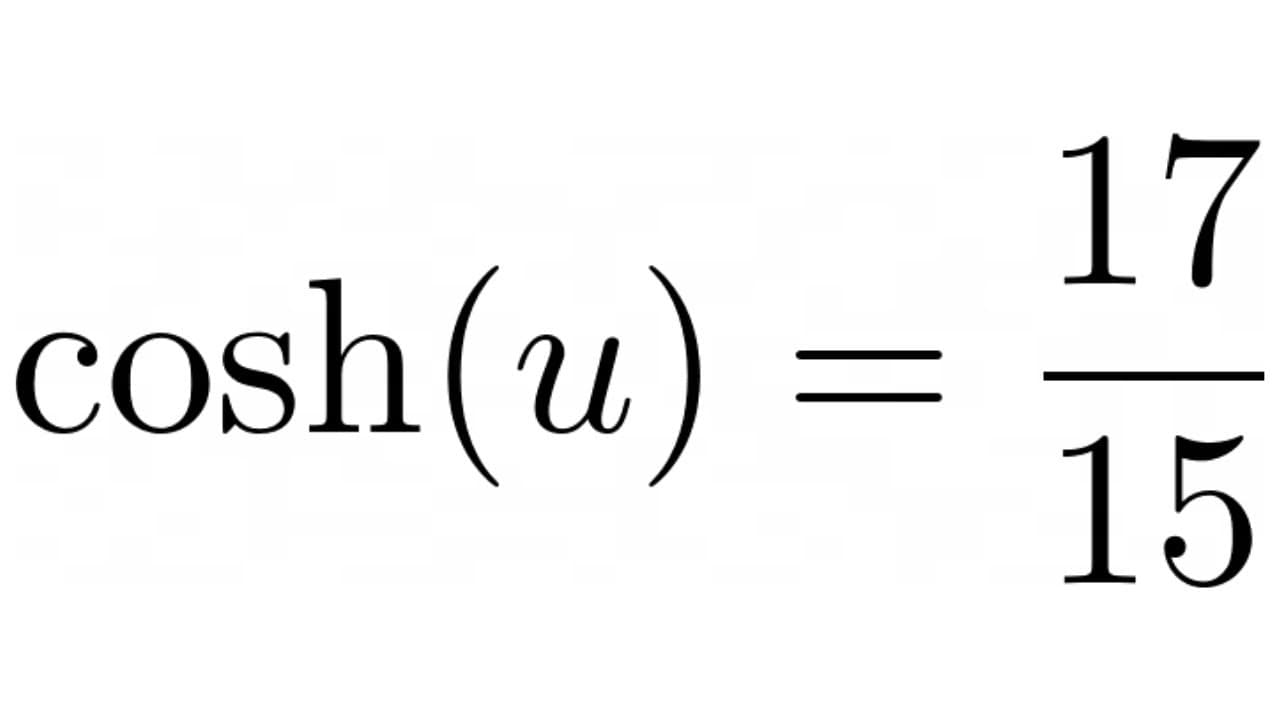
Solving for hyperbolic functions given a cosine value, find other five functions using identities and reciprocals.
Transcript
in this problem we're given that the hyperbolic cosine of u is equal to 17 over 15. and the question is to find the other five uh hyperbolic functions so we'll start by using the identity cosench squared of u minus cinch squared of u equals one so we can use this identity to find cinch once we find cinch it's pretty easy because we can find the oth... Read More
Key Insights
- 🆘 Using trigonometric identities helps solve for hyperbolic functions efficiently.
- 🐬 Reciprocal hyperbolic functions can be easily obtained by flipping the original functions.
- 📈 The graph of sinh(u) has both positive and negative values, impacting the determination of other hyperbolic functions.
Install to Summarize YouTube Videos and Get Transcripts
Explore YouTube Video Summarizer or Get YouTube Transcript Extractor
Questions & Answers
Q: How do you begin solving for the hyperbolic functions given cosh(u) = 17/15?
You start by using the identity cosh^2(u) - sinh^2(u) = 1 to find sinh(u) first, and then use reciprocals to find other functions.
Q: Why is finding sinh(u) important in this problem?
Finding sinh(u) is crucial because once you have sinh(u), you can easily calculate the other hyperbolic functions using basic trigonometric relationships.
Q: How do you find hyperbolic tangent of u with the given information?
Hyperbolic tangent of u is found by dividing sinh(u) by cosh(u), giving you tanh(u), and the reciprocal functions are obtained by flipping the original functions.
Q: What is the approach to finding reciprocal hyperbolic functions like sech(u) and csch(u)?
Reciprocal hyperbolic functions like sech(u) and csch(u) are found by simply flipping the original functions, following the same process used to find initial hyperbolic functions.
Summary & Key Takeaways
-
Given cosh(u) = 17/15, find other hyperbolic functions.
-
Use cosh^2(u) - sinh^2(u) = 1 identity to find sinh(u) and others.
-
Reciprocals like sech(u), csch(u), and coth(u) are found by flipping the original functions.
Read in Other Languages (beta)
Share This Summary 📚
Summarize YouTube Videos and Get Video Transcripts with 1-Click
Try YouTube Summary with ChatGPT & Claude or YouTube Transcript Generator
Explore More Summaries from The Math Sorcerer 📚



Summarize YouTube Videos and Get Video Transcripts with 1-Click
Try YouTube Summary with ChatGPT & Claude or YouTube Transcript Generator