Chapter 63 - Gauss-Jordan Elimination with Curve Fitting
TL;DR
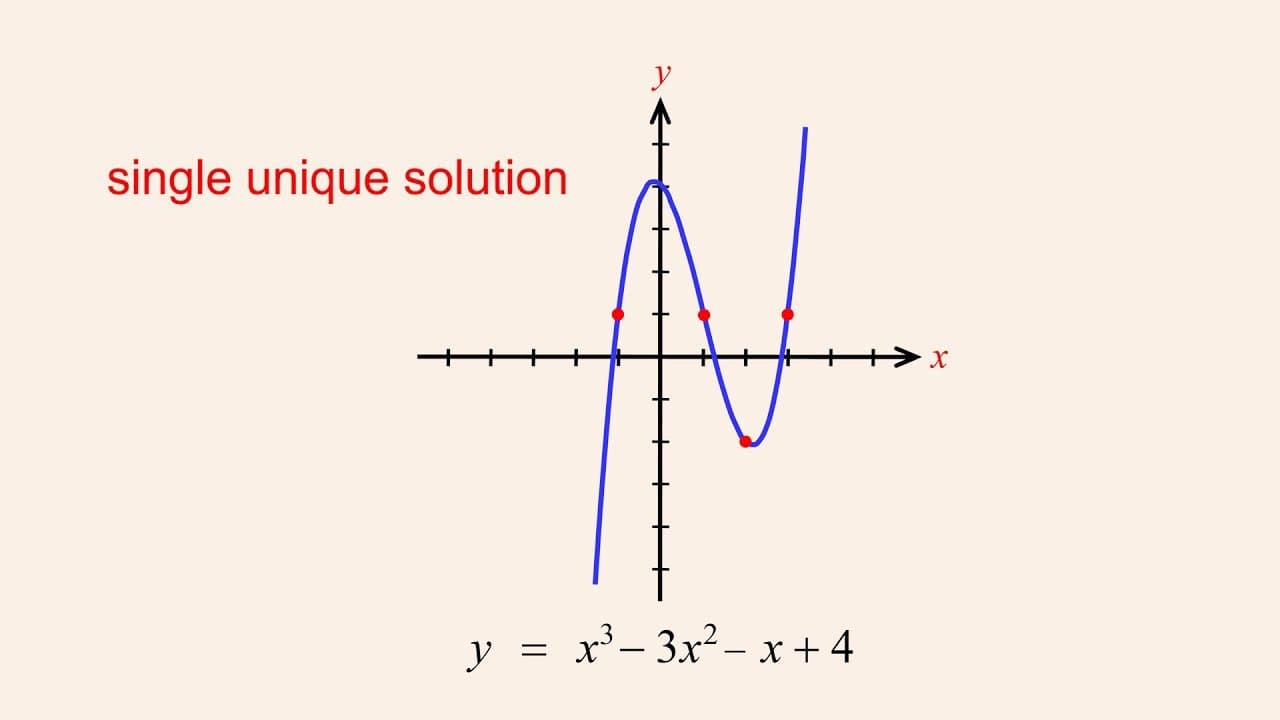
Learn how to find a cubic function that fits data points through Gauss-Jordan elimination.
Transcript
Hello. I'm Professor Von Schmohawk and welcome to Why U. In the previous lecture we examined an application for systems of linear equations with four or more variables that involved the calculation of traffic flow through a network of streets. In this lecture we will examine another type of application that can be solved using systems of linear equ... Read More
Key Insights
- 😥 Curve fitting involves finding a mathematical function that fits given data points.
- 🈸 Cubic functions are commonly used in curve fitting applications.
- 🇯🇴 Gauss-Jordan elimination is applied to solve systems of linear equations in curve fitting.
- 😥 Inconsistent systems can arise in curve fitting when data points are positioned in a way that no function can pass through them.
- 😥 Infinitely many solutions can occur in curve fitting when given fewer data points than unknowns.
- ❓ Parametric equations are used to describe solutions when curve fitting results in infinitely many possibilities.
- 😥 Curve fitting using parametric equations allows for a range of unique polynomial functions passing through given points.
Install to Summarize YouTube Videos and Get Transcripts
Explore YouTube Video Summarizer or Get YouTube Transcript Extractor
Questions & Answers
Q: What is curve fitting and how is it used in mathematics?
Curve fitting is the process of finding a mathematical function that fits given data points. In mathematics, it is used to model real-world systems and analyze relationships between variables.
Q: How are cubic functions utilized in curve fitting?
Cubic functions are third-degree polynomial equations used in curve fitting. The coefficients in these equations determine the shape and position of the curve that passes through data points.
Q: What is Gauss-Jordan elimination and how is it applied in curve fitting?
Gauss-Jordan elimination is a method used to solve systems of linear equations. In curve fitting, it is used to find the coefficients of a cubic function by reducing the system of equations to row-echelon form.
Q: How can curve fitting result in inconsistent systems of equations?
Inconsistent systems occur when data points are positioned such that no curve can pass through them. This leads to equations with no valid solution, indicating that the points do not fit any function.
Summary & Key Takeaways
-
Curve fitting involves finding a function that fits given data points using cubic equations.
-
The process uses systems of linear equations with unknown coefficients to determine the curve.
-
Gauss-Jordan elimination is applied to solve for the coefficients and graph the function.
Read in Other Languages (beta)
Share This Summary 📚
Summarize YouTube Videos and Get Video Transcripts with 1-Click
Try YouTube Summary with ChatGPT & Claude or YouTube Transcript Generator
Explore More Summaries from MyWhyU 📚

Summarize YouTube Videos and Get Video Transcripts with 1-Click
Try YouTube Summary with ChatGPT & Claude or YouTube Transcript Generator