Invalid conclusions from studies example | Study design | AP Statistics | Khan Academy
TL;DR
Spending more time on smartphones is associated with less happiness among teenagers, but the study does not prove causality.
Transcript
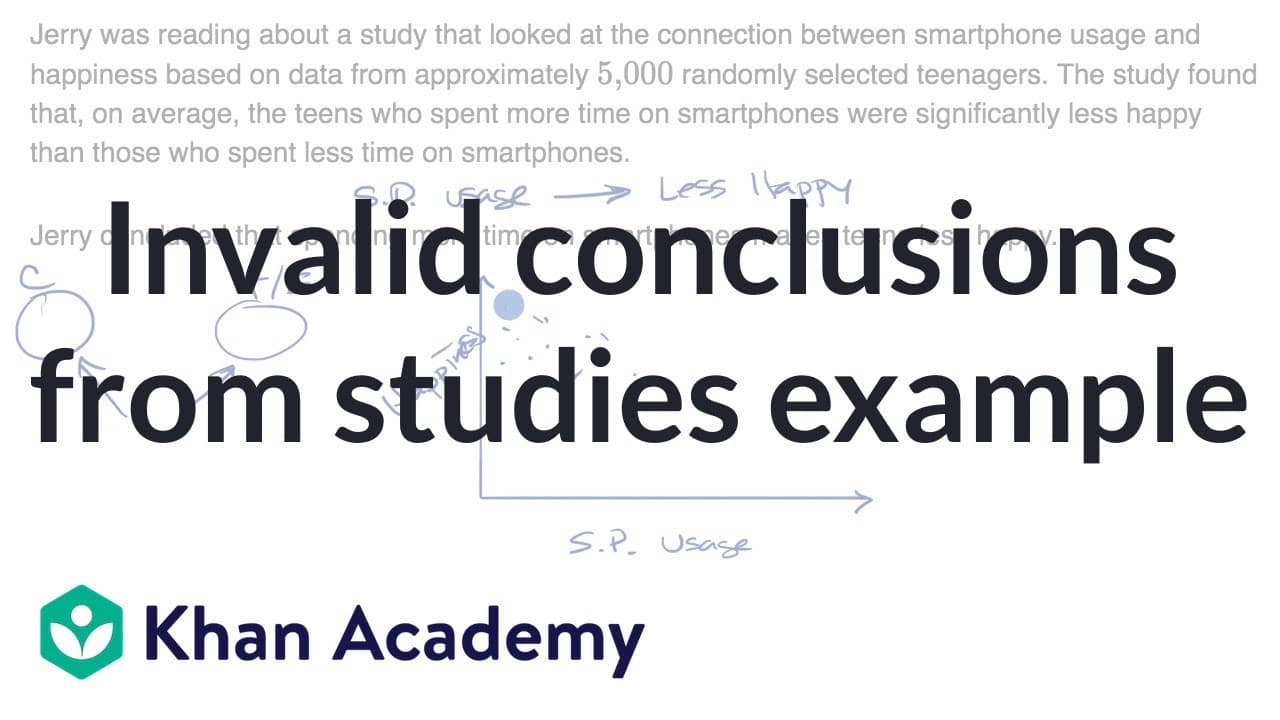
- [Instructor] Jerry was reading about a study that looked at the connection between smartphone usage and happiness based on data from approximately 5,000 randomly selected teenagers. The study found that on average the teens who spent more time on smartphones were significantly less happy than those who spent less time on smartphones. Jerry conclu... Read More
Key Insights
- 😘 The study found an association between more smartphone usage and lower happiness levels among teenagers.
- ❓ Causality cannot be determined from an observational study, like this one.
- ◀️ Other variables may explain the observed association, or the relationship may even be reversed.
- 👨🔬 The study highlights the importance of critically interpreting conclusions drawn from research.
- 🔉 Popular media often oversimplify study findings and establish causal connections where there might only be associations.
- 🕴️ Experimental studies are better suited for establishing causality.
- 🤨 The study raises questions about the impact of excessive smartphone usage on teenage well-being.
Install to Summarize YouTube Videos and Get Transcripts
Explore YouTube Video Summarizer or Get YouTube Transcript Extractor
Questions & Answers
Q: Does the study prove that smartphone usage causes less happiness in teenagers?
No, the study is observational and only establishes an association between smartphone usage and happiness, not causality. There could be other factors at play.
Q: How was the study conducted?
The study involved analyzing the smartphone usage and happiness levels of 5,000 randomly selected teenagers, likely through surveys or data collection.
Q: Can we conclude that happier teenagers use smartphones less?
While the study suggests an association between less smartphone usage and higher happiness levels, it is important to consider that causality could go the other way or that there may be other variables at play.
Q: What is the difference between an observational study and an experimental study?
An experimental study involves a control group, a treatment group, and random assignment. Observational studies, like this one, only establish associations between variables.
Summary & Key Takeaways
-
A study of 5,000 randomly selected teenagers found that those who spent more time on smartphones were generally less happy.
-
The study was observational, not experimental, meaning it could only establish an association between smartphone usage and happiness, not causality.
-
It is possible that less happy teenagers use their smartphones more, or that there are other variables at play.
Read in Other Languages (beta)
Share This Summary 📚
Summarize YouTube Videos and Get Video Transcripts with 1-Click
Try YouTube Summary with ChatGPT & Claude or YouTube Transcript Generator
Explore More Summaries from Khan Academy 📚



Summarize YouTube Videos and Get Video Transcripts with 1-Click
Try YouTube Summary with ChatGPT & Claude or YouTube Transcript Generator