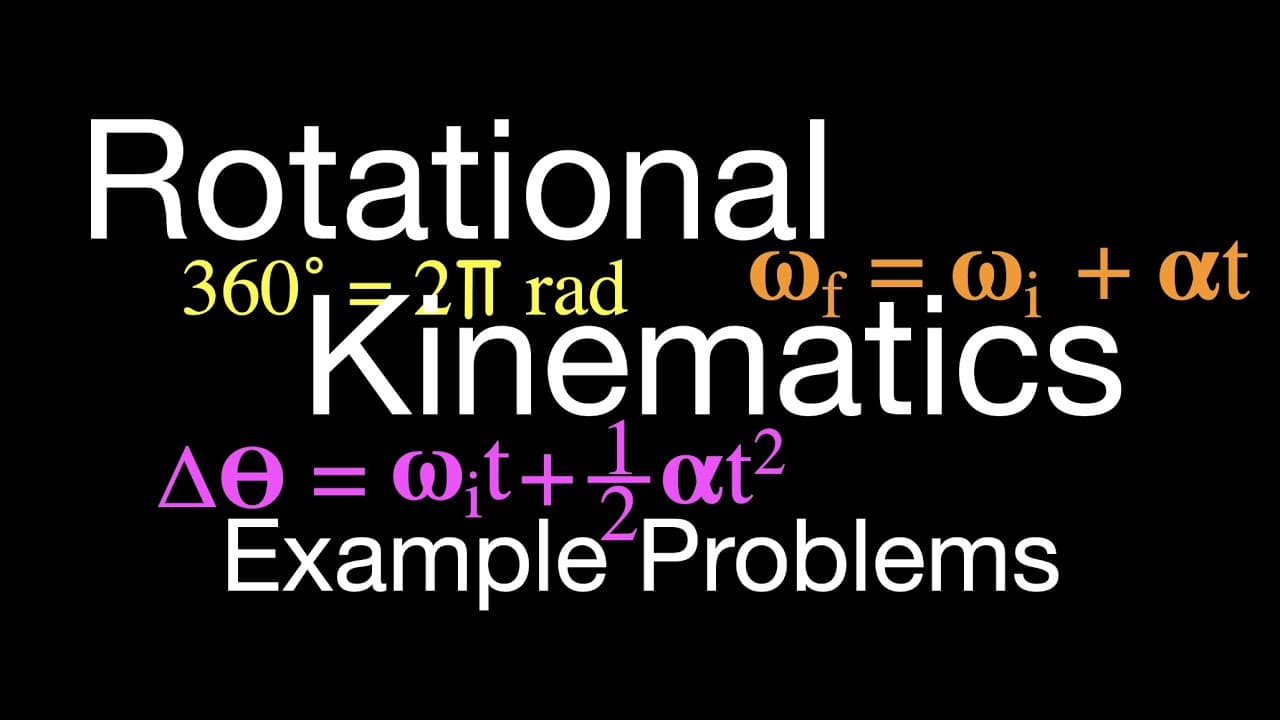
Rotational Motion: Kinematic Equations, Example Problems
TL;DR
Solving rotational mechanics example problems with conversions, equations, and applications to real-life scenarios.
Transcript
in today's video we're gonna go over eight different example problems for rotational mechanics and before you get started please don't forget to subscribe to my channel step by step science get all my excellent physical chemistry in math videos when i look at my youtube analytics i see that really a lot of people who watch my videos have not subscr... Read More
Key Insights
- 🦾 Understanding the conversion between revolutions and radians is essential for rotational mechanics problems.
- 🫥 Equations for rotational and linear motion show the parallels between circular and straight-line motion.
- 📐 Calculating angular acceleration and velocity requires applying kinematic equations to rotational scenarios.
- 🛀 The relationship between radius and linear velocity shows the impact of distance from the center in rotational motion.
- 📐 Tangential acceleration in rotational motion is directly proportional to the angular acceleration and the radius.
- 🦾 Frequency and period, as well as angular and linear velocity, are interconnected in rotational mechanics.
- 🆘 Solving example problems helps apply theoretical knowledge to practical scenarios involving rotational motion.
Install to Summarize YouTube Videos and Get Transcripts
Explore YouTube Video Summarizer or Get YouTube Transcript Extractor
Questions & Answers
Q: How are rotational mechanics related to linear mechanics?
Rotational mechanics have analogous terms to linear mechanics, such as angular velocity, acceleration, and displacement, but involve circular motion instead of straight lines.
Q: What equations are used in rotational motion without acceleration?
The equation for angular velocity without acceleration is angular displacement divided by time, while the equation for linear motion without acceleration is velocity equals distance divided by time.
Q: How is angular velocity calculated from revolutions per minute?
To convert from revolutions per minute to radians per second, multiply by 2π and divide by 60, resulting in the angular velocity in radians per second.
Q: How does distance traveled in rotational motion relate to angular displacement?
The distance traveled in rotational motion is calculated using the equation distance equals radius times angular displacement, providing the linear velocity from the angular velocity.
Summary & Key Takeaways
-
Explaining the basics of rotational mechanics and the similarities to linear mechanics.
-
Demonstrating conversion between revolutions and radians.
-
Solving example problems involving angular velocity, acceleration, displacement, and linear motion.
Read in Other Languages (beta)
Share This Summary 📚
Summarize YouTube Videos and Get Video Transcripts with 1-Click
Try YouTube Summary with ChatGPT & Claude or YouTube Transcript Generator
Explore More Summaries from Step by Step Science 📚

Summarize YouTube Videos and Get Video Transcripts with 1-Click
Try YouTube Summary with ChatGPT & Claude or YouTube Transcript Generator