Interpreting linear graphs word problems example 1 | Algebra I | Khan Academy
TL;DR
Exploring how the increase or decrease in one variable affects the other variable on a graph.
Transcript
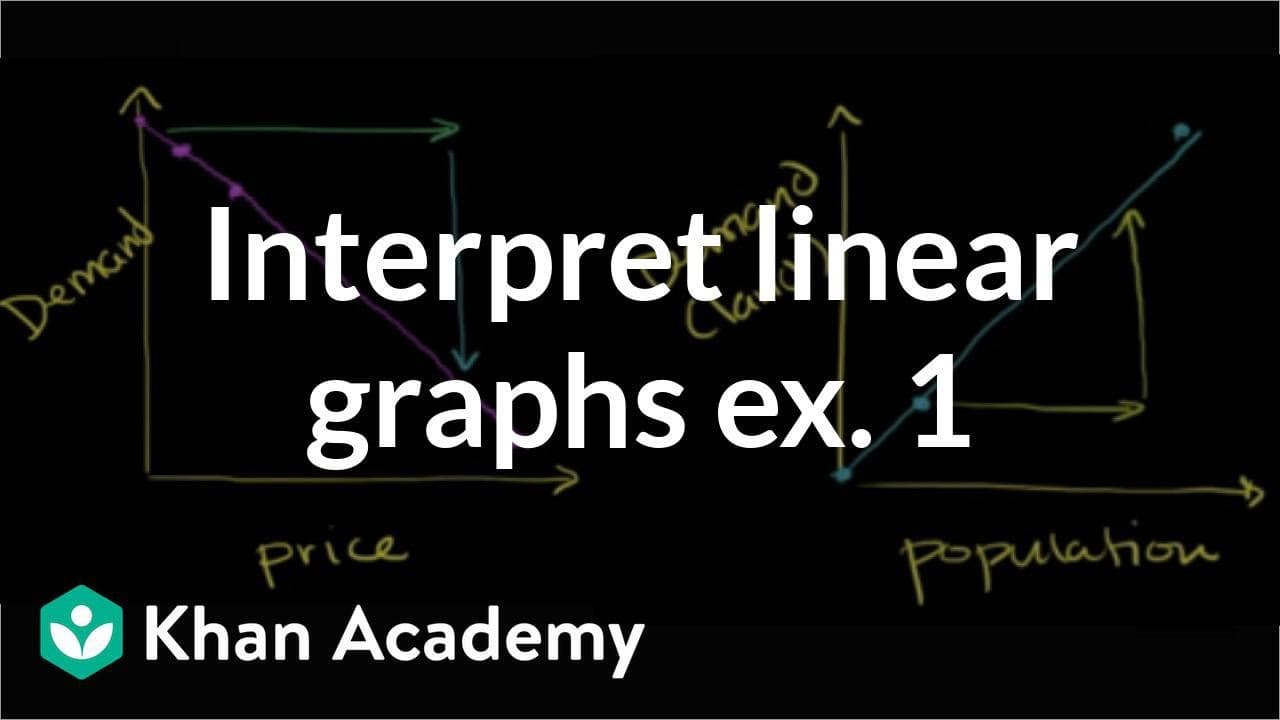
what i want to do with this video is think about the relationship between variables and then think about what the graph of that relationship should look like. So let's say these two axis, the horizontal axis over here I plot the price of a product and lets say this vertical axis over here i plot the demand for the product, and i'm only plotting the... Read More
Key Insights
- ❓ When the price of a product decreases, the demand increases, and when the price increases, the demand decreases.
- 🏝️ The demand for land increases as the population in an area increases.
- 🫥 An upward-sloping line on a graph indicates a positive relationship between variables, while a downward-sloping line suggests a negative relationship.
- 📈 Graphs can help visualize and understand how different variables interact with each other.
- 🫥 The relationship between variables can be represented by lines, curves, or other shapes on a graph.
- 🫥 The slope of a line on a graph provides information about the relationship between variables.
- ❓ Positive slopes indicate that as one variable increases, the other also increases.
Install to Summarize YouTube Videos and Get Transcripts
Explore YouTube Video Summarizer or Get YouTube Transcript Extractor
Questions & Answers
Q: How does the price of a product relate to its demand?
When the price of a product is low, the demand tends to be high. As the price increases, the demand decreases. This relationship is commonly seen in most normal products.
Q: How does population affect the demand for land?
As the population in an area increases, the demand for land also increases. More people are interested in buying land when there are more potential buyers available.
Q: What does an upward-sloping line on a graph indicate?
An upward-sloping line shows a positive relationship between the variables. As one variable increases, the other variable also increases. This indicates a positive correlation between the two variables.
Q: How can we determine the relationship between two variables on a graph?
By examining the slope of the line connecting the data points, we can determine the relationship between the two variables. An upward slope signifies a positive relationship, while a downward slope suggests a negative relationship.
Summary & Key Takeaways
-
The relationship between price and demand for most normal products is that as the price decreases, the demand increases, and vice versa.
-
The demand for land increases as the population in an area increases.
-
When graphing the relationship between two variables, an upward-sloping line indicates that as one variable increases, the other also increases, while a downward-sloping line indicates a decrease in one variable as the other increases.
Read in Other Languages (beta)
Share This Summary 📚
Summarize YouTube Videos and Get Video Transcripts with 1-Click
Try YouTube Summary with ChatGPT & Claude or YouTube Transcript Generator
Explore More Summaries from Khan Academy 📚



Summarize YouTube Videos and Get Video Transcripts with 1-Click
Try YouTube Summary with ChatGPT & Claude or YouTube Transcript Generator