Mercury Barometer Problems, Physics - Air Pressure, Height & Density Calculations - Fluid Statics
TL;DR
This video explains how to calculate the height of a mercury column in a barometer and how to determine atmospheric pressure using density and height measurements of different fluids.
Transcript
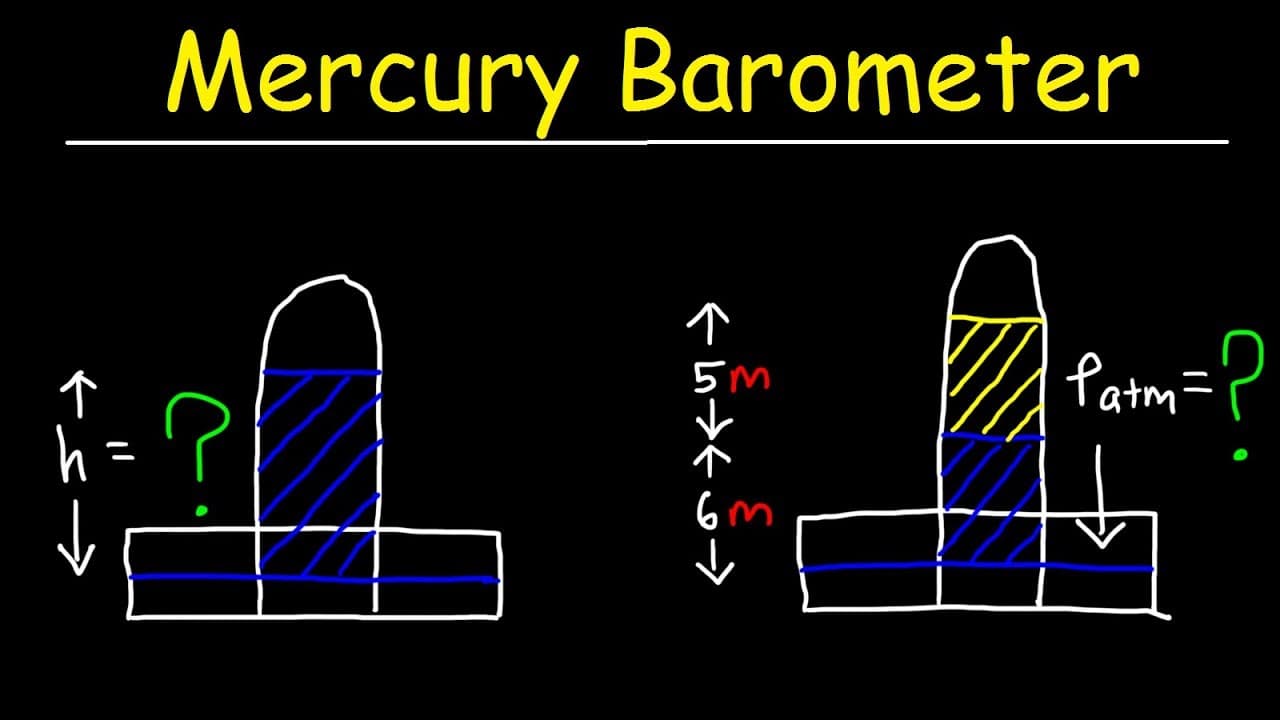
in this video we're going to focus on solving some physics problems associated with barometers a mercury barometer is exposed to air at sea level what is the height of the mercury column and we're given the density of mercury so let's draw a picture so let's say we have a dish that contains some mercury and we have a test tube that's placed upside ... Read More
Key Insights
- 😒 Barometers use a column of fluid to measure atmospheric pressure.
- ❓ The height of a mercury column in a barometer can be calculated using the atmospheric pressure, density of mercury, and acceleration due to gravity.
- ❓ The atmospheric pressure can be determined at a given elevation using the density and height of the mercury column.
- ❓ Different fluids in a barometer can be analyzed by equating their pressures to the atmospheric pressure and using the respective densities and heights.
- 🚾 Water and oil have different densities, which affects the height of their respective columns in a barometer.
Install to Summarize YouTube Videos and Get Transcripts
Explore YouTube Video Summarizer or Get YouTube Transcript Extractor
Questions & Answers
Q: How is atmospheric pressure transmitted through a fluid in a barometer?
According to Pascal's law, pressure exerted on a fluid is transmitted throughout that fluid. In the case of a barometer, the weight of the atmosphere creates an upward pressure that supports the height of the fluid column.
Q: How is the height of a mercury column in a barometer calculated at sea level?
The height can be calculated by dividing the atmospheric pressure at sea level (given as 101,325 Pa) by the product of the density of mercury (13,600 kg/m^3) and the acceleration due to gravity (9.8 m/s^2). The resulting value is 0.76 meters or 760 millimeters.
Q: If a barometer is filled with water instead of mercury, what height of water column can the air pressure support?
Since water is less dense than mercury, a greater height of water column is required to exert the same weight force and equal the atmospheric pressure. Using the same formula as before, the height of the water column is calculated to be 9.792 meters.
Q: In a barometer with water and oil, what is the atmospheric pressure if the heights of the water and oil columns are 6 meters and 5 meters, respectively?
By calculating the pressures exerted by each fluid using their respective densities and heights, the atmospheric pressure is found to be 94.08 kPa or 0.9287 atm.
Summary & Key Takeaways
-
The video introduces the concept of barometers and how they work using a mercury column and atmospheric pressure.
-
It explains how to calculate the height of the mercury column by equating the atmospheric pressure with the pressure created by the weight of the mercury fluid.
-
The video then demonstrates how to calculate the atmospheric pressure at a given elevation and how to determine the height of a different fluid column in a barometer.
Read in Other Languages (beta)
Share This Summary 📚
Summarize YouTube Videos and Get Video Transcripts with 1-Click
Try YouTube Summary with ChatGPT & Claude or YouTube Transcript Generator
Explore More Summaries from The Organic Chemistry Tutor 📚



Summarize YouTube Videos and Get Video Transcripts with 1-Click
Try YouTube Summary with ChatGPT & Claude or YouTube Transcript Generator