The Maxwell–Boltzmann distribution | AP Chemistry | Khan Academy
TL;DR
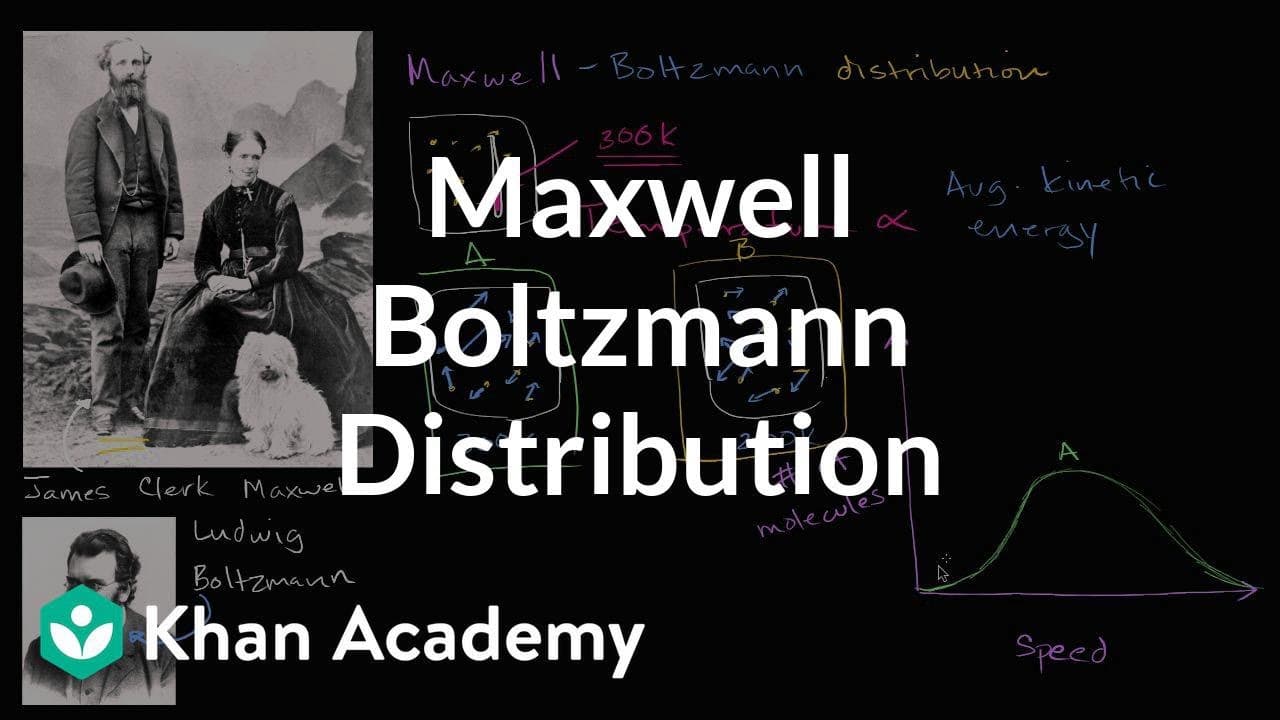
The Maxwell-Boltzmann distribution describes the distribution of speeds of gas particles at different temperatures.
Transcript
- [Voiceover] So let's think a little bit about the Maxwell-Boltzmann distribution. And this right over here, this is a picture of James Clerk Maxwell. And I really like this picture, it's with his wife Katherine Maxwell and I guess this is their dog. And James Maxwell, he is a titan of physics famous for Maxwell's equations. He also did some of th... Read More
Key Insights
- ❓ James Clerk Maxwell and Ludwig Boltzmann independently developed the Maxwell-Boltzmann distribution.
- ❓ Temperature is proportional to the average kinetic energy of molecules.
- 🚄 The distribution shows that higher temperature leads to a broader speed distribution and higher average kinetic energy.
- 🤒 The most probable speed of nitrogen molecules at room temperature is approximately 422 meters per second.
- 🫢 Some gas particles can travel faster than the speed of sound.
- 🚄 The mass of particles determines why high-speed collisions with the body do not cause pain.
Install to Summarize YouTube Videos and Get Transcripts
Explore YouTube Video Summarizer or Get YouTube Transcript Extractor
Questions & Answers
Q: Who were the scientists behind the Maxwell-Boltzmann distribution?
James Clerk Maxwell and Ludwig Boltzmann independently developed the distribution, describing the speed distribution of gas particles.
Q: How does temperature relate to the average kinetic energy of molecules?
Temperature is proportional to the average kinetic energy of molecules in a system. Higher temperature means higher average kinetic energy.
Q: How does the distribution of speeds change at different temperatures?
At higher temperatures, the distribution becomes broader, indicating a wider range of speeds and higher average kinetic energy.
Q: Why is the peak of the distribution higher at lower temperatures?
The peak of the distribution is higher at lower temperatures because the narrower distribution means a higher concentration of molecules at a slower speed.
Summary & Key Takeaways
-
James Clerk Maxwell and Ludwig Boltzmann independently developed the Maxwell-Boltzmann distribution to describe the speed distribution of gas particles.
-
Temperature is proportional to the average kinetic energy of molecules in a system.
-
The Maxwell-Boltzmann distribution shows that at higher temperatures, the distribution of speeds of gas particles is broader, with a higher average kinetic energy.
Read in Other Languages (beta)
Share This Summary 📚
Summarize YouTube Videos and Get Video Transcripts with 1-Click
Try YouTube Summary with ChatGPT & Claude or YouTube Transcript Generator
Explore More Summaries from Khan Academy 📚



Summarize YouTube Videos and Get Video Transcripts with 1-Click
Try YouTube Summary with ChatGPT & Claude or YouTube Transcript Generator