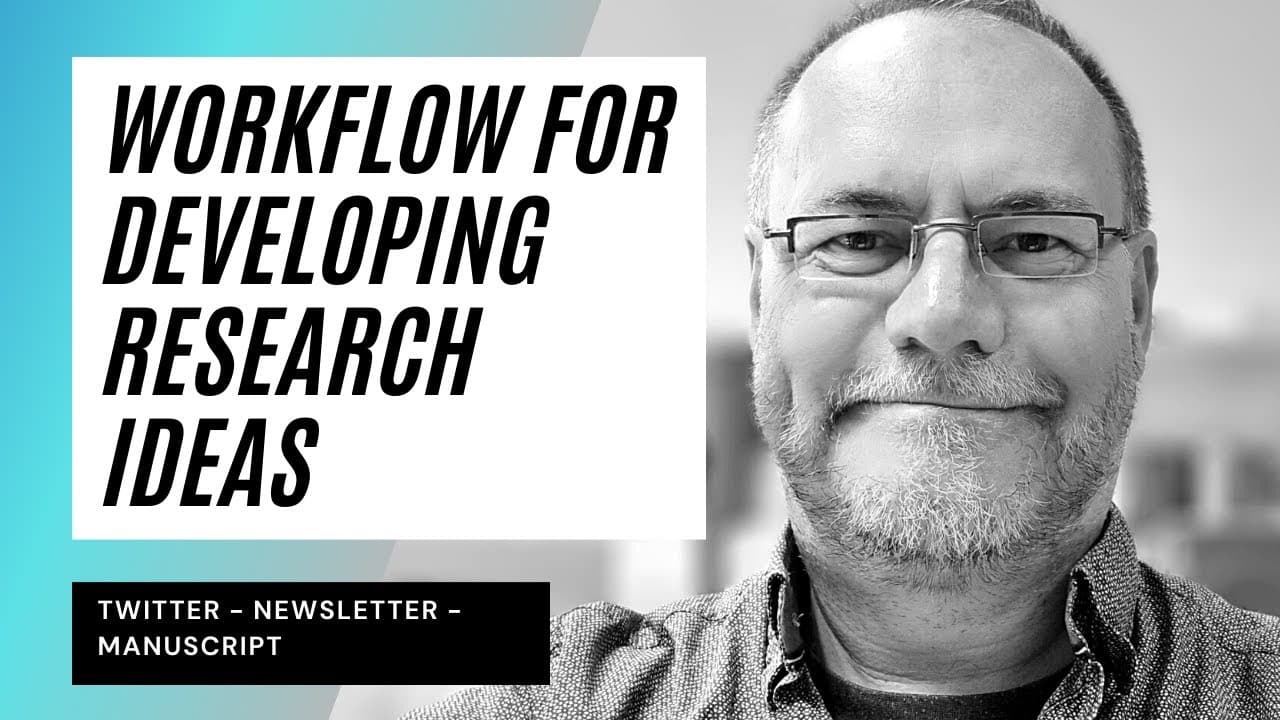
New workflow for developing research ideas (3-step process: tweet, newsletter, manuscript)
TL;DR
The author shares a new workflow for developing research ideas publicly, involving stages of Twitter/Mastodon posts, a Substack newsletter, and potential manuscript development.
Transcript
hi there I recently tried out a new way of more publicly developing research ideas for example for Viewpoint and opinion papers and I want to share that here with you well this new workflow for developing research ideas it has three stages so the first stage is a short message on Twitter or Mastodon that just has a very brief outline of what the id... Read More
Key Insights
- 👻 The workflow allows for more extensive feedback and refinement of early-stage research ideas.
- 🥶 It could potentially lead to co-author recruitment and grant proposal development.
- 🔉 Sharing Substack newsletters with non-social media individuals can be advantageous for collaboration.
- ❓ The workflow encourages the author to write regularly and systematically.
- 💡 Caution should be exercised when sharing very early-stage ideas to avoid idea theft.
- 💗 The response and input received may vary, and the workflow requires time to grow.
- 🙈 The author sees this as an experimental approach and does not recommend it for all ideas.
Install to Summarize YouTube Videos and Get Transcripts
Explore YouTube Video Summarizer or Get YouTube Transcript Extractor
Questions & Answers
Q: What are the three stages involved in this new workflow for developing research ideas?
The three stages are: a short message on Twitter or Mastodon, a Substack newsletter incorporating feedback, and potential manuscript development.
Q: What advantages does the author see in using this workflow?
The advantages include eliciting broader feedback, refining ideas, potential co-author recruitment, and opportunities for grant proposal development.
Q: Are there any drawbacks to this workflow?
The author acknowledges the risk of idea theft and the limited initial response as potential drawbacks.
Q: What does the author do with the Substack newsletters besides incorporating feedback?
The author also shares the newsletters with individuals who may not be on social media, seeking contributions to develop the ideas into manuscripts.
Summary & Key Takeaways
-
The workflow involves three stages: a brief outline of the idea on Twitter/Mastodon, incorporating feedback into a Substack newsletter, and potentially developing a manuscript from the newsletter.
-
The advantages of this workflow include eliciting broader feedback, refining ideas, and potential co-author recruitment or grant proposal development.
-
Drawbacks include the risk of idea theft and the limited initial response, but the author considers it an experimental approach for early-stage ideas.
Read in Other Languages (beta)
Share This Summary 📚
Summarize YouTube Videos and Get Video Transcripts with 1-Click
Try YouTube Summary with ChatGPT & Claude or YouTube Transcript Generator
Explore More Summaries from Life in academia 📚

Summarize YouTube Videos and Get Video Transcripts with 1-Click
Try YouTube Summary with ChatGPT & Claude or YouTube Transcript Generator