Long division with decimals | Arithmetic operations | 5th grade | Khan Academy
TL;DR
Learn how to divide decimals by whole numbers using long division.
Transcript
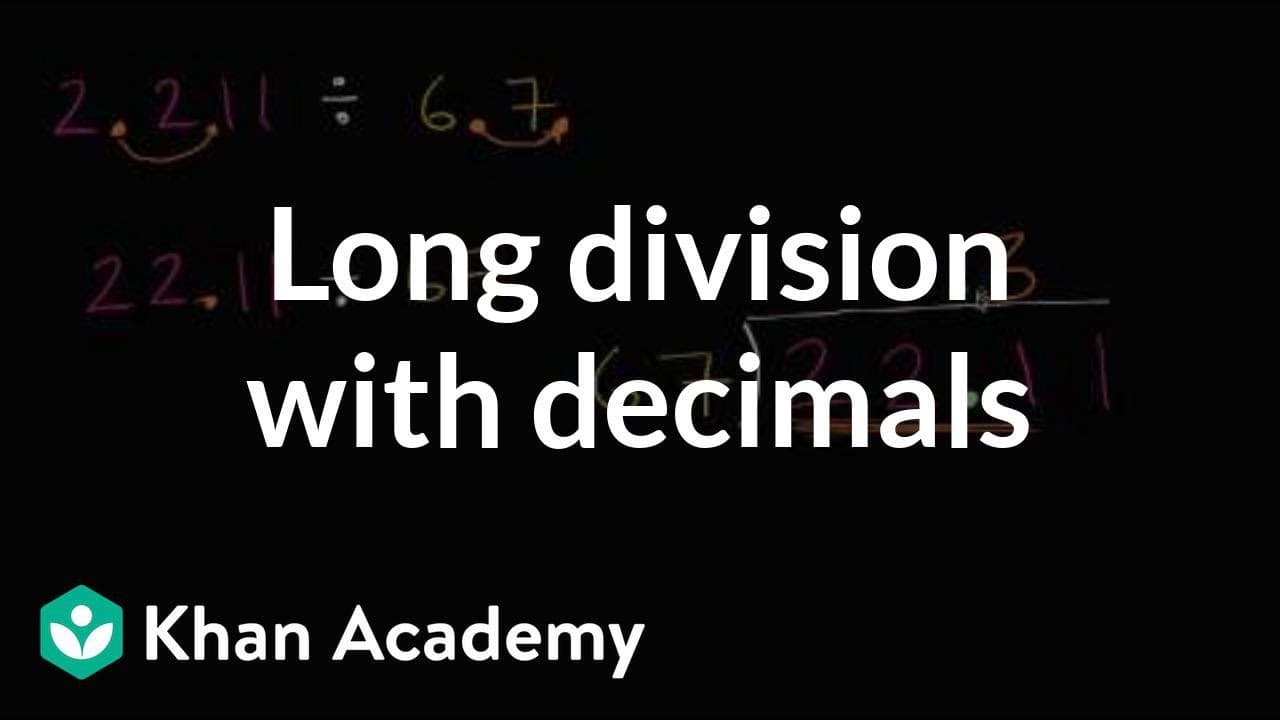
- [Voiceover] Let's figure out what 2.211 divided by 6.7 is. So the first thing I like to do is, I don't like to divide by a decimal. So I'm going to multiply 6.7, I'm going to multiply 6.7 by 10, which is essentially just taking this decimal and moving it one space to the right. Well I can't just do that to the 6.7, I also have to do that to the 2... Read More
Key Insights
- 👉 Dividing decimals by whole numbers requires moving the decimal point one space to the right for both the dividend and divisor.
- 😥 Keeping track of the decimal point in the quotient while performing long division is essential for accurate results.
- 👻 Neatly writing and organizing the numbers in long division helps prevent errors and allows for easier understanding.
- 😘 Adjust the quotient if the initial guess is too high or too low by checking the remainder.
- ➗ The division process is complete when there are no more digits to bring down and the remainder is less than the divisor.
- ➗ Long division is an effective method for dividing decimals by whole numbers.
- #️⃣ Dividing decimal numbers by whole numbers helps in solving real-life problems that involve proportions or ratios.
Install to Summarize YouTube Videos and Get Transcripts
Explore YouTube Video Summarizer or Get YouTube Transcript Extractor
Questions & Answers
Q: How do you divide decimals by whole numbers?
To divide decimals by whole numbers, you can multiply the decimal by 10 and move the decimal point one space to the right for both the dividend and divisor before performing long division.
Q: Why is it important to write things neatly and keep track of place value in long division problems?
Writing things neatly and keeping track of place value is crucial in long division because it helps prevent errors and ensures accurate calculations. It also makes it easier to understand and follow the steps in the division process.
Q: What do you do if the initial guess for the quotient is too high or too low?
If the initial guess for the quotient is too high, the remainder will be larger than the divisor. In contrast, if the initial guess is too low, the remainder will be smaller than the divisor. Adjust the quotient accordingly to ensure an accurate result.
Q: How do you determine when the division process is complete?
The division process is complete when there are no more digits to bring down from the dividend and the remainder is less than the divisor. At this point, the quotient is the final result.
Summary & Key Takeaways
-
Start by moving the decimal point one space to the right for both the dividend and divisor to avoid dividing by a decimal.
-
Rewrite the problem with the new whole number divisor and perform long division as usual.
-
Keep track of the decimal point in the quotient and ensure neat column placement to avoid errors.
Read in Other Languages (beta)
Share This Summary 📚
Summarize YouTube Videos and Get Video Transcripts with 1-Click
Try YouTube Summary with ChatGPT & Claude or YouTube Transcript Generator
Explore More Summaries from Khan Academy 📚



Summarize YouTube Videos and Get Video Transcripts with 1-Click
Try YouTube Summary with ChatGPT & Claude or YouTube Transcript Generator