Worked example: finding relative extrema | AP Calculus AB | Khan Academy
TL;DR
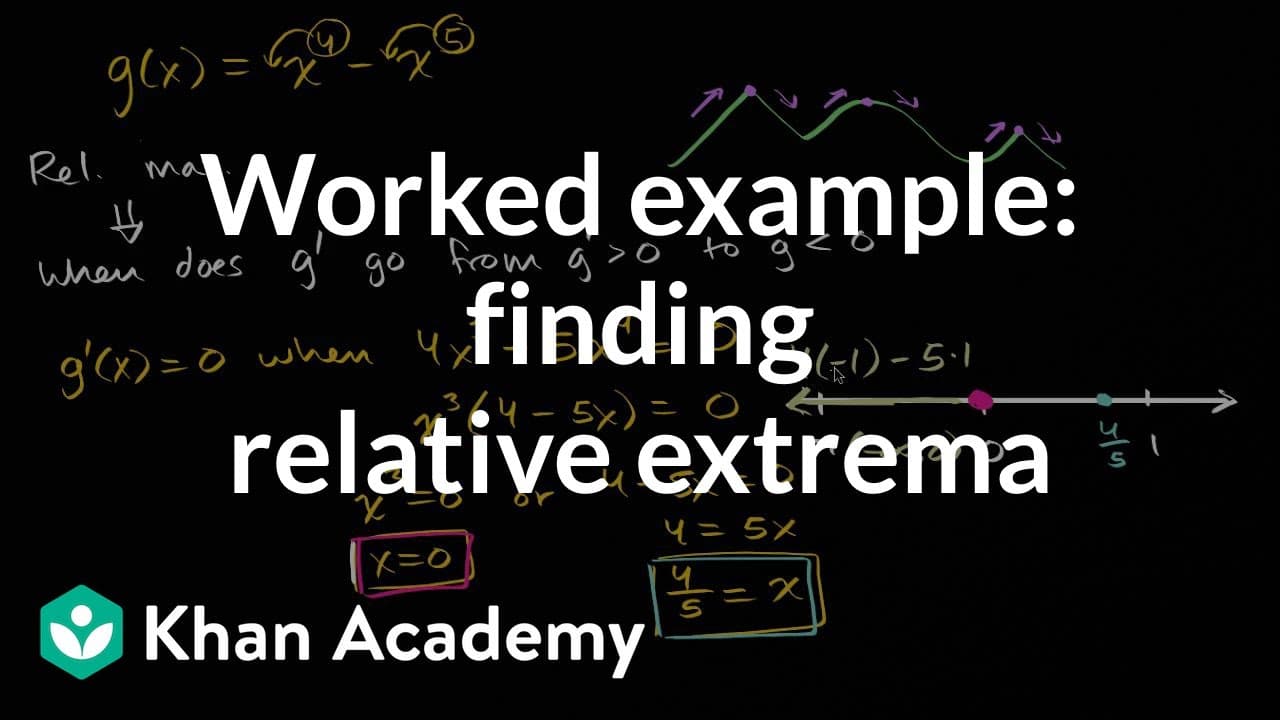
Determine the x-values at which a function has a relative maximum by analyzing its derivative.
Transcript
- [Voiceover] So we have g(x) being equal to x to the fourth minus x to the fifth, and what we wanna do without having to graph g, we want to figure out at what x values does g have a relative maximum? And just to remind us what's going on in a relative maximum, so let me draw a hypothetical function right over here, so a relative maximum is going ... Read More
Key Insights
- ❓ A relative maximum occurs when the function transitions from increasing to decreasing.
- 😥 Critical points, where the derivative is zero or undefined, could be potential locations for relative maxima.
- 🆘 Analyzing the behavior of the derivative helps determine the increasing or decreasing nature of the function.
- #️⃣ Polynomial functions often have defined derivatives for all real numbers.
- 😥 By evaluating the derivative on either side of critical points, one can identify relative maximum points.
- 👈 The x-values where the function goes from increasing to decreasing represent relative maximum points.
- 👈 The process involves finding critical points, determining the behavior of the function around these points, and identifying the x-values where the function transitions from increasing to decreasing.
Install to Summarize YouTube Videos and Get Transcripts
Explore YouTube Video Summarizer or Get YouTube Transcript Extractor
Questions & Answers
Q: How can we determine where a function has a relative maximum without graphing it?
By analyzing the behavior of the first derivative of the function. When the derivative transitions from positive to negative, it signifies a relative maximum.
Q: What are critical points in relation to finding a relative maximum?
Critical points are x-values where the derivative is either zero or undefined. These points are potential candidates for relative maxima.
Q: How do we find the critical points of a function?
Set the derivative equal to zero and solve for x. Also, check for values where the derivative is undefined, which is rare for polynomial functions.
Q: How do we determine the increasing or decreasing behavior of the function?
Evaluate the derivative at a point in each interval around the critical points. If the derivative is positive, the function is increasing, and if it's negative, the function is decreasing.
Q: What does it mean when the function transitions from increasing to decreasing at a specific x-value?
This indicates the presence of a relative maximum point at that x-value.
Summary & Key Takeaways
-
To find the x-values where a function has a relative maximum, analyze the behavior of its first derivative.
-
Critical points are where the derivative is either zero or undefined, which are potential locations for the relative maximum.
-
Evaluate the derivative on either side of the critical points to determine the increasing or decreasing behavior of the function.
-
The x-values where the function transitions from increasing to decreasing represent the relative maximum points.
Read in Other Languages (beta)
Share This Summary 📚
Summarize YouTube Videos and Get Video Transcripts with 1-Click
Try YouTube Summary with ChatGPT & Claude or YouTube Transcript Generator
Explore More Summaries from Khan Academy 📚



Summarize YouTube Videos and Get Video Transcripts with 1-Click
Try YouTube Summary with ChatGPT & Claude or YouTube Transcript Generator