Formal definition for limit of a sequence | Series | AP Calculus BC | Khan Academy
TL;DR
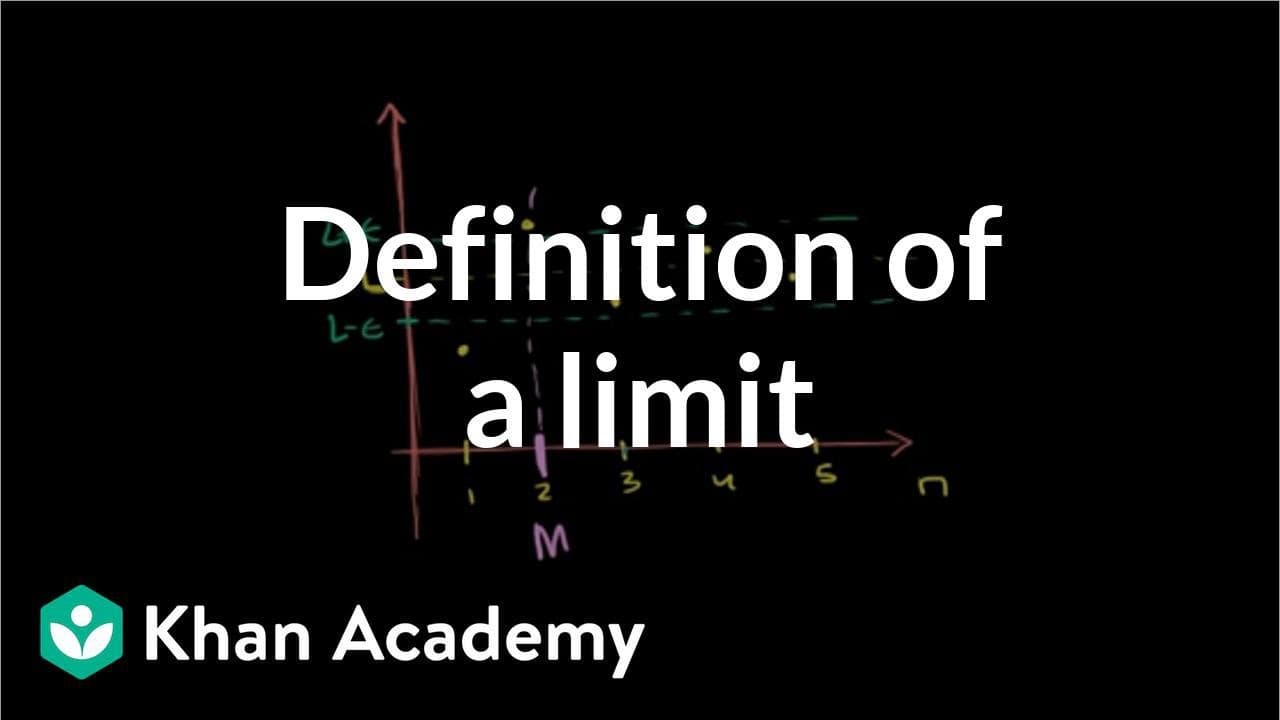
This video explains the concept of converging to a value, L, as a sequence approaches infinity, using a definition that is similar to the limit of a function as it approaches infinity.
Transcript
what i want to do in this video is to provide ourselves with a rigorous definition of what it means to take the limit of a sequence as n approaches infinity and what we'll see is actually very similar to the definition of any function as a limit approaches infinity and this is because the sequences really can be just viewed as a function of their i... Read More
Key Insights
- ⛔ Taking the limit of a sequence as n approaches infinity is similar to the limit of a function as it approaches infinity.
- 🗽 Convergence is determined by the distance between a(n) and L being less than any positive epsilon.
- 🤶 The positive M in the definition serves as a threshold for n.
- 🥹 The definition holds for any positive epsilon.
- 😚 Convergence can be visually observed as a sequence getting progressively closer to the desired value, L.
- 👻 The definition allows for the proof of sequence convergence.
- 🫵 Sequences can be viewed as functions of their indices.
Install to Summarize YouTube Videos and Get Transcripts
Explore YouTube Video Summarizer or Get YouTube Transcript Extractor
Questions & Answers
Q: How does the definition of taking the limit of a sequence as n approaches infinity relate to the limit of a function?
The definition is similar because sequences can be seen as functions of their indices. Convergence to a value, L, is determined by the distance between a(n) and L being less than any positive epsilon.
Q: Can you explain the significance of the positive M in the definition?
The positive M serves as a threshold. If n is greater than M, it guarantees that a(n) will be within epsilon of L, which signifies convergence.
Q: Does the definition apply to any positive epsilon?
Yes, the definition holds for any positive epsilon. The goal is to show that regardless of how small or large epsilon is, there exists a positive M where the distance between a(n) and L is within epsilon.
Q: How is convergence visually represented using the definition?
Convergence is shown by the fact that as n becomes larger than M, a(n) gets closer to L. Visually, this can be seen as a sequence progressively approaching the horizontal line representing L.
Summary & Key Takeaways
-
The video provides a rigorous definition of taking the limit of a sequence as n approaches infinity, which is similar to the definition of a function's limit as it approaches infinity.
-
A sequence can be viewed as a function of its indices, and the goal is to determine what it means for a sequence to converge to a value, L.
-
The definition states that for any positive epsilon, there exists a positive M such that if n is greater than M, the distance between a(n) and L is less than epsilon.
Read in Other Languages (beta)
Share This Summary 📚
Summarize YouTube Videos and Get Video Transcripts with 1-Click
Try YouTube Summary with ChatGPT & Claude or YouTube Transcript Generator
Explore More Summaries from Khan Academy 📚



Summarize YouTube Videos and Get Video Transcripts with 1-Click
Try YouTube Summary with ChatGPT & Claude or YouTube Transcript Generator