Multiply monomials by polynomials: Area model | Algebra 1 | Khan Academy
TL;DR
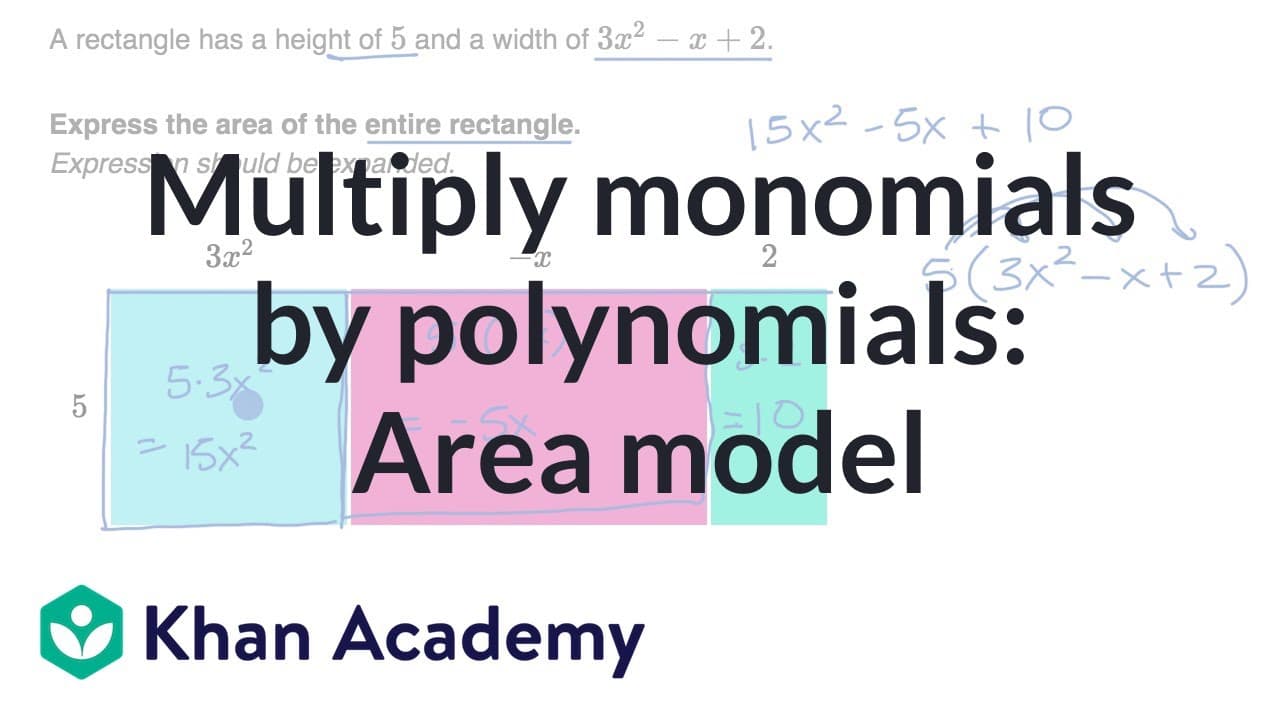
This video demonstrates how to find the area of rectangles with algebraic expressions by breaking them down into smaller areas and expanding the expression.
Transcript
- [Instructor] We are told a rectangle has a height of five and a width of 3x squared minus x plus two. Then we're told express the area of the entire rectangle, and the expression should be expanded. So pause this video and see if you could work through this. All right, now let's work through this together. What this diagram is showing us is exact... Read More
Key Insights
- 😑 The area of a rectangle with algebraic expressions for height and width can be found by breaking it down into smaller areas.
- 😑 The dimensions of the rectangle can include algebraic expressions that may have positive or negative values.
- 😑 The concept of distributing one dimension across the other dimensions helps simplify the expression for the area.
- 🔨 Area models are a helpful tool to visualize and understand the distributive property.
- 🥳 The total area of the rectangle is the sum of the areas of its individual parts.
- 🎮 The diagram in the video is not drawn to scale and is only used to illustrate the concept.
- 😑 Algebraic expressions allow for flexibility in representing various mathematical quantities.
Install to Summarize YouTube Videos and Get Transcripts
Explore YouTube Video Summarizer or Get YouTube Transcript Extractor
Questions & Answers
Q: How can we find the area of a rectangle with algebraic expressions for height and width?
To find the area, we break down the rectangle into smaller areas and multiply the corresponding dimensions. The total area is the sum of these areas.
Q: Can we have a negative width for a rectangle in algebraic expressions?
In algebraic expressions, the values of variables like x can be positive or negative. So, depending on the value of x, the width of the rectangle can be positive or negative.
Q: Is the diagram in the video drawn to scale?
No, the diagram is not drawn to scale. It is only used as an indicative representation to demonstrate the concept. The relative sizes of the areas may not be accurate.
Q: How can we use area models to simplify the expression for the area?
Area models help understand the distributive property. By multiplying the height with the entire width expression, the distributive property can be applied to obtain the simplified expression for the area.
Summary & Key Takeaways
-
The video explains how to find the area of a rectangle with a given height and width expressed as algebraic expressions.
-
The area of the rectangle can be found by breaking it down into smaller areas and multiplying the corresponding dimensions.
-
The concept of distributing the value of one dimension across the other dimensions is emphasized.
Read in Other Languages (beta)
Share This Summary 📚
Summarize YouTube Videos and Get Video Transcripts with 1-Click
Try YouTube Summary with ChatGPT & Claude or YouTube Transcript Generator
Explore More Summaries from Khan Academy 📚



Summarize YouTube Videos and Get Video Transcripts with 1-Click
Try YouTube Summary with ChatGPT & Claude or YouTube Transcript Generator