Solving square-root equations: two solutions | Mathematics III | High School Math | Khan Academy
TL;DR
Learn how to solve radical equations by isolating the radical, squaring both sides, and testing solutions for validity.
Transcript
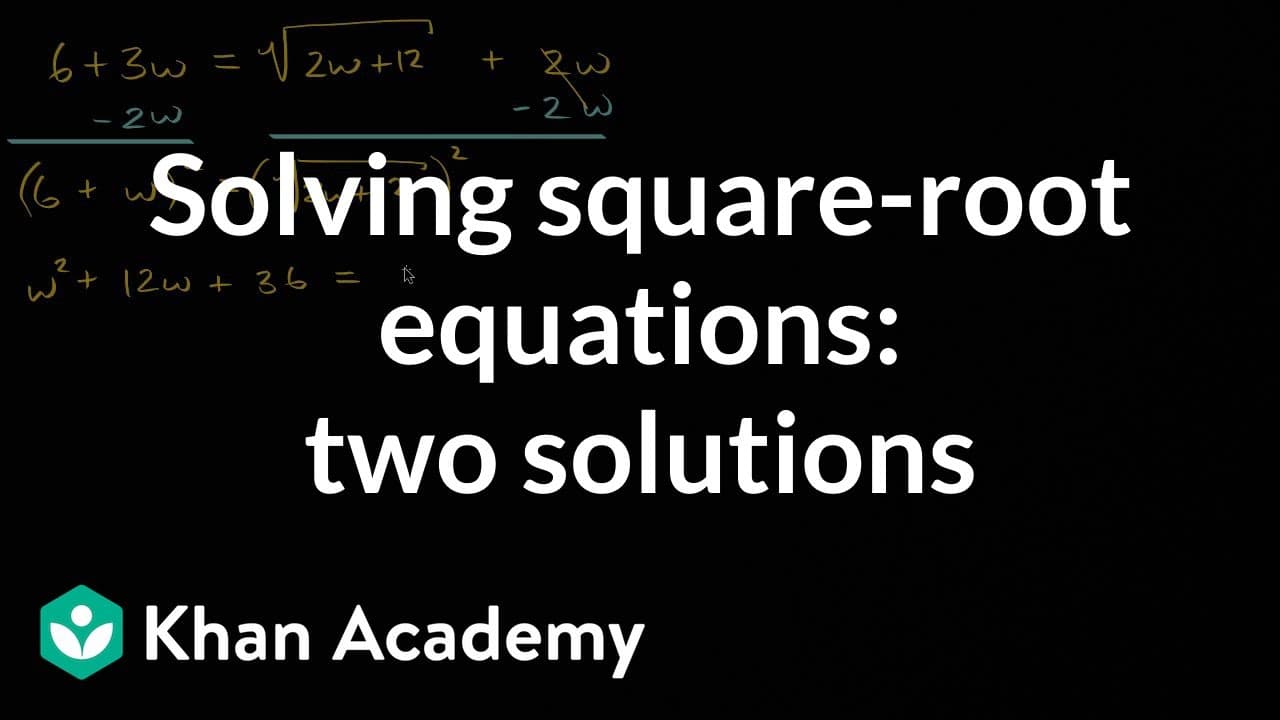
- [Voiceover] Let's say that we have the equation six plus three w is equal to the square root of two w plus 12 plus two w. See if you can pause the video and solve for w, and it might have more than one solution, so keep that in mind. Alright, now let's work through this together. So the first thing I'd like to do whenever I see one of these radic... Read More
Key Insights
- 🤘 Isolate the radical sign on one side of the equation before solving a radical equation.
- 🙃 Squaring both sides of the equation allows for the elimination of the radical sign.
- ❓ Be aware of the possibility of extraneous solutions when solving radical equations.
- 🏆 Validating solutions by testing them with the original equation is crucial in ensuring accuracy.
- 🙃 Factoring can help simplify and solve quadratic expressions that appear after squaring both sides.
- 🙈 Zero times any value, as seen in the factoring step, will result in a solution.
- ❎ Negative values are valid solutions in radical equations.
Install to Summarize YouTube Videos and Get Transcripts
Explore YouTube Video Summarizer or Get YouTube Transcript Extractor
Questions & Answers
Q: How do you begin solving a radical equation?
To solve a radical equation, start by isolating the radical sign on one side of the equation, typically by subtracting or adding terms on both sides.
Q: Why is it important to square both sides of a radical equation?
Squaring both sides allows you to eliminate the radical sign, allowing for further simplification and solution finding.
Q: What is an extraneous solution in the context of radical equations?
An extraneous solution is a solution that satisfies a squared equation but does not satisfy the original equation. It arises due to the nature of squaring radicals, which may introduce additional values.
Q: Why is it necessary to test solutions for validity?
Testing solutions ensures that they satisfy the original equation, as squared equations may introduce extraneous solutions. This step helps identify solutions that are valid.
Summary & Key Takeaways
-
The video teaches how to solve radical equations by isolating the radical sign on one side of the equation.
-
The process involves squaring both sides of the equation and may result in extraneous solutions.
-
Testing the solutions to see if they are valid for the original equation is necessary.
Read in Other Languages (beta)
Share This Summary 📚
Summarize YouTube Videos and Get Video Transcripts with 1-Click
Try YouTube Summary with ChatGPT & Claude or YouTube Transcript Generator
Explore More Summaries from Khan Academy 📚



Summarize YouTube Videos and Get Video Transcripts with 1-Click
Try YouTube Summary with ChatGPT & Claude or YouTube Transcript Generator