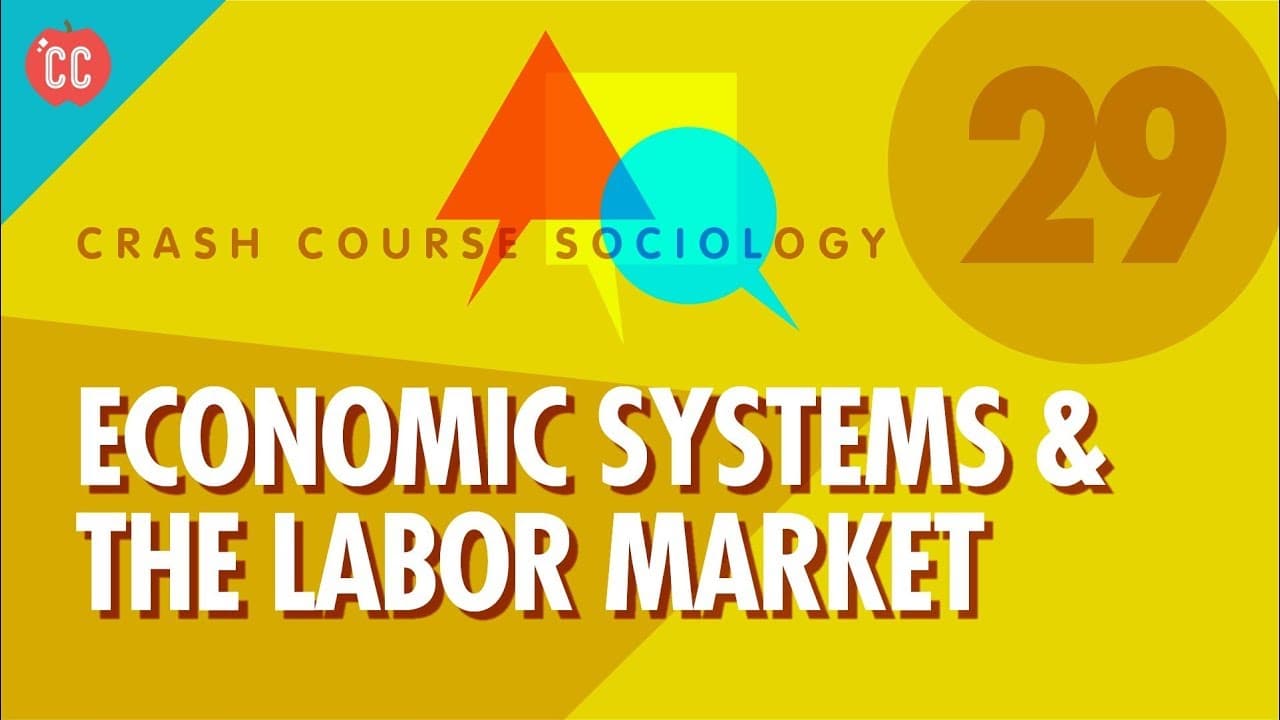
Economic Systems & the Labor Market: Crash Course Sociology #29
TL;DR
Explores economic systems, labor markets, and historical economic revolutions.
Transcript
A social institution that has one of the biggest impacts on society is the economy. And you might think of the economy in terms of numbers – unemployment numbers, GDPs, or whatever the stock market is doing today. But while we often talk about it in numerical terms, the economy is really made of people! It’s the social institution that organizes al... Read More
Key Insights
- The economy, a crucial social institution, organizes production, consumption, and trade, impacting societal structures and individual lives.
- Economic systems like capitalism and socialism shape societal living conditions and influence economic efficiency and inequality.
- The agrarian revolution enabled surplus production, leading to permanent settlements, trade networks, and population growth.
- The industrial revolution introduced mass production and specialization, improving living standards but also increasing economic inequality.
- Labor unions emerged to combat poor working conditions and low wages, advocating for workers' rights and fair labor practices.
- Capitalism relies on private ownership and competition, while socialism emphasizes collective ownership and equal distribution of resources.
- The information revolution is transforming economies, reducing manufacturing roles and increasing service and idea-based jobs.
- Corporations, operating globally, are pivotal in the current economic landscape, influencing both economic and political spheres.
Install to Summarize YouTube Videos and Get Transcripts
Explore YouTube Video Summarizer or Get YouTube Transcript Extractor
Questions & Answers
Q: What are the three sectors of an economy?
The three sectors of an economy are the primary, secondary, and tertiary sectors. The primary sector involves the extraction of raw materials, such as farming and mining. The secondary sector focuses on transforming these raw materials into manufactured goods. The tertiary sector provides services rather than goods, including roles like teachers and lawyers.
Q: How did the agrarian revolution impact societies?
The agrarian revolution allowed societies to produce surplus food, leading to permanent settlements, trade networks, and population growth. It marked a shift from hunter-gatherer societies to agricultural economies, enabling more complex societal structures and the development of different economic roles beyond mere subsistence farming.
Q: What were the effects of the industrial revolution?
The industrial revolution introduced mass production, specialization, and wage labor, significantly increasing productivity and living standards. However, it also led to economic inequality, with workers facing poor conditions and low wages. This era saw the rise of labor unions advocating for workers' rights and better working conditions.
Q: How do capitalism and socialism differ?
Capitalism emphasizes private ownership and profit-driven efficiency, with competition as a key driver. In contrast, socialism focuses on collective ownership and equitable resource distribution, aiming to meet everyone's basic needs. While capitalism can lead to market failures and inequality, socialism aims for social equality but often struggles with political power concentration.
Q: What is the information revolution?
The information revolution is an ongoing economic transformation characterized by a shift from manufacturing-based economies to those centered on services and idea production. Technology reduces the need for human labor in traditional roles, leading to job automation and offshoring, impacting labor markets and economic structures globally.
Q: Why do market failures occur in capitalism?
Market failures in capitalism occur when an unregulated market allocates resources inefficiently. Examples include monopolies, where lack of competition allows companies to charge higher prices. Governments may intervene to correct these failures by regulating industries or breaking up monopolies to ensure fair competition and consumer protection.
Q: What role do corporations play in modern economies?
Corporations are crucial in modern economies, operating as legal entities with separate liabilities from their members. They often function across national boundaries, influencing global economic and political landscapes. Corporations drive economic activity, impact labor markets, and play a significant role in shaping economic policies and international trade.
Q: How has the labor market changed in post-industrial societies?
In post-industrial societies, the labor market has shifted from agriculture and manufacturing to service-oriented roles. The tertiary sector now dominates, comprising a diverse range of jobs from healthcare to education. This shift reflects broader economic changes driven by technological advances, altering job availability, skills demand, and employment patterns.
Summary & Key Takeaways
-
The video discusses how economies are structured into primary, secondary, and tertiary sectors, each playing a role in production and services. It highlights historical economic revolutions, including the agrarian and industrial revolutions, which shifted societies from subsistence farming to industrialized economies, impacting labor markets and living standards.
-
Capitalism and socialism are explored as competing economic models. Capitalism focuses on private ownership and profit-driven efficiency, while socialism emphasizes collective ownership and meeting basic needs. The video also addresses the challenges and benefits of each system, including issues like market failures and income inequality.
-
The ongoing information revolution is reshaping the labor market, with a shift from manufacturing to service and idea-based jobs. The video highlights the decline of traditional labor roles and the increasing significance of corporations in a globalized economy, affecting both economic and political dynamics.
Read in Other Languages (beta)
Share This Summary 📚
Summarize YouTube Videos and Get Video Transcripts with 1-Click
Try YouTube Summary with ChatGPT & Claude or YouTube Transcript Generator
Explore More Summaries from CrashCourse 📚


Summarize YouTube Videos and Get Video Transcripts with 1-Click
Try YouTube Summary with ChatGPT & Claude or YouTube Transcript Generator