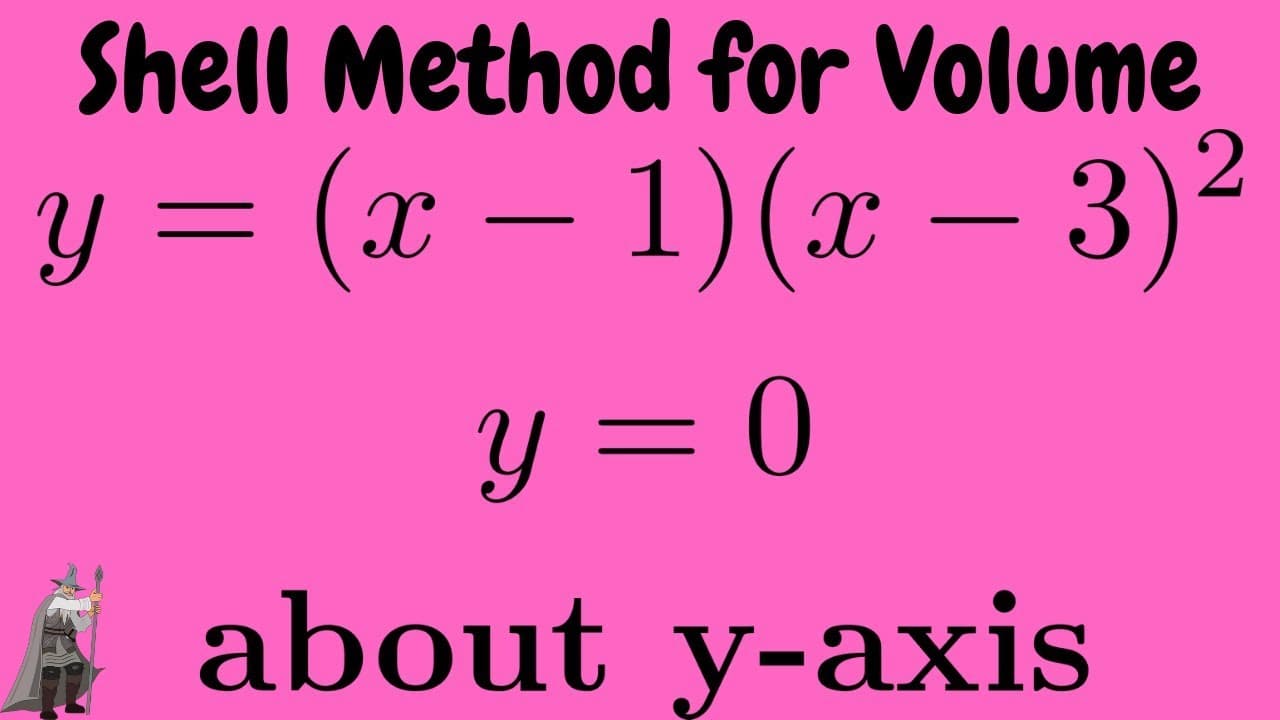
Shell Method Volume of Solid y = (x - 1)(x - 3)^2, y = 0, about y-axis
TL;DR
Finding volume using the shell method by rotating a region around the y-axis.
Transcript
in this problem we're being asked to find the volume of the solid that we get when we rotate this bounded region about the y-axis let's come over here and do a preliminary sketch so this polynomial function has two zeros uh one and three so here's one two three we know that the multiplicity of one if you recall from algebra i guess is one and the m... Read More
Key Insights
- 🦻 Understanding the behavior of the function around its zeros aids in visualizing and approaching the volume calculation problem effectively.
- 🐚 The choice of the shell method for finding solid rotation volumes depends on the orientation of the rectangles parallel to the axis of revolution.
- 😫 The average radius p(x) and function height h(x) play crucial roles in setting up the integral formula for calculating the solid's volume accurately.
- 🔇 Utilizing the prescribed formula for volume calculations with the shell method ensures a systematic approach to determining the resulting volume of rotation.
Install to Summarize YouTube Videos and Get Transcripts
Explore YouTube Video Summarizer or Get YouTube Transcript Extractor
Questions & Answers
Q: How are the zeros of the polynomial function used in determining the volume of the solid?
The zeros, such as 1 and 3 in this case, help in understanding the form of the function and its behavior around those points, crucial for setting up the volume integral calculation accurately.
Q: Why is the shell method specifically chosen for finding the volume in this scenario?
The shell method is suitable since the rectangles are parallel to the axis of revolution (y-axis), simplifying the integral setup by considering the height and average radius of each shell.
Q: What role does the multiplicity of the zeros play in the shape of the solid generated upon rotation?
The multiplicity, whether odd or even, affects how the polynomial curve interacts with the x-axis, influencing whether the solid will cross or touch the axis upon rotation.
Q: How can one confirm the correctness of the volume calculation obtained using the shell method for solid rotation?
Utilizing calculators or mathematical software to check the volume integral and its evaluation ensures the accuracy of the final result obtained in this problem-solving process.
Summary & Key Takeaways
-
Given a polynomial function with zeros at 1 and 3, the volume of the solid formed by rotating the bounded region around the y-axis is calculated using the shell method.
-
Identifying h(x) as the function height and p(x) as the average radius, the volume integral is setup and solved using the given formula.
-
The final volume calculation yields 24π/5 units cubed using the prescribed method.
Read in Other Languages (beta)
Share This Summary 📚
Summarize YouTube Videos and Get Video Transcripts with 1-Click
Try YouTube Summary with ChatGPT & Claude or YouTube Transcript Generator
Explore More Summaries from The Math Sorcerer 📚



Summarize YouTube Videos and Get Video Transcripts with 1-Click
Try YouTube Summary with ChatGPT & Claude or YouTube Transcript Generator