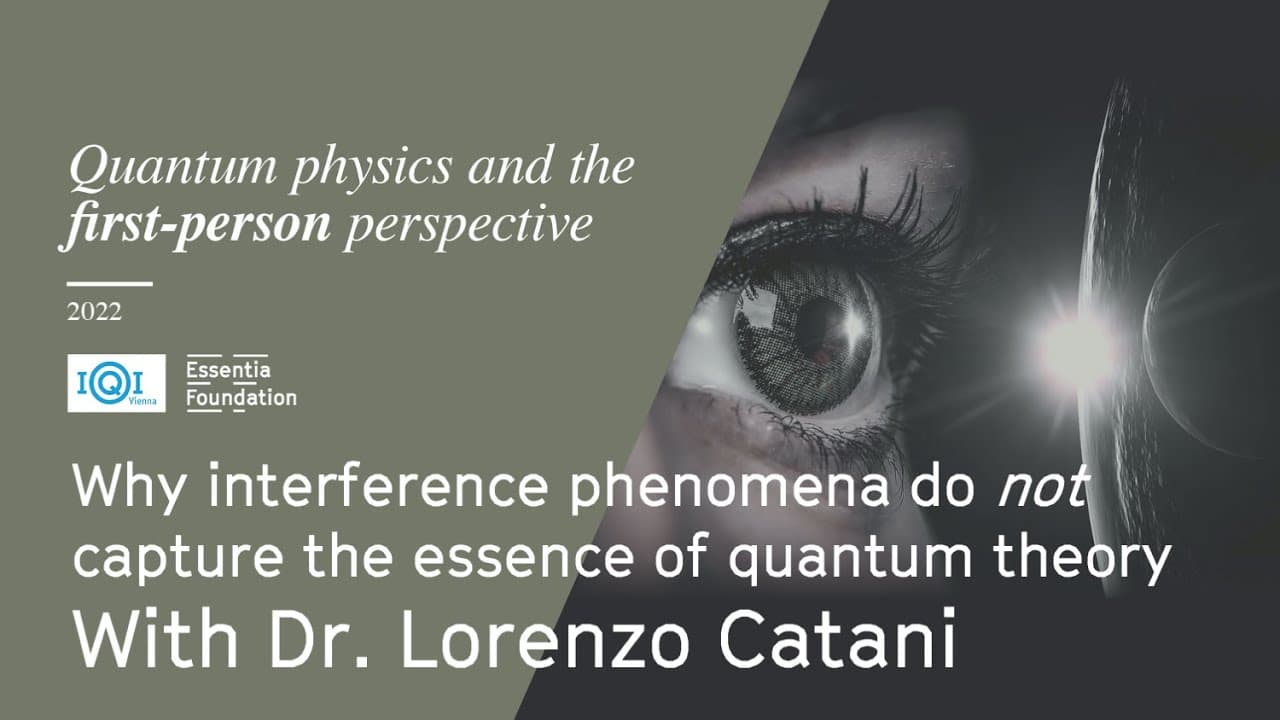
Why interference phenomena do not capture the essence of quantum theory, with Dr. Lorenzo Catani
TL;DR
Classical statistical theory provides an explanation for quantum interference phenomena, challenging interpretational claims, with implications for understanding quantum theory.
Transcript
foreign speaker of today which is Lorenzo katani Lorenzo that is PhD in 2018 at University College London he's been a postdoc at Chapman University in California and now he's a postdocal researcher at to Berlin and he will tell us about why interference phenomena do not capture the essence of quantum theory uh yeah thanks for the introduction and t... Read More
Key Insights
- 🏛️ The toy field theory demonstrates a classical statistical model's ability to reproduce quantum interference without invoking radical interpretational claims, shedding light on the nature of classical and quantum phenomena.
- 👋 By utilizing epistemic restrictions and deterministic local dynamics, the toy field theory challenges traditional notions of wave-particle duality and observer dependence in the context of quantum interference.
- 🏛️ Interference phenomena, once viewed as inherently mysterious, can be explained through classical means, emphasizing the importance of distinguishing between genuine non-classical aspects of quantum theory and mere phenomenological effects.
Install to Summarize YouTube Videos and Get Transcripts
Explore YouTube Video Summarizer or Get YouTube Transcript Extractor
Questions & Answers
Q: How does the toy field theory explain the wave-particle duality relations?
The toy field theory uses an epistemic restriction to justify an observable trade-off between wave-like fringe visibility and particle-like which-way distinguishability, exceeding classical limits and pointing towards non-classical quantum phenomena.
Q: What distinguishes the interpretational claims associated with quantum interference from the classical explanation offered by the toy field theory?
The toy field theory challenges notions like wave-particle complementarity and observer dependence by providing a classical account of quantum interference with locality and determinism, undermining the need for radical interpretational shifts in quantum theory.
Q: Can the toy field theory address more advanced quantum phenomena beyond interference patterns?
While the toy field theory focuses on reproducing interference phenomenology, future research aims to explore non-contextual violations, like Bell inequalities, to uncover the truly non-classical aspects of quantum theory.
Summary & Key Takeaways
-
Lorenzo presents a classical statistical theory, the toy field theory, to explain quantum interference phenomena with two field modes and an epistemic restriction.
-
Quantum interference, once considered mysterious, is shown to have classical explanations through simple setups like Max Cendr interferometers and quantum eraser experiments.
-
The toy field theory reproduces the trap phenomenology of quantum interference without requiring wave-particle complementarity or non-local causal explanations.
Read in Other Languages (beta)
Share This Summary 📚
Summarize YouTube Videos and Get Video Transcripts with 1-Click
Try YouTube Summary with ChatGPT & Claude or YouTube Transcript Generator
Explore More Summaries from Essentia Foundation 📚
Summarize YouTube Videos and Get Video Transcripts with 1-Click
Try YouTube Summary with ChatGPT & Claude or YouTube Transcript Generator