How To Make A Neural Network | Neural Networks Explained
TL;DR
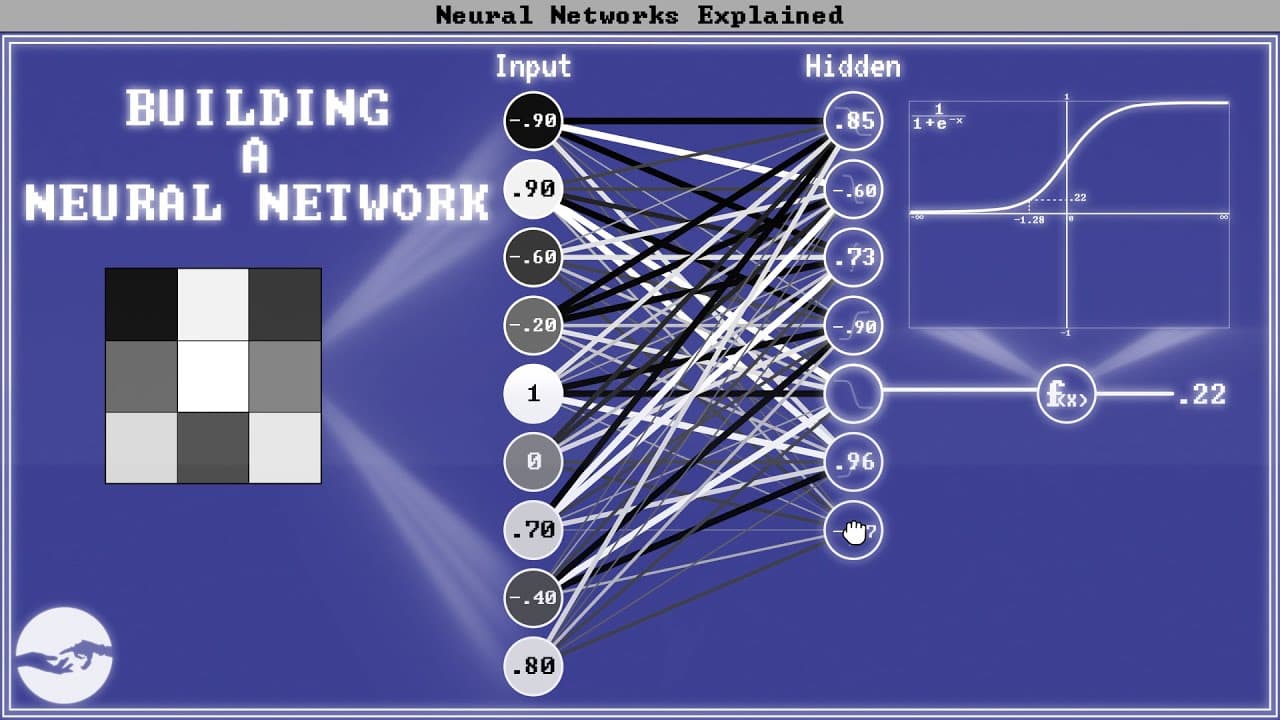
Exploring the structure and math behind neural nets to understand pattern recognition capabilities.
Transcript
To support the production of more high-quality content consider supporting us on Patreon or YouTube membership. Additionally, consider visiting our parent company, EarthOne. For sustainable living made simple! In the last video in this series, we discussed the biologically inspired structure of deep learning neural networks and built up an abstract... Read More
Key Insights
- 🏛️ Neural networks build layers of representation to classify patterns in input data.
- 🥳 Receptive fields in nodes determine which parts of the input image activate the node.
- 💐 Activation functions introduce nonlinearity and control value flow in hidden layers.
- 🏋️ Connection weights influence the importance of input values in determining node output.
- 🤳 Deep learning systems require gradient descent and backpropagation for self-learning.
- 🏛️ Building deep neural networks involves adding multiple hidden layers for complex problem-solving.
- ❎ ReLU activation functions help filter out negative values in hidden layers.
Install to Summarize YouTube Videos and Get Transcripts
Explore YouTube Video Summarizer or Get YouTube Transcript Extractor
Questions & Answers
Q: How do neural networks form representations from input data?
Neural networks form representations by processing input data through multiple layers of nodes, each layer extracting higher-level features from the input.
Q: What are receptive fields in neural networks?
The receptive field of a node in a neural network is the input values that maximize the node's activation, determining which parts of the input data that node responds to.
Q: Why are activation functions necessary in neural networks?
Activation functions are essential in neural networks to introduce nonlinearity, control the flow of values between layers, and transform raw node values into meaningful output signals.
Q: How do connection weights impact the output of a node in a neural network?
Connection weights in a neural network determine the importance of input values, influencing how strongly a node connects to output nodes and affecting the overall output.
Summary & Key Takeaways
-
Delve deeper into the structure and mathematics of neural nets to see how they form pattern recognition capabilities.
-
Illustrated through an intuitive example of building layers of representation for pattern recognition using images.
-
Detailed explanation of how input, output, hidden layers, weights, and activation functions work in neural networks.
Read in Other Languages (beta)
Share This Summary 📚
Summarize YouTube Videos and Get Video Transcripts with 1-Click
Try YouTube Summary with ChatGPT & Claude or YouTube Transcript Generator
Explore More Summaries from Futurology — An Optimistic Future 📚






Summarize YouTube Videos and Get Video Transcripts with 1-Click
Try YouTube Summary with ChatGPT & Claude or YouTube Transcript Generator