How to Make Invitations in Portuguese 🇵🇹
TL;DR
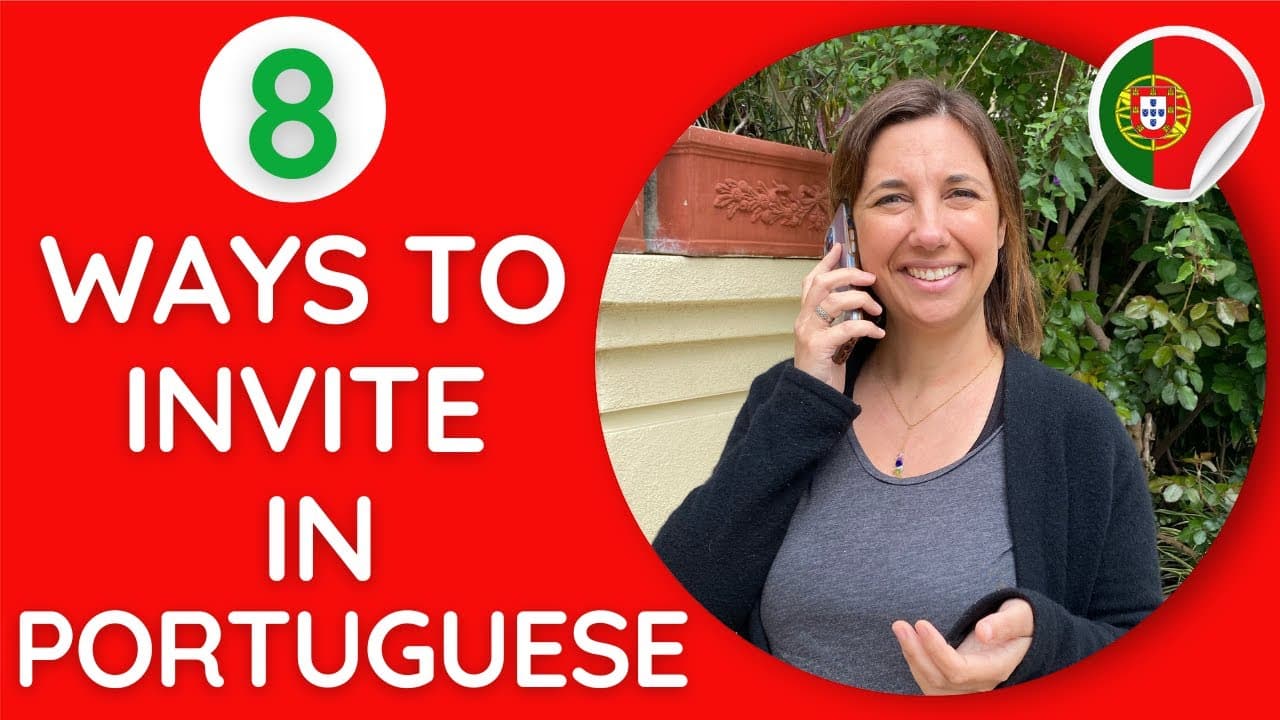
Learn eight ways to make invitations in Portuguese.
Transcript
Inviting and having social interactions are all part of our lives and, especially when we move to a new country or want to get to know a new person better. Knowing how to invite or understanding when we are being invited is very important. Today I will teach you 8 ways to make invitations in Portuguese. Some are more formal, others more casual.... Read More
Key Insights
- The verb 'convidar' is used for formal invitations and is common in written formats such as wedding invitations.
- Using 'querer' is the most neutral way to invite someone, suitable for both formal and informal situations.
- The verb 'apetecer' implies an invitation by suggesting an activity one might feel like doing.
- 'Achar' can be used to make suggestions, requiring the use of Infinitivo Pessoal, which may be challenging for beginners.
- Direct questions like 'Posso contar contigo?' serve as indirect invitations for events.
- The verb 'gostar' in the imperfect tense can be used for polite invitations, often implying the action rather than stating it directly.
- 'Anda, vamos!' is an informal and enthusiastic way to invite someone to join in an activity immediately.
- The expression 'Quando quiseres, aparece!' offers open-ended invitations, indicating the speaker's availability for a visit.
Install to Summarize YouTube Videos and Get Transcripts
Explore YouTube Video Summarizer or Get YouTube Transcript Extractor
Questions & Answers
Q: What is the most formal way to invite someone in Portuguese?
The most formal way to invite someone in Portuguese is by using the verb 'convidar' followed by the preposition 'para.' This form is commonly used in written invitations for formal events like weddings. The directness and formality of this expression make it suitable for official and ceremonial contexts.
Q: How does the verb 'querer' function in making invitations?
The verb 'querer' is used to make neutral invitations, neither too formal nor too informal. It is conjugated in the present tense in Portuguese when inviting someone, unlike in English where the conditional is used. This makes it versatile for various social settings and is especially useful for learners preparing for the CIPLE exam.
Q: What is an implicit way to invite someone using the verb 'apetecer'?
Using the verb 'apetecer' provides an implicit invitation by suggesting a shared activity. For example, asking 'Apetece-te sair este fim de semana?' translates to 'Do you feel like going out this weekend?' It implies an invitation without directly stating it, making it a casual and friendly way to propose plans.
Q: How can 'achar' be used to invite someone?
The verb 'achar' can be used to invite someone by making a suggestion, often phrased as a question. For instance, 'O que achas de irmos ao festival de música no sábado?' means 'What do you think about us going to the music festival on Saturday?' This method requires using the Infinitivo Pessoal, which may be challenging for beginners.
Q: What does the expression 'Posso contar contigo?' imply?
The expression 'Posso contar contigo?' implies an indirect invitation by asking if one can rely on the person's presence at an event. It translates to 'Can I count on you for my birthday party?' and is a polite way to gauge someone's commitment to attend without directly inviting them.
Q: How is the verb 'gostar' used in invitations?
The verb 'gostar' is used in the imperfect tense to extend polite invitations, often implying rather than explicitly stating the action. For example, 'Gostava de te convidar para a minha festa de aniversário' means 'I'd like to invite you to my birthday party.' This form is courteous and suggests the invitation subtly.
Q: What is the significance of 'Anda, vamos!' in invitations?
'Anda, vamos!' is an informal and enthusiastic invitation to join in an activity immediately. It translates to 'Come on, let's go!' and is used to encourage participation in spontaneous events, such as an impromptu outdoor cinema session. This expression conveys excitement and urgency.
Q: How does 'Quando quiseres, aparece!' function as an invitation?
The expression 'Quando quiseres, aparece!' functions as an open-ended invitation, offering the speaker's availability for a visit. It means 'Stop by anytime you would like!' and can be adapted for formality by using different verb conjugations. This phrase is welcoming and suggests that the invitee is always welcome.
Summary & Key Takeaways
-
The video provides eight different ways to make invitations in Portuguese, ranging from formal to informal expressions. It covers the use of various verbs like 'convidar,' 'querer,' 'apetecer,' and 'gostar,' explaining their contexts and nuances in inviting someone.
-
Understanding how to make invitations in Portuguese is essential for social interactions, especially for those new to the language or preparing for language proficiency exams. The video offers practical examples and phrases useful for everyday conversations and formal occasions.
-
In addition to teaching invitation phrases, the video encourages viewers to subscribe for more content on the Portuguese language and culture. It also highlights additional resources available through Patreon and social media platforms for enhanced learning experiences.
Read in Other Languages (beta)
Share This Summary 📚
Summarize YouTube Videos and Get Video Transcripts with 1-Click
Try YouTube Summary with ChatGPT & Claude or YouTube Transcript Generator
Explore More Summaries from Learn European Portuguese Online 📚



Summarize YouTube Videos and Get Video Transcripts with 1-Click
Try YouTube Summary with ChatGPT & Claude or YouTube Transcript Generator