Network Architecture Overview - Packet Switching and Access Networks - Optical Networks
TL;DR
Exploring network components like hubs, nodes, and network interface units in different network architectures.
Transcript
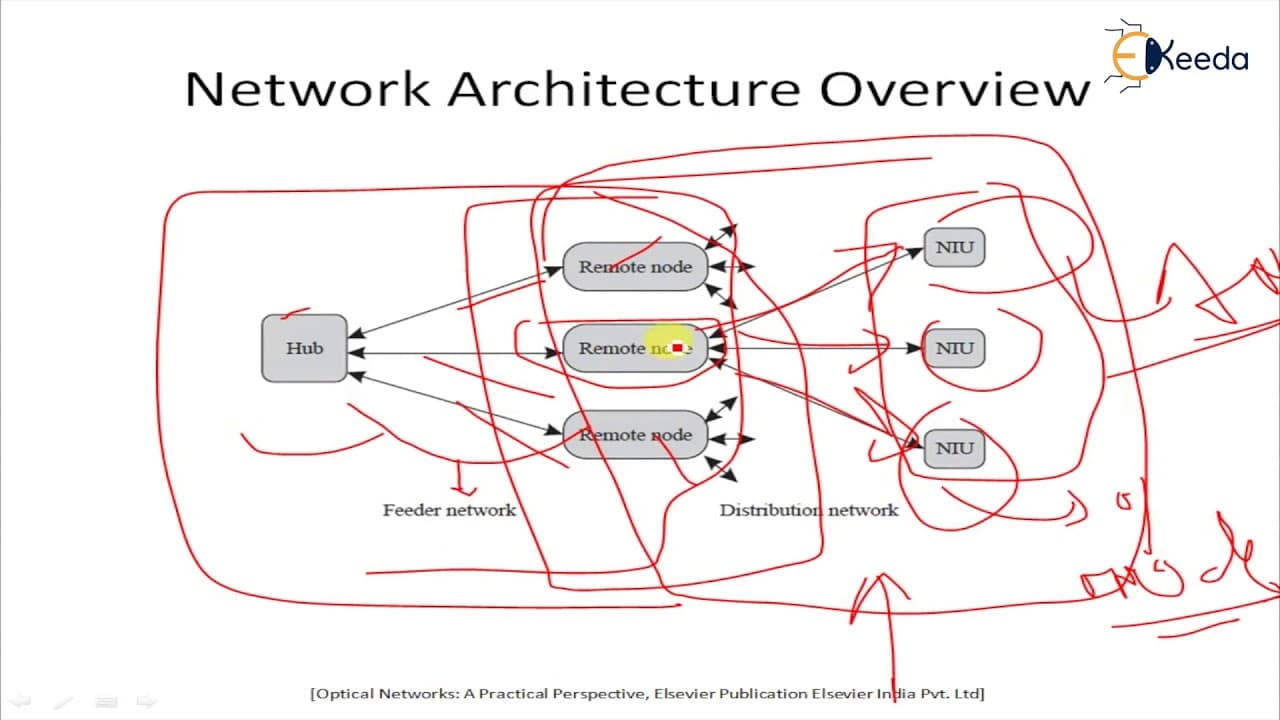
hello students here we are going to learn about network architecture overview so first xs network consists of mainly the sum of component is like hub basic device for the connections to different node remote node rn and the network interface unit so basically hub is a central office or is called one kind of local exchanger or the central controller... Read More
Key Insights
- 🛟 Hubs serve as central components connecting nodes in network architectures.
- 🇦🇪 Network architectures vary, with broadcast networks broadcasting data to all network interface units.
- 🔒 Switch networks offer increased security compared to broadcast networks.
- ❓ Feeder networks allocate bandwidth for data transmission in network architectures.
- 🚠 Telephone networks use twisted pair copper cables, while cable networks utilize fiber optics.
- 🐕🦺 Different types of network architectures provide different levels of security and service.
- ⚾ Access networks classify based on feeder network configurations and bandwidth allocation.
Install to Summarize YouTube Videos and Get Transcripts
Explore YouTube Video Summarizer or Get YouTube Transcript Extractor
Questions & Answers
Q: What is a hub in a network architecture?
A hub acts as a central controller connecting nodes in a network architecture, facilitating data transfer among devices within the network. It serves as a pivotal component for communication between various nodes.
Q: How do broadcast networks differ from switch networks in terms of data transmission?
In a broadcast network, data is broadcast to all network interface units, providing services to all devices. In contrast, switch networks segment data streams, offering more secure and selective data transmission.
Q: What role does the feeder network play in network architectures?
The feeder network between hubs and remote nodes allocates bandwidth for data transmission. It can either provide dedicated bandwidth to each network interface unit or shared bandwidth among multiple units.
Q: How do telephone networks differ from cable networks in terms of infrastructure?
Telephone networks typically use twisted pair copper cables, while cable networks utilize fiber optic cables for data transmission. Both networks offer varying bandwidth capacities and signal processing capabilities.
Summary & Key Takeaways
-
A network architecture overview delves into components like hubs, nodes, and network interface units.
-
Hubs serve as central controllers connecting different nodes in a network architecture.
-
Different network architectures like broadcast and switch networks offer various services and security levels.
Read in Other Languages (beta)
Share This Summary 📚
Summarize YouTube Videos and Get Video Transcripts with 1-Click
Try YouTube Summary with ChatGPT & Claude or YouTube Transcript Generator
Explore More Summaries from Ekeeda 📚






Summarize YouTube Videos and Get Video Transcripts with 1-Click
Try YouTube Summary with ChatGPT & Claude or YouTube Transcript Generator