Problem 3 Based on Effective Stress and Capillarity of Soils - Soil Mechanics
TL;DR
Calculating safe excavation depth in clay with artesian pressure and groundwater table consideration.
Transcript
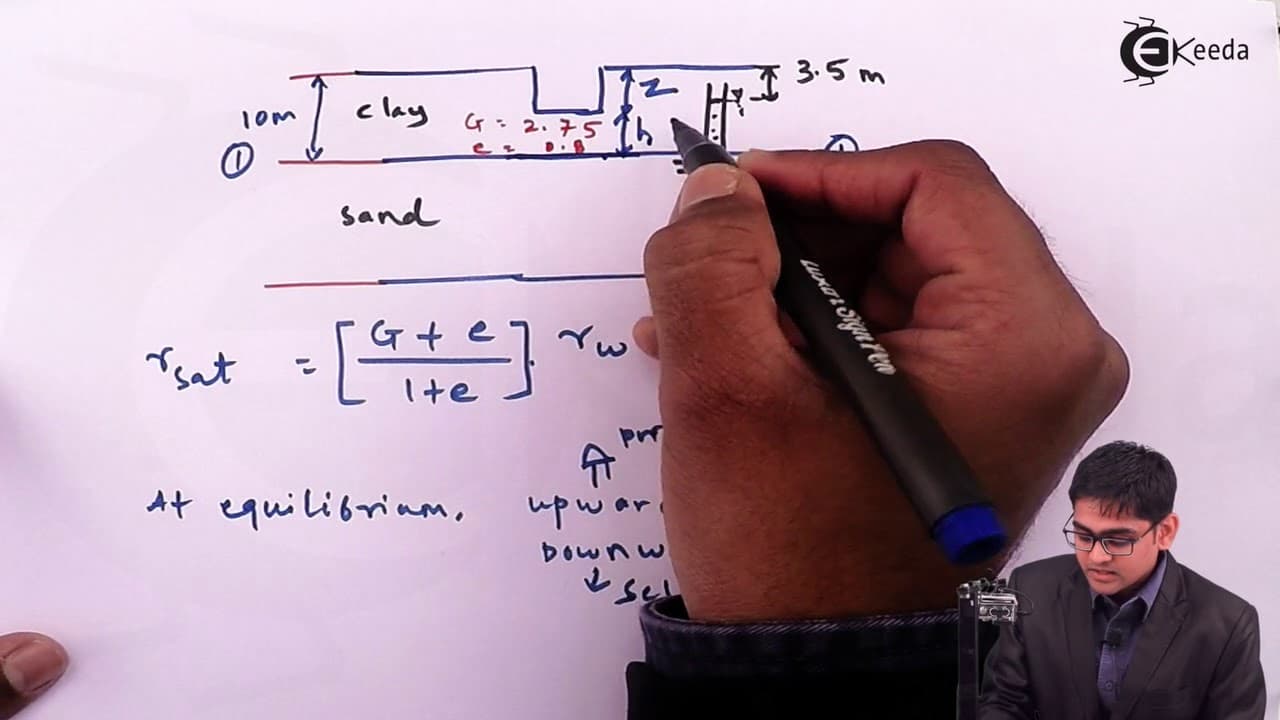
so see the nice problem in the capillarity and effective stress principle you got the foundation trench which needs to be excavated in a stratum of the stiff clay which is 10 meter thick and this is underlined by a bit of coarse sand and in a trial borehole the ground water table was observed to rise to an elevation of three point five meter below ... Read More
Key Insights
- 🦺 Consider artesian pressure and groundwater table elevation when determining safe excavation depth in clay.
- 💦 Balancing upward pore water pressure with downward self-weight pressure is crucial for maintaining stability in excavation.
- 🦻 Saturated unit weight calculation aids in assessing total stress at a level for safe excavation depth determination.
- 💐 Lowering the groundwater table can increase stability by reducing upward pressure on the excavation.
Install to Summarize YouTube Videos and Get Transcripts
Explore YouTube Video Summarizer or Get YouTube Transcript Extractor
Questions & Answers
Q: How is the safe excavation depth calculated in clay stratum with artesian pressure?
The safe excavation depth is determined by balancing upward pore water pressure with the downward self-weight pressure, ensuring bottom stability using effective stress principles.
Q: What is the significance of the groundwater table observation in the excavation problem?
The observed groundwater table elevation indicates the maximum depth to which excavation can be safely carried out without risking instability due to artesian pressure and pore water.
Q: Why is saturated unit weight essential in calculating safe excavation depth?
Saturated unit weight is crucial for determining total stress acting at a level and balancing it with pore water pressure, ensuring stability during excavation in clay stratum.
Q: How does lowering the groundwater table affect the safe excavation depth?
Lowering the groundwater table reduces upward pore water pressure, necessitating a decrease in depth to maintain stability by balancing with downward self-weight pressure.
Summary & Key Takeaways
-
Excavating a trench in stiff clay 10 meters thick underlain by coarse sand with a groundwater table at 3.5 meters below ground surface.
-
Determining the safe depth for excavation without bottom instability considering saturated unit weight and pore water pressure.
-
Calculating the safe excavation depth using effective stress principles and balancing upward and downward pressures.
Read in Other Languages (beta)
Share This Summary 📚
Summarize YouTube Videos and Get Video Transcripts with 1-Click
Try YouTube Summary with ChatGPT & Claude or YouTube Transcript Generator
Explore More Summaries from Ekeeda 📚




Summarize YouTube Videos and Get Video Transcripts with 1-Click
Try YouTube Summary with ChatGPT & Claude or YouTube Transcript Generator