How to Calculate Changing Distance Between Moving Cars
TL;DR
To find the rate at which the distance between a car and a truck is changing as they approach an intersection, apply the Pythagorean theorem and differentiate with respect to time. By determining the speeds and distances involved, this method reveals that the distance is decreasing at a rate of 66 miles per hour.
Transcript
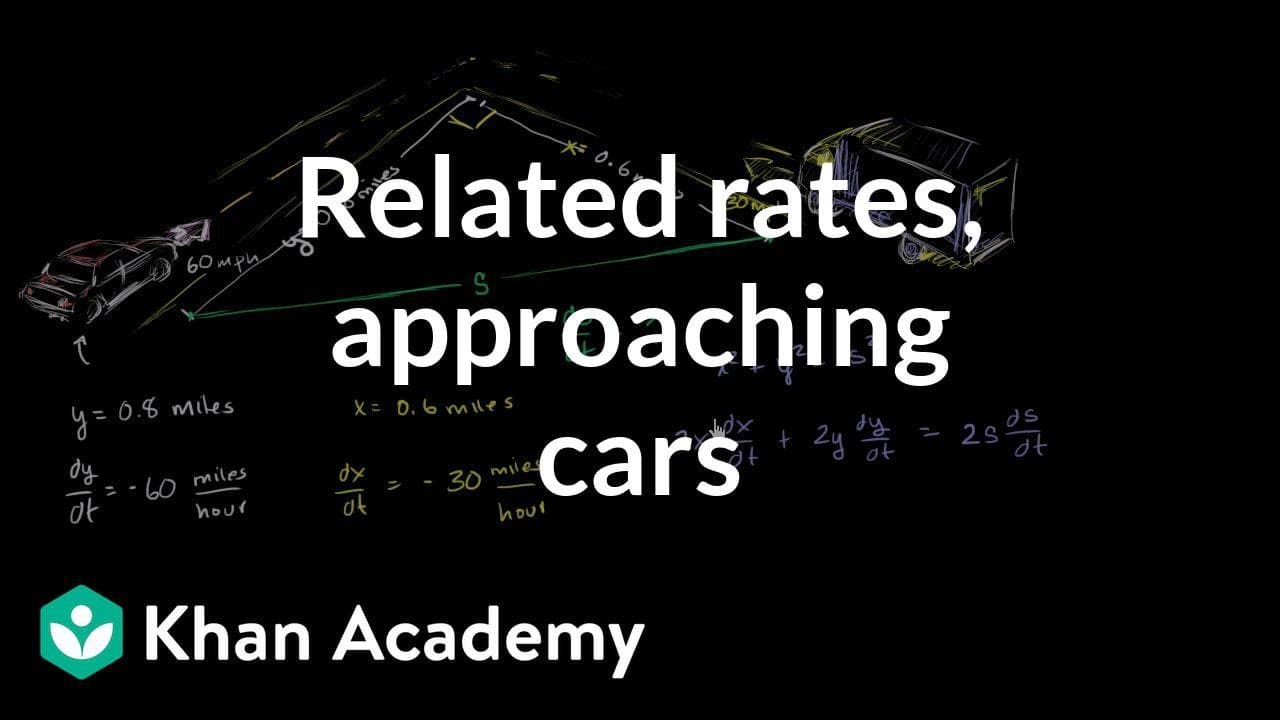
So this car right over here is approaching an intersection at 60 miles per hour. And right now, right at this moment, it is 0.8 miles from the intersection. Now we have this truck over here, it's approaching the same intersection on a street that is perpendicular to the street that the car is on. And right now it is 0.6 miles from the intersection.... Read More
Key Insights
- 🗯️ The Pythagorean theorem can be applied to relate distances in a right triangle.
- 🫡 Differentiation with respect to time can be used to find rates of change.
- 📏 The chain rule is used to differentiate composite functions.
- 🇦🇪 The units of the rates of change will be in miles per hour.
Install to Summarize YouTube Videos and Get Transcripts
Explore YouTube Video Summarizer or Get YouTube Transcript Extractor
Questions & Answers
Q: How can we calculate the rate at which the distance between the car and the truck is changing?
To calculate the rate of change, we need to use the Pythagorean theorem to relate the distances of the car and truck to the overall distance between them. We can then differentiate this relationship with respect to time to find the desired rate.
Q: What are the given values for the car and the truck?
The car is 0.8 miles away from the intersection, traveling at 60 miles per hour towards it. The truck is 0.6 miles away, approaching at 30 miles per hour.
Q: How are the distances and rates of change represented in the problem?
Let x represent the distance from the truck to the intersection (0.6 miles) and y represent the distance from the car to the intersection (0.8 miles). The rates of change are dx/dt (negative 30 miles per hour) for the truck and dy/dt (negative 60 miles per hour) for the car.
Q: What relationship can we establish between x, y, and the overall distance s?
We can use the Pythagorean theorem to express that x squared plus y squared equals s squared. This relationship allows us to differentiate and relate the rates of change.
Summary & Key Takeaways
-
A car is approaching an intersection at 60 miles per hour and is currently 0.8 miles away from the intersection.
-
A truck is approaching the same intersection on a perpendicular street at 30 miles per hour and is currently 0.6 miles away.
-
The video teaches how to find the rate of change in the distance between the car and the truck.
Read in Other Languages (beta)
Share This Summary 📚
Summarize YouTube Videos and Get Video Transcripts with 1-Click
Try YouTube Summary with ChatGPT & Claude or YouTube Transcript Generator
Explore More Summaries from Khan Academy 📚



Summarize YouTube Videos and Get Video Transcripts with 1-Click
Try YouTube Summary with ChatGPT & Claude or YouTube Transcript Generator